

PBFT Fault Tolerance Calculator
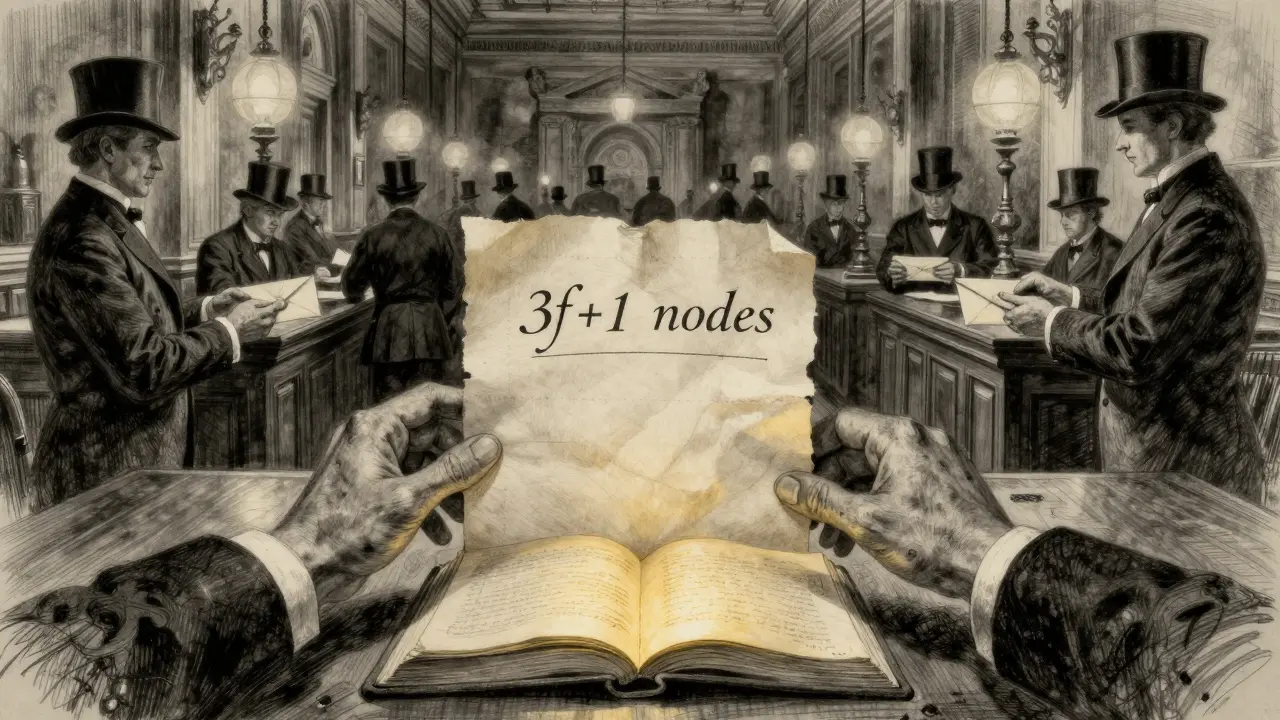
PBFT requires 3f+1 nodes to tolerate f Byzantine faults. Enter values below to calculate the minimum node requirement or maximum fault tolerance.
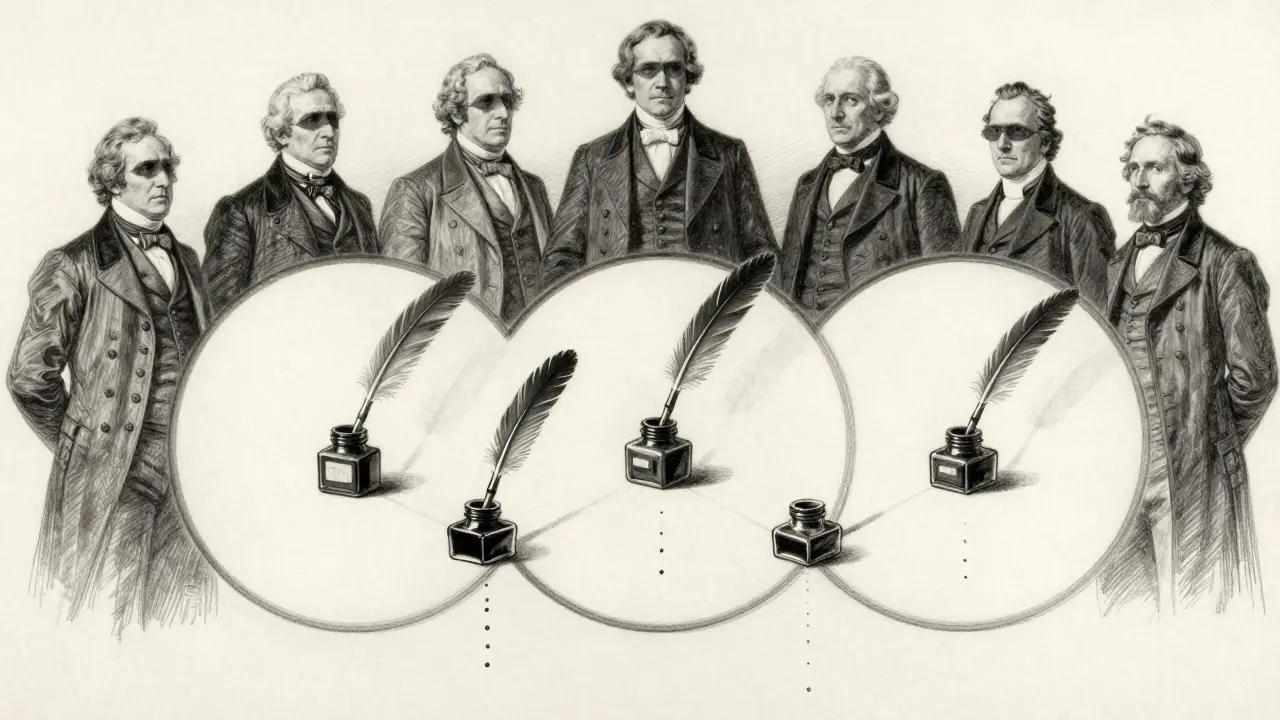
Imagine a group of generals surrounding a city, trying to decide when to attack. Some are traitors. They might send conflicting messages-tell one group to attack at dawn, another to retreat. If the honest generals can’t agree on a plan, the whole mission fails. This is the Byzantine Generals’ Problem, a classic puzzle in distributed systems. Now imagine solving it without trusting anyone. That’s exactly what Practical Byzantine Fault Tolerance (PBFT) does.
Unlike Bitcoin’s proof-of-work, which relies on computational brute force, PBFT is a consensus algorithm built for trustless environments where some participants might lie, cheat, or crash randomly. It doesn’t need miners. It doesn’t need energy-hungry hardware. It just needs a known group of nodes-validators-who talk to each other in a strict, predictable way. And it works. Fast. With real-world results.
How PBFT Works: The Three-Phase Dance
PBFT doesn’t guess. It doesn’t wait for six confirmations. It reaches agreement in three clear steps, every time.
- Pre-prepare: A client sends a request to the primary node (the leader for this round). The primary broadcasts a pre-prepare message to all other replicas, saying: “Here’s the request, here’s the sequence number.”
- Prepare: Each replica checks the message. If it’s valid, they send a prepare message to everyone else. Once a replica collects 2f+1 prepare messages (from other nodes), it’s confident the request is legitimate.
- Commit: Now each replica sends a commit message. Once they get 2f+1 commit messages, they execute the request and send a reply to the client. At this point, the transaction is final. No reorgs. No waiting.
That’s it. No blockchain forks. No uncertainty. If you’re running a financial settlement system, this matters. A transaction is settled in seconds, not minutes. And it’s cryptographically signed-no one can fake a message without the private key.
Why 3f+1 Nodes? The Math Behind Trust
PBFT isn’t magic. It’s math. To tolerate up to f Byzantine (malicious or faulty) nodes, you need at least 3f + 1 total nodes. Why?
Think of it like this: If you have 4 nodes, you can only handle 1 faulty node. If 2 nodes lie, they can trick the other 2 into disagreeing. But with 7 nodes, you can handle 2 bad actors. Even if those 2 send conflicting messages, the remaining 5 honest nodes can outvote them. The math is simple: n > 3f. It’s the minimum number needed to ensure the honest majority can always outvote the traitors.
This requirement is the biggest trade-off. Bitcoin can have 10,000 nodes. PBFT struggles past 100. Each node must talk to every other node. That’s O(n²) communication. At 100 nodes, that’s 9,900 messages per request. At 500 nodes? Over 250,000. It doesn’t scale for public blockchains. But for a consortium of 10 banks? Perfect.
PBFT vs. Other Consensus Algorithms
How does PBFT stack up against the alternatives?
| Algorithm | Byzantine Fault Tolerant? | Finality | Max Nodes | Energy Use | Best For |
|---|---|---|---|---|---|
| PBFT | Yes | Immediate | ~100 | Very Low | Permissioned networks, finance |
| Raft | No | Immediate | ~50 | Very Low | Internal systems, crash faults only |
| PoW (Bitcoin) | Yes | Probabilistic (6+ blocks) | Unlimited | Extremely High | Public blockchains, censorship resistance |
| DPoS (EOS) | No | Fast, but reversible | ~100 | Low | High-throughput public chains |
| Tendermint (PBFT variant) | Yes | Immediate | ~100 | Very Low | Cosmos ecosystem, modular blockchains |
PBFT beats PoW on speed and efficiency. It beats Raft on security. But it loses on scale. That’s why it’s not used in Bitcoin or Ethereum. But it’s everywhere in enterprise systems.
Where PBFT Is Actually Used
You won’t find PBFT in your crypto wallet. But you’ll find it behind the scenes in:
- Hyperledger Fabric: Used by JPMorgan Chase, Walmart, and Maersk. Their supply chain and interbank settlement systems rely on PBFT for instant, final transactions.
- Cosmos Network: Uses Tendermint, a direct descendant of PBFT. It handles cross-chain communication with immediate finality.
- Private financial ledgers: Banks use PBFT for real-time reconciliation of nostro-vostro accounts. One JPMorgan engineer reported cutting settlement time from minutes to seconds.
- Government identity systems: Estonia and Singapore have tested PBFT-based systems for secure citizen data sharing.
Chainalysis estimated that PBFT-based systems handle $47 billion in daily transactions across enterprise blockchains. That’s not speculative crypto. That’s real money moving in regulated environments.
Why PBFT Fails in Public Blockchains
Here’s the catch: PBFT assumes you know who the validators are. No anonymous nodes. No one can join randomly. That’s fine for a consortium of 10 known banks. But it’s a disaster for Bitcoin.
Why? Because of Sybil attacks. A single attacker could create hundreds of fake identities and take over the network. PBFT has no way to stop that. Proof-of-stake and proof-of-work solve this with economic incentives and computational cost. PBFT doesn’t. It assumes identity is already verified.
That’s why you won’t see PBFT on Ethereum or Solana. Those networks need openness. PBFT needs control.
Real-World Challenges and Fixes
Even in permissioned networks, PBFT isn’t easy.
- Network partitions: If a group of nodes loses connectivity, consensus stalls. Hyperledger Fabric’s fix? Temporarily switch to a crash-tolerant mode until the network heals.
- Validator churn: Adding or removing nodes mid-process breaks PBFT. Most systems freeze the validator set until a scheduled update.
- Latency spikes: A developer on Reddit reported that adding more than 15 validators to a Hyperledger Fabric network caused latency to jump from 200ms to over 2 seconds.
And the learning curve? Steep. According to Linux Foundation training data, even experienced engineers need 2-3 weeks to fully understand PBFT’s message flow and timeout tuning. Most failures come from misconfigured timeouts or poor network setup.
The Future of PBFT
PBFT isn’t dying. It’s evolving.
- Sharded PBFT: A 2023 USENIX paper showed a version that splits validators into smaller groups, reducing communication from O(n²) to near-linear.
- Dynamic validator sets: Hyperledger Fabric plans to introduce this in 2024, allowing nodes to join/leave without restarting the network.
- Hybrid models: Many enterprises are now using PBFT for settlement (where finality matters) and PoS for user-facing transactions (where scale matters).
According to Gartner, PBFT and its derivatives will remain the dominant consensus mechanism in enterprise blockchain through 2027. Why? Because when you’re moving millions in real-time payments, you can’t afford probabilistic finality. You need certainty.
The future isn’t about replacing PBFT. It’s about using it where it shines-and pairing it with other tools where it doesn’t.
Should You Use PBFT?
Ask yourself these questions:
- Do you have a known, limited set of participants (like banks, suppliers, or government agencies)?
- Do you need instant, irreversible transaction finality?
- Are you willing to manage validator keys and network configurations manually?
- Will you have fewer than 100 validators?
If you answered yes to all four, PBFT is likely your best choice.
If you’re building a public app with thousands of users? Look at PoS, DPoS, or newer algorithms like Avalanche’s Snowman. PBFT will slow you down.
It’s not about which algorithm is “better.” It’s about which one fits your problem.
What is the main advantage of PBFT over proof-of-work?
PBFT achieves immediate transaction finality without needing energy-intensive mining. Transactions are confirmed in seconds, not minutes or hours. It’s also far more energy-efficient, using minimal computing power compared to Bitcoin’s proof-of-work.
Can PBFT be used in public blockchains like Bitcoin?
No. PBFT requires a fixed, known set of validators. Public blockchains allow anyone to join, making them vulnerable to Sybil attacks where one entity controls many fake identities. PBFT has no mechanism to prevent this.
Why does PBFT need 3f+1 nodes to tolerate f faults?
This is based on the Byzantine Generals’ Problem. To ensure honest nodes can always outvote malicious ones, you need at least three times as many honest nodes as faulty ones. With 3f+1 nodes, even if f nodes are malicious, the remaining 2f+1 honest nodes can agree on the correct state.
Is PBFT faster than Raft?
PBFT and Raft have similar speed in terms of latency, but PBFT is slower because it handles malicious behavior, not just crashes. Raft assumes nodes fail but don’t lie. PBFT must verify messages against possible deception, adding overhead. But PBFT is safer in hostile environments.
What industries use PBFT the most?
Financial services (42%), government (23%), and healthcare (15%) are the top adopters. These sectors need secure, auditable, and instantly final transactions-like interbank settlements, patient record sharing, or supply chain provenance.
What are the biggest drawbacks of PBFT?
Its main drawbacks are poor scalability (O(n²) communication), inability to handle dynamic validator sets, and vulnerability to network partitions. It’s also complex to configure and manage, requiring deep expertise in distributed systems.
If you're building a system where trust is limited but control is high, PBFT gives you something no other consensus algorithm can: certainty. And in finance, law, and logistics, certainty is worth more than speed.
PBFT is such a quiet hero in enterprise blockchains. Nobody talks about it like they do with PoW or PoS, but when you're settling $47B/day across banks, you don't want probabilistic finality-you want certainty. The 3f+1 math? Elegant. The O(n²) scaling? Brutal. But for permissioned networks? Perfect trade-off. I've seen Hyperledger Fabric cut settlement time from 90s to 1.2s. No joke.
It's not sexy, but it's sacred in finance.
So PBFT is basically just a really fancy voting system for adults who can't be trusted? Cool. I guess if you're running a bank consortium, you don't need millions of nodes-just a bunch of guys in suits who all know each other. Still, the fact that it can't handle more than 100 nodes feels like a bug, not a feature. Why not just use Raft and call it a day?
Ohhh so PBFT is the corporate version of 'I'll believe it when I see it' consensus? No anonymous nodes? No mining? Just a bunch of known entities nodding at each other like they're in a boardroom? LOL. Meanwhile Bitcoin's miners are out here burning coal to keep the whole thing alive and no one's asking them to prove their identity. Classic enterprise logic.
Also 2f+1 messages? That's not consensus, that's group therapy.
Wait… so PBFT assumes you know who the validators are? That means someone’s controlling who gets to join the network. Who’s that someone? Corporations? Governments? The Fed? And you’re telling me this is ‘decentralized’? Bro. This is just a permissioned database with fancy math and a blockchain sticker on it. They’re not building trust-they’re building control. And they call this innovation?
Remember when they said ‘blockchain’ meant freedom? This is the opposite. It’s the digital version of a gated community.
3f+1 nodes. Immediate finality. O(n²) overhead. That’s the whole thing.
You people keep acting like PBFT is some genius breakthrough. It’s just a glorified consensus protocol from the 90s with a blockchain label slapped on it. And you think it’s better than PoW because it’s faster? Please. PoW has survived 15 years of attacks, hacks, and regulatory wars. PBFT collapses if one node has a bad internet connection. That’s not resilience. That’s fragility dressed in corporate jargon. India’s government blockchain projects are already failing because they don’t understand this. You need decentralization, not control.
Let me tell you something… PBFT is not about consensus… it’s about control… they say ‘known validators’… but who decides who is known?… Who owns the keys?… Who holds the power?… You think these banks are honest?… You think governments don’t manipulate the validator list?… This is not technology… this is surveillance… disguised as innovation… 3f+1?… No… it’s 3f+1 lies… and we’re all just watching…
Why do Western tech blogs always act like PBFT is some African innovation? It's a French and American algorithm from the 90s. We in Nigeria have better consensus models in our mobile money systems-faster, cheaper, and no need for 100 nodes. PBFT is a luxury for rich countries who can afford to waste bandwidth on bureaucracy. Africa doesn't need permission to transact-we just need access.
I love how this post doesn't mention that PBFT requires a trusted setup phase. That’s the elephant in the room. You’re not just trusting the validators-you’re trusting the initial configuration. Who set up the first 7 nodes? Who signed the genesis keys? That’s the real vulnerability. If the initial admin gets compromised, the whole chain is compromised from day one. It’s not just about node count-it’s about root trust.
And honestly? That’s why I still prefer PoS. At least with PoS, the trust is economic, not administrative.
There’s something deeply human about PBFT. It’s not about machines reaching agreement-it’s about humans agreeing to trust each other, even when they know some might lie. It’s a social contract encoded in code. That’s why it works in banks and governments-they don’t want anonymity, they want accountability. The real question isn’t whether PBFT is efficient-it’s whether we’re ready to accept that some systems need boundaries, not openness. Maybe the future isn’t about removing trust-it’s about designing it better.
Y’all are underestimating PBFT so hard. It’s not just a consensus algorithm-it’s a lifeline for industries that can’t afford to wait 10 minutes for a transaction to settle. Imagine being a hospital that needs to verify patient records across 5 hospitals in real time. Or a logistics company tracking a vaccine shipment across borders. PBFT doesn’t just make it possible-it makes it reliable.
Yes, it’s complex. Yes, it’s not for everyone. But when you’re moving real money, real lives, real supply chains-you don’t gamble with probabilistic finality. You choose certainty. And that’s not boring. That’s responsible. Keep building, keep innovating-but don’t knock what saves real-world systems.
Just a quick note: I’ve implemented PBFT in two enterprise projects. The biggest issue isn’t the math-it’s the timeout tuning. Get the timeout values wrong, and suddenly your network stalls for 30 seconds on every request. It’s not a bug. It’s a configuration nightmare. Most teams don’t realize how sensitive it is to network jitter. I’ve seen teams spend weeks debugging ‘consensus failures’ that were just bad latency.
It works-but only if you treat it like a delicate instrument, not a plug-and-play module.
So if I get this right-PBFT is basically a way to make a private club of validators agree on stuff without fighting? Like a corporate parliament? But you need at least 7 people to have 2 bad ones? That’s wild. Why not just use a spreadsheet? Oh right-because you need a blockchain for the marketing slide deck.
Still… I get why JPMorgan uses it. They don’t want some random guy on Reddit mining blocks. They want their auditors to sleep at night.
3f+1 nodes. Immediate finality. O(n²) overhead. That’s the whole thing.
Also, Tendermint is just PBFT with a new name and a better UI. Stop pretending it’s revolutionary.
People keep acting like PBFT is the enemy of decentralization. But here’s the truth: not every system needs to be open to everyone. Not every transaction needs to be anonymous. Some of us work in industries where accountability matters more than ideology. PBFT isn’t the problem-it’s the solution for people who actually have to move real money, real data, real trust.
Stop romanticizing chaos. Sometimes structure is the real innovation.
Does anyone else notice that PBFT is basically the same as Raft but with extra steps to handle malicious actors? Like… Raft assumes nodes fail. PBFT assumes they lie. But the message flow? Nearly identical. The only difference is the 2f+1 threshold and the extra prepare/commit phases. So why does PBFT get all the hype? Is it just because it sounds more sci-fi?
Here’s the thing nobody talks about: PBFT doesn’t just need 3f+1 nodes-it needs 3f+1 *reliable* nodes. If one of your validators is a legacy server running Windows XP in a basement somewhere, you’re not secure. You’re just pretending to be. Most enterprise PBFT deployments fail not because of the algorithm, but because someone thought ‘we can just use that old server from 2012.’
It’s not a tech problem. It’s a people problem.
Let’s be real-PBFT is the blockchain equivalent of a corporate retreat. Everyone sits in a circle, nods politely, and pretends they all agree. Meanwhile, two people are secretly texting each other to sabotage the vote. And the rest? They just want to get back to their desks. That’s the vibe. It’s not consensus. It’s performative agreement.
But hey-if it works for banks, I guess it works.
I’ve spent the last six months trying to explain to my team why we can’t just scale PBFT to 500 nodes like we did with our internal database. It’s not that the algorithm is broken-it’s that the communication complexity is a nightmare. Every message has to go to every node. At 100 nodes, that’s almost 10k messages per round. At 500? Over 250k. Our network engineers are crying. Our latency jumped from 200ms to 2.3 seconds. And no, we can’t just upgrade the bandwidth-this is a fundamental architectural limit. PBFT was never meant for scale. It was meant for precision. And that’s okay. We just need to stop pretending it’s a universal solution. It’s not. It’s a scalpel, not a hammer.
PBFT? More like PBFT: Pay Bunches For Trust. They say it’s secure? Lol. I’ve seen the logs from Hyperledger Fabric deployments. Half the nodes are running on AWS EC2 instances with default passwords. The ‘trusted validators’ are just IT guys who forgot to change the root password. This isn’t blockchain-it’s a security theater with extra steps. And don’t even get me started on the ‘finality’-if the primary node goes down, the whole thing halts. That’s not fault-tolerant. That’s a single point of failure dressed in math.
PBFT is the quiet MVP of enterprise blockchain. 🙌
Yeah it’s not flashy. Yeah it doesn’t have memes. But when your bank’s settlement system runs 24/7 without a hiccup? That’s PBFT. No energy waste. No 10-minute waits. Just clean, fast, final transactions. It’s not for everyone-but it’s perfect for the systems that actually matter. Let’s stop comparing it to Bitcoin like it’s a race. Different tools. Different jobs.
Respect the workhorses. 🐴
Let me get this straight-you’re telling me that the ‘revolutionary’ consensus algorithm used by JPMorgan and Walmart is basically a Byzantine version of ‘majority rules’ with extra steps and a PhD thesis? And you call this innovation? It’s not blockchain-it’s a corporate spreadsheet with a blockchain-shaped sticker. The only thing ‘decentralized’ here is the marketing budget.
Meanwhile, real crypto is out here building censorship-resistant networks. PBFT? It’s just permissioned control with a side of jargon.
There’s something beautiful about PBFT. It’s not about trustless systems-it’s about *trusted* systems that are still secure. We live in a world where people think ‘decentralized’ means ‘no rules.’ But what if the real power is in having rules that work? PBFT doesn’t pretend everyone is equal-it assumes some people are responsible, and gives them the tools to act together. It’s not the future of everything-but it’s the future of finance, logistics, healthcare. Systems where safety matters more than openness.
Maybe we don’t need to break everything. Maybe we just need to build better things.
Look-I’ve built three blockchain systems. Two used PoW. One used PBFT. The PoW ones? Took 10 minutes to confirm. Used more electricity than a small town. The PBFT one? 800ms. Zero energy waste. And the client? They cried. Not because it was broken-because it was too fast. They weren’t used to transactions being final before they finished their coffee.
People think blockchain = slow. PBFT says: ‘Nope. You’re just using the wrong tool.’
Stop comparing apples to tractors. PBFT isn’t for public chains. It’s for the real world. And the real world doesn’t need mining. It needs reliability.
It’s funny how we talk about PBFT like it’s a technical marvel when really, it’s just a reflection of how institutions work: slow, hierarchical, and deeply afraid of chaos. The algorithm doesn’t solve the Byzantine problem-it just contains it. It’s not magic. It’s management.
But maybe that’s the point. Not every problem needs a revolution. Sometimes, you just need a well-oiled machine. And PBFT? It’s the most honest machine we’ve got for the systems that can’t afford to fail.
Someone mentioned network partitions. That’s the silent killer. I saw a Hyperledger Fabric network go down for 14 hours because a firewall rule blocked one node’s heartbeat. The system didn’t crash-it just… paused. No one knew why. Took days to debug. PBFT’s strength is also its weakness: everything depends on everyone being online. No one talks about that. But it’s the #1 reason enterprises fail with it.
It’s not the algorithm. It’s the network.