
Since November 2017, the Central Bank of Morocco - Bank Al-Maghrib - has made it clear: using Bitcoin, Ethereum, or any other cryptocurrency is illegal. No banks, no exchanges, no official platforms can touch digital assets. But if you walk through the streets of Casablanca, Marrakech, or Rabat, you’ll find people doing it anyway. Not for gambling. Not for speculation. For something far more practical: international payments.
Why Moroccans Need Crypto for Cross-Border Money
Morocco has one of the largest diasporas in the world. Over 4 million Moroccans live abroad - mostly in France, Spain, Belgium, and Canada. Every year, they send home billions in remittances. In 2024, that number hit $10.3 billion. But the traditional way? Slow, expensive, and frustrating. Take a Moroccan worker in Paris. To send $500 to his family in Fes, he uses Western Union or a bank wire. Fees? Around 10%. That’s $50 gone. Exchange rates? Often worse than what you see online. Wait time? Two to five business days. And if the recipient doesn’t have a bank account? Good luck getting cash. Crypto changes that. With just a smartphone and internet, someone in Paris can send $500 in Bitcoin to a wallet in Morocco. The transaction? Takes 10 minutes. Fees? Under $2. The recipient? Can cash out instantly through a local peer-to-peer trader. No bank account needed. This isn’t theoretical. A 2025 survey by a local fintech group found that 28% of Moroccans with family abroad had used crypto for remittances in the past year. That number jumps to 47% among those under 35.The Ban That Didn’t Stick
Bank Al-Maghrib’s 2017 ban wasn’t just a warning - it was a full legal block. The central bank cited risks: money laundering, volatility, no consumer protection. And yes, those are real concerns. But the ban ignored a bigger truth: people were already using crypto because the system wasn’t working. Banks in Morocco limit how much foreign currency you can withdraw. You need paperwork to send money abroad. The process is designed to control capital flow - not to help families stay connected. So people found a loophole: decentralized networks. There’s no official crypto exchange in Morocco. But there are hundreds of informal traders. You’ll find them on WhatsApp groups, Telegram channels, even Facebook Marketplace. They buy and sell Bitcoin, USDT, or Ethereum in cash. Need to send money to your cousin in Toronto? You give your local trader $500 in dirhams. They send $500 in USDT to the recipient’s wallet. The cousin cashes out at a trader in Canada. No bank involved. No paperwork. No delays. The market for this underground activity is growing fast. Projections show Morocco’s crypto transaction volume hitting $292.4 million by 2026 - despite the ban. That’s not speculation. That’s real money moving because people have no other choice.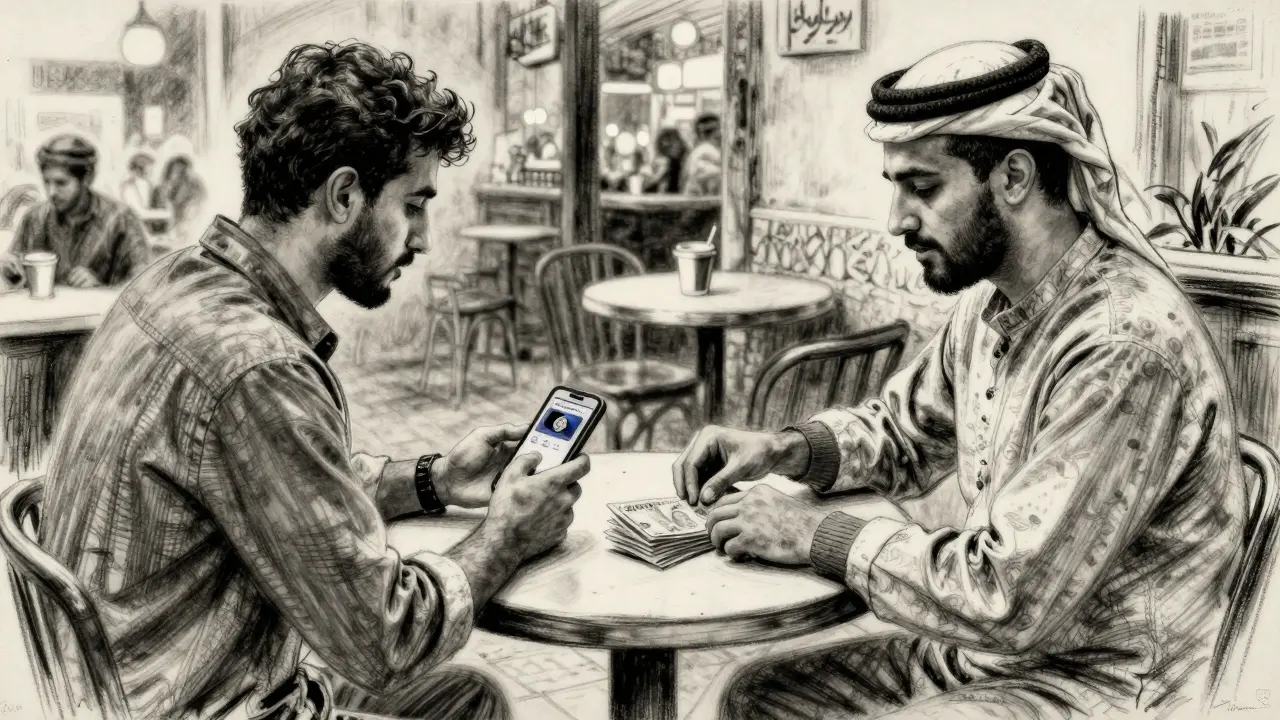
How It Actually Works
Here’s how a typical crypto remittance works in Morocco:- A Moroccans abroad buys crypto on an international exchange (like Binance or Kraken) using their foreign bank account.
- They send the crypto (usually USDT or BTC) to a trusted contact in Morocco.
- The contact meets a local peer-to-peer trader - often at a café or market - and hands over cash in dirhams.
- The trader sends the equivalent amount in crypto to the recipient’s wallet (or vice versa).
- The recipient cashes out at another local trader, or uses the crypto to pay for online services, buy goods from international sellers, or even pay for education abroad.
The Government’s Two-Track Strategy
Morocco isn’t ignoring this. It’s trying to control it. While cracking down on private crypto trading, Bank Al-Maghrib is quietly building its own digital currency - a Central Bank Digital Currency (CBDC). Unlike Bitcoin, this wouldn’t be decentralized. It would be fully controlled by the central bank. Think of it as digital dirhams, but faster, traceable, and designed for international use. In 2025, the central bank partnered with Egypt and the World Bank to test cross-border CBDC pilots. The goal? Replace the underground crypto networks with a government-backed system that’s efficient, secure, and legal. But here’s the catch: they’re not replacing crypto because it’s bad. They’re replacing it because it’s too popular.
What’s Next? Legalization on the Horizon?
On July 21, 2025, Bank Al-Maghrib announced it had drafted a law to legalize and regulate cryptocurrencies. Not ban them. Not ignore them. Regulate them. The draft law would allow licensed platforms to operate, require KYC checks, and set limits on transactions. It’s still under review - but the shift is clear. Morocco is moving from prohibition to control. This doesn’t mean crypto use will disappear. It means it will become more structured. People won’t have to rely on shady WhatsApp traders. They’ll use regulated apps, with legal protections, transparent fees, and real-time tracking. Until then, the underground network keeps running. And it’s not going away.Why This Matters Beyond Morocco
Morocco isn’t alone. Nigeria, Argentina, Lebanon, and Venezuela have all seen similar patterns: when official systems fail, people turn to crypto for survival. The lesson? You can’t ban technology. You can only delay it. And when you do, you create risks - black markets, fraud, loss of trust in institutions. Morocco’s story shows that the real issue isn’t crypto. It’s access. If people can’t send money home easily, cheaply, and quickly, they’ll find another way. Crypto is just the tool they picked. The central bank knows this. That’s why they’re building a CBDC - not to stop crypto, but to give people a better, safer option. The question isn’t whether Moroccans will use crypto for international payments. It’s whether the government will let them do it legally - before more people get hurt.Is cryptocurrency completely illegal in Morocco?
Yes, under Moroccan law since November 2017, all cryptocurrency transactions are banned. Banks and financial institutions are prohibited from handling digital assets. However, enforcement focuses on exchanges and platforms - not individual users. Peer-to-peer trading continues widely underground.
Can Moroccans legally receive crypto payments from abroad?
Technically, no. Receiving crypto is still considered illegal under the 2017 ban. But in practice, thousands do it daily through informal traders. There are no known cases of individuals being prosecuted for personal remittances - only for operating unlicensed exchanges or large-scale money laundering.
What’s the most popular cryptocurrency used in Morocco for payments?
Tether (USDT) is by far the most used. It’s a stablecoin pegged to the US dollar, so its value doesn’t swing like Bitcoin. This makes it ideal for remittances - recipients know exactly how much dirhams they’ll get. Bitcoin is also common, but less so for daily transfers due to volatility.
How do Moroccans cash out crypto without a bank account?
They use peer-to-peer traders - often local shop owners, phone sellers, or café staff who act as cash-in/cash-out points. You send crypto to their wallet, they hand you dirhams in cash. These traders charge 1-3% fees - far lower than Western Union’s 10%. Many operate out of informal networks on WhatsApp or Telegram.
Will Morocco legalize crypto in the future?
Yes - likely within the next 1-2 years. A draft law to regulate cryptocurrencies was finalized in July 2025. The goal isn’t to ban crypto, but to bring it under supervision. Licensed platforms will be allowed, with strict KYC rules, transaction limits, and anti-money laundering controls. This would make crypto safer and more accessible - not less.


