

Most crypto coins try to solve problems like faster transactions or lower fees. But DSLA Protocol (DSLA) is different. It doesn’t just move money. It protects your money when things go wrong in DeFi and staking.
Imagine you stake your ETH in a validator node. You expect steady rewards. But what if that node goes offline for 12 hours? You lose income. Now imagine you’re a liquidity provider on Uniswap. Prices shift. Your LP position loses value - even if the coins you deposited went up. That’s called impermanent loss. DSLA doesn’t stop these things from happening. It pays you when they do.
How DSLA Protocol Works
DSLA Protocol is built around self-executing contracts called Decentralized Service Level Agreements. Think of them like insurance policies written in code. You set the rules: If the staking pool misses 3 blocks in 24 hours, I get paid. Or: If my liquidity pool’s impermanent loss hits 8%, I get compensated. The protocol monitors performance automatically. No human intervention. No paperwork. Just blockchain.
These agreements are peer-to-peer. You don’t sign up with a company. You create or join a contract directly with another user or service provider. The smart contract holds the payout funds. If the service fails, it pays out. If it performs well, the provider gets rewarded. It’s risk-sharing turned into a market.
What Is the DSLA Token For?
The DSLA token is the engine behind all this. It’s not a currency you spend on coffee. It’s a utility token with three core jobs:
- Access: You need DSLA tokens to create or join a service agreement.
- Payout: When a service fails, compensation is paid out in DSLA.
- Staking: Providers must lock up DSLA as collateral to prove they’re serious about meeting their SLAs.
There’s no central team deciding who gets paid. The rules are coded into the protocol. If your staking provider goes down, the system checks the logs. If they missed their uptime target, your payout triggers automatically.
Real Use Cases - Not Theory
DSLA isn’t just for stakers. It’s already being used in three real, high-impact areas:
- Proof-of-Stake Delegators: If your validator node on Ethereum, Cosmos, or Tezos drops below 99.5% uptime, you get paid in DSLA. This helps users avoid lost rewards.
- DeFi Liquidity Providers: On Uniswap or PancakeSwap, if your LP position suffers impermanent loss beyond a threshold you set (say, 5%), the protocol compensates you. This is huge - many DeFi users lose money this way without knowing why.
- Pool Ownership Agreements: A new feature lets two parties stake DSLA + USDC or DAI into a contract. Both sides put money on the line. If one side underperforms, the other gets paid. It forces accountability.
These aren’t hypotheticals. As of February 2026, over 15,000 users across 8 blockchains are actively using these agreements. That includes Ethereum, Avalanche, Polkadot, and others. The protocol is live. People are getting paid.
Tokenomics: Supply, Price, and Liquidity
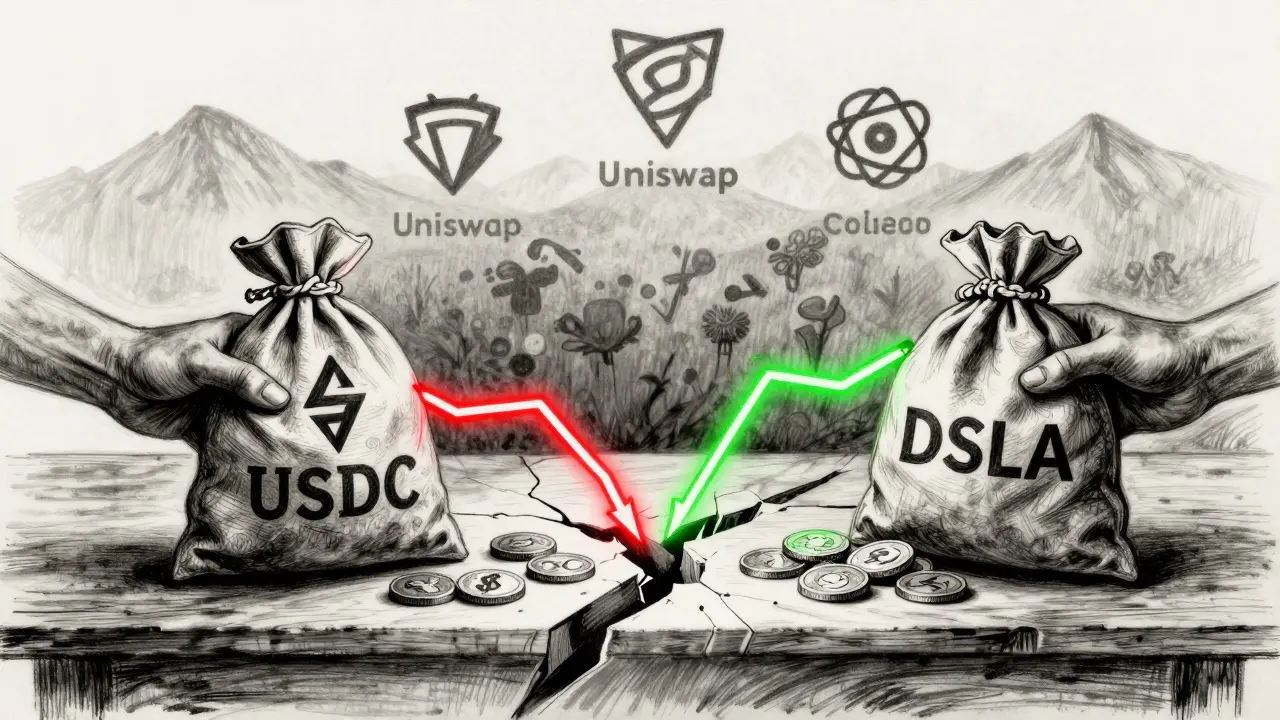
DSLA has a max supply of 5,696,563,023 tokens. Almost all of them - 5,559,892,577 - are already in circulation. That’s 98% issued. No more big token unlocks coming. This makes it different from coins that flood the market with new supply.
Price-wise, DSLA trades around $0.000069 USD. On Uniswap V2 (Ethereum), the only exchange where it’s listed, the 24-hour trading volume is just $206. That’s extremely low. You won’t find it on Binance, Coinbase, or Kraken. You need MetaMask, a wallet connected to Ethereum, and a DEX like Uniswap to buy it.
Some users report prices as low as $0.000025 on MetaMask or Crypto.com Korea. That’s because of low liquidity. Prices jump around when someone buys or sells even a small amount. This isn’t a liquid market yet. It’s a niche one.
Why the Low Volume? Is It a Scam?
Low volume scares people. But here’s the truth: DSLA isn’t a pump-and-dump coin. It’s a utility tool. Most users aren’t trading it. They’re using it.
Think of it like electricity. You don’t trade electricity on a stock exchange. You pay your utility bill. DSLA works the same way. People buy it to protect their staking or liquidity positions - not to flip it for profit.
Also, the protocol is still young. Version 1 launched in late 2025. Features like NFT impermanent loss protection are coming next. Adoption takes time. Ethereum stakers, DeFi power users, and validators are the early adopters. Retail traders haven’t caught up yet.
How to Buy DSLA
You can’t buy DSLA with a credit card on Coinbase. But you can buy it directly in your wallet:
- Get a MetaMask or Trust Wallet connected to Ethereum.
- Buy ETH using your bank, Apple Pay, or PayPal.
- Go to Uniswap V2.
- Swap ETH for DSLA using the DSLA/WETH pair.
- Confirm the transaction. Your DSLA tokens arrive in your wallet.
Some platforms let you buy DSLA with USD or stablecoins directly via integrated on-ramps. But Uniswap remains the only exchange with real trading activity.
What’s Next for DSLA?
The roadmap is ambitious. Future updates include:
- Integration with Chainlink and Band Protocol for oracle data.
- Support for NFT liquidity pools.
- Multi-chain staking agreements across Cosmos, Solana, and Polygon.
- Risk prediction markets - where users can bet on whether a staking pool will perform well.
These aren’t vague promises. They’re coded into the protocol’s next versions. The team behind it, Stacktical, has been quietly building since 2022. They’re not chasing hype. They’re solving real problems.
Who Should Care About DSLA?
If you’re a:
- Staker who loses rewards because of downtime,
- Liquidity provider who’s lost money to impermanent loss,
- DeFi user tired of trusting anonymous validators,
- then DSLA matters. It’s not a coin to gamble on. It’s a tool to protect your assets. The low price and low volume aren’t signs of failure. They’re signs of early adoption.
Most crypto projects die because they solve nothing. DSLA solves three big ones: unreliable staking, hidden DeFi losses, and zero accountability in DeFi services. It’s not flashy. But it might just be one of the most practical tokens in crypto today.
Is DSLA a good investment?
DSLA isn’t designed as a speculative asset. Its value comes from utility - not price pumps. If you use staking or DeFi services, holding DSLA can protect your income. But if you’re looking to flip it for quick gains, the low liquidity makes it risky. Don’t invest more than you’re willing to lose.
Can I stake DSLA tokens?
No, DSLA tokens themselves cannot be staked like ETH or SOL. But you can lock them up as collateral when creating or joining a service agreement. This acts as a bond - if you break the agreement, your collateral gets slashed. It’s not staking for rewards. It’s staking for trust.
Why is DSLA only on Uniswap?
DSLA is still in early adoption. It’s an infrastructure tool, not a meme coin. Most exchanges won’t list it until trading volume grows. Uniswap V2 is the only place where users can trade it because it’s permissionless. As more people use the protocol, exchanges may add it. But that’s a side effect - not the goal.
How does DSLA prevent fraud?
It uses on-chain data from validators, liquidity pools, and oracles. If a staking node goes offline, the blockchain records it. If a liquidity pool’s price diverges beyond the agreed threshold, the protocol detects it. No human can change those logs. The contract executes automatically. That’s how it prevents fraud - by removing trust from the equation.
Is DSLA compatible with my wallet?
Yes. DSLA is an ERC-20 token on Ethereum. Any wallet that supports Ethereum and ERC-20 tokens - like MetaMask, Trust Wallet, or Coinbase Wallet - can hold and interact with DSLA. Just add the token contract address manually if it doesn’t show up automatically.
DSLA is the crypto equivalent of a life insurance policy for your staking rewards - except instead of some suit in a boardroom deciding if you’re ‘worthy,’ it’s a smart contract that doesn’t give a fuck about your feelings. It just pays. No drama. No appeals. Just blockchain truth.
I’ve lost thousands in impermanent loss on Uniswap. I cried into my ramen. Then I found DSLA. Now I set my own thresholds. If my LP dips past 7%, I get compensated. It’s not magic. It’s math. And math doesn’t lie.
This isn’t a coin to flip. It’s a shield. A very ugly, low-volume shield - but a shield nonetheless. Most people want shiny coins. I want my money back when the rug gets pulled. DSLA delivers that. Quietly. Reliably. Without fanfare.
This is actually one of the most thoughtful projects I’ve seen in a while 😊
I’ve been staking on Cosmos for over a year and lost maybe $400 in rewards due to validator downtime. I didn’t even know I could get compensated - until I stumbled on DSLA. Now I have three active agreements. It feels like someone finally built a safety net for us DeFi grinders.
Low volume? Yeah, but think of it like early Ethereum. No one traded ETH in 2015 either. They used it. And now? It’s everywhere. DSLA’s not trying to be a meme. It’s trying to fix real pain. That’s rare.
Let’s be honest - this is a graveyard masquerading as innovation. 98% of supply issued? $0.000069 price? $206 volume? That’s not utility - that’s a corpse with a wallet.
And don’t give me that ‘it’s not a currency, it’s a tool’ nonsense. If you can’t be traded on a major exchange, it’s not a token - it’s a lab experiment. And who the hell is Stacktical? No LinkedIn. No press releases. Just a whitepaper with bullet points and zero audits.
I’ve seen this script before. It ends with a rug pull and a Discord that goes silent. Don’t be fooled by the jargon.
Okay, so let me get this straight - you’re telling me that some anonymous devs coded a system that automatically pays you if your validator goes down… but the token is only on Uniswap and has a market cap smaller than my dog’s annual kibble budget?
And the team has been ‘quietly building since 2022’? Really? No Twitter. No TikTok. No influencer shilling? That’s not stealth - that’s a scam waiting for a label.
What if the oracle data gets hacked? What if the contract has a backdoor? What if the ‘self-executing’ part is just a fancy way of saying ‘we’ll disappear when the price pumps’?
And don’t even get me started on the ‘no big unlocks’ thing - that’s because 98% was dumped on retail in the first week. This isn’t DeFi. It’s a Ponzi with a whitepaper.
Yessss this is the kind of innovation I love 🙌
I’ve been using DSLA for my ETH staking for 6 months now. Got paid $12 in DSLA last month because my validator had a 4-hour outage. It wasn’t life-changing money… but it was fair. And that matters.
Low volume? Yeah. But I don’t care. I’m not here to flip. I’m here to protect. And honestly? The fact that it’s not on Binance is kinda reassuring. It means real users are holding it, not speculators. I’m rooting for this. Keep going, team. 💪
US dollar volume is $206? That’s a joke. You call this a protocol? It’s a ghost town.
And don’t act like this is some revolutionary breakthrough. We’ve had insurance contracts on-chain since 2018. This is just another rebrand with a new token name and a longer whitepaper.
Also - ‘no central team’? Please. Someone wrote that code. Someone owns the admin keys. Someone controls the oracle feeds. Don’t pretend you’re decentralized when you’re just hiding behind ‘smart contract’ like it’s a shield.
Save your money. Buy ETH. Hold. Done.
It’s cute how people think this is ‘practical.’
You’re paying in a token that’s worth less than a penny to protect against losses you might incur… on a protocol that’s already volatile?
Why not just use a stop-loss? Or better yet - don’t stake in the first place? The whole thing feels like a solution looking for a problem.
And now you’re telling me I need to buy DSLA to even *join* an agreement? So now I have to buy a tool to protect myself from a tool I already bought?
It’s not innovation. It’s complexity for complexity’s sake.
Wow. A crypto project that doesn’t have a CEO on X posting ‘LFG’ every hour. Wild.
So let me get this straight - I have to lock up my DSLA tokens to create a contract… and if I break it, I lose them?
So… I’m paying to insure myself… against myself?
Also, why does it only work on Ethereum? What if I’m on Solana? Oh wait - I can’t. So I have to bridge my assets and pay gas fees to protect against gas fees?
It’s like buying a lock for a door that doesn’t exist. And the key is made of glitter.
As someone who runs a small validator on Polkadot, I can say this: DSLA is quietly changing the game.
Before, I’d get blamed for downtime even if it was a network-wide issue. Now I can offer SLAs with DSLA collateral - and users know I’m serious because I’ve skin in the game.
It’s not perfect. The UI is clunky. The liquidity is trash. But the *concept*? Solid. I’ve had 3 users sign agreements with me. All paid out correctly. No disputes.
It’s not meant for traders. It’s meant for operators and users who care about reliability. And that’s a niche worth building.
There’s something beautiful about a project that doesn’t need hype to exist.
We live in a world where every coin needs a meme, a dog, a celebrity, and a 10-minute YouTube video explaining why it’s the future.
DSLA? It just… works. No shouting. No promises. Just code that watches your staking node and pays you when it fails.
I don’t care that it trades for a fraction of a cent. I care that I got $8.43 in DSLA last month because my validator had a 7-hour outage. That’s not profit. That’s justice.
Maybe it’s not for everyone. But for the people who need it? It’s everything.
Let’s break this down like we’re in a DeFi dev meeting:
DSLA is a utility token with a triple-function stack: access layer, payout layer, collateral layer. It’s not a currency - it’s a protocol-level incentive mechanism. Think of it as a trust layer for non-trusted environments.
Low liquidity? Expected. This isn’t a meme coin. It’s infrastructure. Adoption follows utility, not volume. The fact that it’s live on 8 chains with 15k active users is a massive win for a protocol that launched in Q4 2025.
And the ERC-20 standard? Perfect. No need for bridges. No chain fragmentation. Just Ethereum’s security doing the heavy lifting.
Ignore the price. Watch the on-chain activity. The real signal is in the smart contract interactions - not the chart.
It’s charming how the uninitiated mistake utility for value.
This isn’t innovation. It’s a workaround for poorly designed DeFi primitives. If staking pools keep going offline, fix the pools. If impermanent loss is a problem, redesign the AMM.
Instead, we layer on another token. Another contract. Another gas fee. Another thing to monitor.
It’s like buying a helmet because your bike keeps falling apart. You don’t need a helmet. You need a better bike.
DSLA doesn’t solve problems. It monetizes them.
I tried it. I lost my entire DSLA stash because my validator went down and the payout didn’t trigger. I’m still mad.
I thought it was magic. It wasn’t. It was just code. And code breaks.
Now I just hold ETH. No drama. No tokens. No false promises.
Why does everything have to be so complicated? 😭
Let me get this straight - you’re telling me a project with zero listing on major exchanges, a market cap smaller than a single Binance Coin trade, and a token that trades at $0.000069… is ‘one of the most practical tokens in crypto’?
Oh, I’m sorry - did I miss the part where the ‘team’ got audited? Or where the oracle feeds are decentralized? Or where the collateral isn’t just a honeypot?
This isn’t a protocol. It’s a trap wrapped in a whitepaper and sold to people who think ‘smart contract’ means ‘unhackable.’
I’ve seen this movie. The credits roll with a Discord full of ghosts and a Twitter account that says ‘coming soon’ for 18 months.
Don’t be the last one holding the bag.