
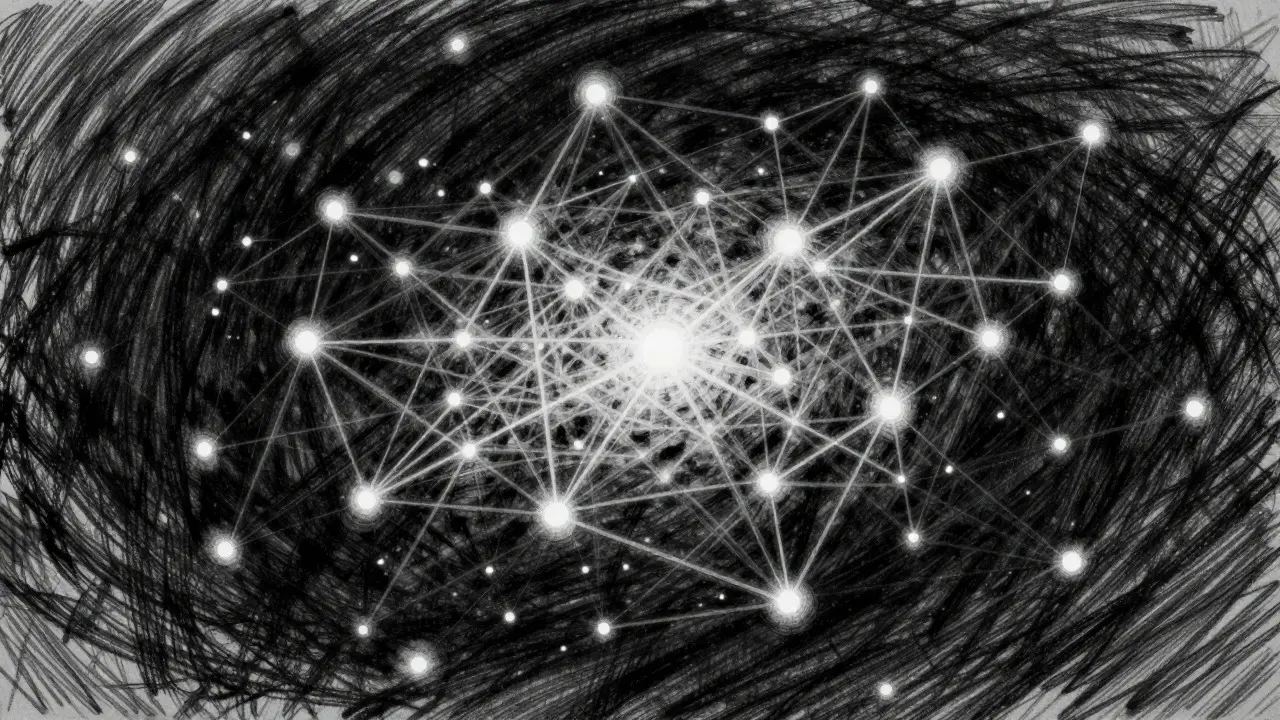
Imagine sending a transaction on Bitcoin. In less than a second, that data isn't just sent to one server; it ripples out to thousands of computers worldwide simultaneously. This rapid spread is not magic-it is the result of blockchain network topology. This concept defines how nodes (computers) connect, communicate, and validate transactions within a distributed ledger. Understanding this architecture is crucial because it directly dictates a network's speed, security, and ability to scale without crashing.
Most people assume all blockchains work the same way under the hood. They don't. Some use flat, equal structures where every node talks to everyone else. Others rely on hierarchical layers or central hubs to manage traffic. The choice between these topologies determines whether your crypto wallet feels instant or sluggish, and whether the network can survive an attack or fail completely if one key component goes down.
What Is Blockchain Network Topology?
Blockchain network topology is the physical and logical arrangement of nodes in a distributed network, defining how they interconnect to maintain the ledger and validate transactions. It serves as the backbone for information flow. Without a clear topology, nodes wouldn't know who to talk to, leading to chaos rather than consensus. This structure affects three main pillars of blockchain performance: decentralization, security, and scalability.
In simple terms, topology answers the question: "Who connects to whom?" If you have 10,000 nodes, do they all connect to each other? Or do they connect to a few gateways? The answer changes everything about how fast data moves and how resilient the system is to failures.
The Dominant Model: Peer-to-Peer Mesh Networks
The most common topology in major cryptocurrencies like Bitcoin and Ethereum is the peer-to-peer (P2P) mesh. In this setup, there is no central authority. Every node is equal. Each computer connects randomly to several other nodes, creating a web-like structure known as a mesh.
This design eliminates single points of failure. If one node goes offline, the rest of the network keeps running because data has multiple routes to travel. When a user sends a transaction, it broadcasts from their node to its immediate peers, who then pass it to theirs. This ripple effect ensures that thousands of nodes receive the data within seconds. This rapid propagation is vital for maintaining network integrity and preventing double-spending attacks.
- Decentralization: High. No single entity controls the network.
- Resilience: Very high. The network survives individual node failures.
- Complexity: Higher. Managing connections requires sophisticated protocols.
Alternative Architectures: Router and Ring Topologies
While P2P meshes dominate public chains, academic research and some enterprise solutions explore different structures to solve specific problems. Two notable alternatives are router topology and ring topology.
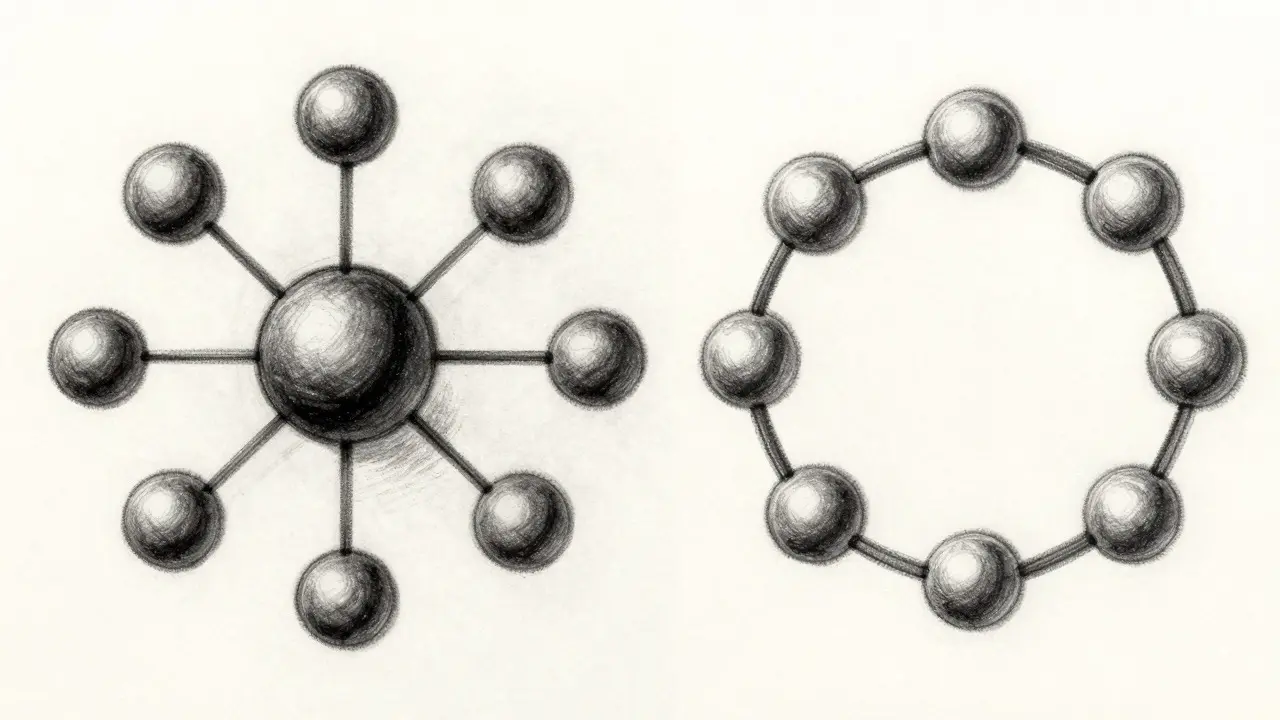
Router topology functions similarly to a star or hub-and-spoke model. Here, multiple blockchains or sub-networks connect to a central router blockchain. Data flows through this central point. This approach resembles traditional banking systems, where a central server validates activity. The advantage is simplicity in management. However, the downside is significant: the central router becomes a bottleneck. As more blockchains connect, the load on the central node increases, potentially slowing down the entire system.
Ring topology, also called strongly connected topology, arranges nodes in a circular path. Each blockchain connects only to its direct neighbors. Data travels around the ring until it reaches its destination. This distributes the network load more evenly than a router topology. It offers superior flexibility and reduces the burden on any single node. However, if one link in the ring breaks, it can disrupt communication unless redundant paths exist.
| Topology Type | Structure | Scalability | Single Point of Failure | Best Use Case |
|---|---|---|---|---|
| Peer-to-Peer Mesh | Flat, interconnected web | Moderate to High | Low | Public cryptocurrencies (Bitcoin, Ethereum) |
| Router (Hub-and-Spoke) | Central hub connecting spokes | Low to Moderate | High | Enterprise permissioned networks |
| Ring (Strongly Connected) | Circular chain of nodes | High | Moderate | Interoperable multi-chain systems |
| Hierarchical (Tree) | Layered root-to-leaf structure | Moderate | Moderate to High | Large-scale organizational deployments |
How Topology Affects Consensus and Performance
Network topology doesn't just move data; it influences how nodes agree on that data. The consensus mechanism-such as Proof-of-Work (PoW) or Proof-of-Stake (PoS)-relies on efficient communication. In a well-designed mesh, nodes quickly reach agreement on transaction validity because information spreads rapidly.
For example, Ethereum uses a consensus mechanism called Gasper, which incorporates proof-of-stake. The efficiency of Gasper depends on validators being able to broadcast votes quickly across the network. If the topology were poorly designed with long communication delays, finality times would increase, making the network feel slower to users.
Conversely, in a centralized router topology, the central node must process all validation logic. This creates a computational bottleneck. While this might be acceptable for a small private network with ten participants, it fails when scaling to millions of users. The hierarchy introduces latency because data must traverse multiple layers before reaching the core.
Security Implications of Network Structure
Security is perhaps the most critical factor influenced by topology. In a decentralized mesh, attacking the network requires taking down a significant portion of the total hash power or stake. This is expensive and difficult. In contrast, a centralized topology presents a tempting target. If the central router or root node suffers a Denial of Service (DoS) attack, the entire network halts.
Furthermore, topology affects privacy. In a fully open mesh, it is easier to trace the origin of a transaction if metadata is leaked. Hierarchical structures can sometimes offer better privacy by limiting direct visibility between end-users, but this comes at the cost of transparency. Developers must balance these factors based on the network's goals. For public financial systems, transparency and resilience usually outweigh privacy concerns, favoring the mesh model.

Current Trends and Future Developments
The field of blockchain network topology is evolving. Researchers are investigating hybrid models that combine the resilience of meshes with the efficiency of hierarchical routing. One area of focus is improving interoperability between different blockchains. By using ring topologies or specialized bridges, developers aim to allow seamless asset transfers across different networks without relying on a single central exchange.
Additionally, advancements in networking protocols are reducing the overhead of maintaining large P2P networks. Techniques like gossip protocols optimize how messages are shared, ensuring that new blocks propagate efficiently even as the number of nodes grows into the millions. These innovations help maintain the decentralization principles that define public blockchains while addressing the scalability challenges that have historically limited their adoption.
Frequently Asked Questions
Is peer-to-peer topology always better than centralized?
Not necessarily. Peer-to-peer is superior for public, trustless networks requiring high resilience. However, for private enterprise networks with controlled access, a hierarchical or router topology might offer better performance and easier management, provided the risk of central failure is mitigated.
How does topology impact transaction speed?
Topology determines how fast data propagates. In a mesh, data spreads via multiple simultaneous paths, often reaching the whole network in seconds. In a ring or tree, data may have to travel sequentially through intermediate nodes, increasing latency. Faster propagation generally leads to quicker confirmation times.
What is the role of the network layer in blockchain?
The network layer handles discovery and communication between nodes. It ensures that peers can find each other, establish connections, and exchange data reliably. This layer is foundational to the topology, implementing the rules for how nodes interact within the chosen structural model.
Can a blockchain change its topology over time?
Yes, though it is complex. Upgrades to consensus mechanisms or networking protocols can effectively alter the functional topology. For instance, moving from a pure PoW mesh to a sharded structure changes how nodes connect and communicate, introducing new hierarchical elements while maintaining overall decentralization.
Why do some enterprise blockchains use hierarchical structures?
Enterprise environments often require governance, identity verification, and predictable performance. Hierarchical topologies allow administrators to control access at different levels, streamline audit trails, and optimize resource allocation, which aligns with business needs better than the chaotic nature of public P2P networks.