

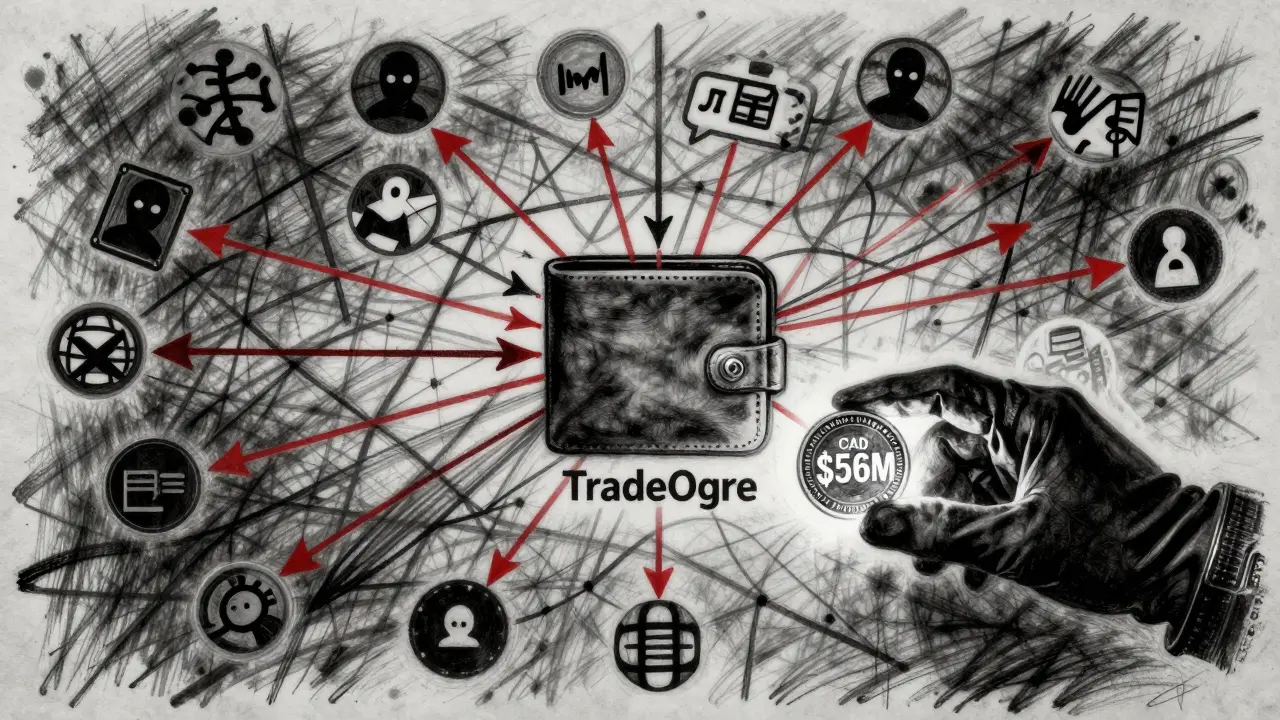
On September 18, 2025, Canadian authorities pulled the plug on TradeOgre is a decentralized cryptocurrency exchange that operated without KYC or regulatory oversight, specializing in privacy coins like Monero. Also known as TradeOgre.io, it was founded in 2018 and became a hub for anonymous trading until its abrupt shutdown. The Royal Canadian Mounted Police (RCMP) is Canada’s federal law enforcement agency responsible for enforcing financial crime laws, including cryptocurrency-related offenses seized CAD$56 million (roughly US$40 million) in digital assets - the largest cryptocurrency confiscation in Canadian history. This wasn’t just a raid on a wallet. It was the complete dismantling of an entire exchange infrastructure. And it sent a clear message: if you run a crypto platform in Canada without following the rules, you’re not safe - no matter how anonymous you think you are.
How TradeOgre Operated - and Why It Was a Target
TradeOgre wasn’t another Binance or Coinbase. It didn’t ask for your ID, your address, or even your real name. You could sign up, deposit Bitcoin or Monero, and trade without ever proving who you were. That’s because it was built on Tor is a privacy-focused network that anonymizes internet traffic by routing it through multiple encrypted relays, often used to host hidden services - a hidden service designed to evade detection. Most exchanges today collect KYC data because regulators demand it. TradeOgre made a business out of ignoring that. It thrived on niche altcoins, especially Monero is a privacy-centric cryptocurrency that obscures sender, receiver, and transaction amount, making it nearly impossible to trace, which is why it became a favorite among users who wanted to disappear from the financial radar.
But here’s the catch: if you’re serving Canadian users, Canadian law applies. Even if your server is in the U.S., your customers are in Canada, and your money flows through Canadian banks or payment processors - you’re not exempt. TradeOgre never registered with FINTRAC is Canada’s Financial Transactions and Reports Analysis Centre, the federal agency responsible for detecting and preventing money laundering and terrorist financing, the country’s anti-money laundering watchdog. No license. No reporting. No compliance. That’s not just risky - it’s illegal under Canadian law.
The Investigation That Took Down a Crypto Exchange
The RCMP didn’t wake up one day and decide to shut down TradeOgre. The operation started in June 2024, after Europol is the European Union’s law enforcement agency that coordinates cross-border criminal investigations, including cryptocurrency crimes passed over a tip about suspicious transaction patterns tied to the exchange. From there, the RCMP’s Money Laundering Investigative Team (MLIT) is a specialized unit within the RCMP focused on tracing illicit financial flows, including cryptocurrency transactions teamed up with Arkham Intelligence is a blockchain analytics firm that tracks cryptocurrency flows, identifies wallet connections, and helps law enforcement trace illicit funds, one of the top firms in crypto forensics.
Here’s what they found: over 18 months, TradeOgre processed over $200 million in transactions - and nearly half of those were linked to known criminal wallets. These weren’t random mistakes. They were repeat offenders: ransomware payouts, darknet market sales, stolen funds from hacks. The team mapped out how money flowed in, got mixed around, then flowed out. They even spotted messages embedded directly into blockchain transactions - digital notes left by the exchange’s operators that said things like “assets frozen” or “RCMP in control.” That’s not something you see every day. It’s a new tactic: law enforcement using the blockchain itself to notify users their funds are seized.
The Shutdown - No Warning, No Explanation
By July 2025, TradeOgre’s website vanished. No announcement. No tweet. No email. Just silence. Users who tried to log in got error pages. Social media accounts went dark. At first, people assumed it was a hack. Or a scam. But within days, blockchain analysts noticed something strange: large sums of Monero and Bitcoin were being moved - not by users, but by wallets flagged by the RCMP. Then, on September 18, the RCMP dropped the bombshell: they had seized CAD$56 million. No court order. No public warrant. Just a press release saying they had taken control of the exchange’s entire asset pool.
TradeOgre’s team never responded. No lawyers. No press releases. No lawsuits. That’s unusual. Most exchanges fight back - even if they’re guilty. But TradeOgre didn’t. Why? Because the evidence was too solid. The RCMP didn’t just guess. They traced every coin. They linked wallets. They showed exactly where the money came from. There was no room for doubt.
What This Means for Other Crypto Exchanges
This wasn’t about punishing one shady platform. It was a warning shot. Before TradeOgre, Canadian regulators mostly went after individual users or mixing services. Now, they’re going after the entire infrastructure. If you’re running a crypto exchange that doesn’t follow Canadian rules - even if you’re based overseas - you’re now on the radar.
Other privacy-focused exchanges like HodlHodl is a peer-to-peer cryptocurrency exchange that allows anonymous trading without KYC, popular among privacy advocates or LocalMonero is a P2P marketplace for trading Monero with minimal identity verification are now watching closely. They’ve built their brands on anonymity. But if they serve Canadian users - and they do - they’re not immune. The RCMP proved they can track money through Tor. They can identify wallet clusters. They can seize funds without a physical server. That changes everything.
The New Era of Crypto Enforcement
The tools used in this case aren’t science fiction. They’re real, and they’re getting better. Blockchain analytics firms like Arkham Intelligence don’t just look at addresses - they map relationships. They track how wallets interact. They find patterns. They connect the dots between a darknet market, a ransomware gang, and an exchange that never asked for ID. And law enforcement is now using these tools as standard equipment.
Canada’s move also shows that international cooperation is now the norm. Europol didn’t just hand over a tip - they provided ongoing intelligence. That kind of collaboration is becoming standard. If you’re a crypto operator thinking you can hide behind borders - you can’t. The lines between jurisdictions are blurring fast.

What Happens to the Seized Money?
The CAD$56 million isn’t being kept by the RCMP. It’s being held in a secure wallet under court supervision. Eventually, some of it will be returned to victims - if they can prove ownership. The rest will go to the Canadian government. But here’s the kicker: the RCMP didn’t say how much of the seized funds was actually stolen. That’s because they don’t know yet. The investigation is still open. More arrests could come. More wallets could be traced. This isn’t over.
What Should You Do If You Use Privacy Exchanges?
If you’re using an exchange that doesn’t ask for ID - especially one that supports Monero - you should ask yourself: Am I using this because I value privacy? Or because I’m trying to hide something? The line is thin. And now, Canadian authorities have shown they can cross it.
Even if you’re not breaking the law, using unregulated platforms puts you at risk. Your funds could disappear overnight. You have no recourse. No customer support. No chargeback. No protection. TradeOgre’s users learned that the hard way.
The future of crypto isn’t about anonymity. It’s about accountability. Exchanges that play by the rules will survive. Those that don’t - will be shut down.
Was TradeOgre a scam?
No, TradeOgre wasn’t a scam in the traditional sense - it wasn’t stealing user funds. It was a real exchange that processed trades. But it operated illegally by ignoring Canadian financial regulations. Its shutdown wasn’t because it was fraudulent - it was because it was unlicensed. Users lost access to their money because the platform was seized, not because the operators ran away with it.
Can I still use TradeOgre?
No. The website and all associated services have been permanently shut down. The domain no longer resolves, and all wallet addresses linked to the exchange are under RCMP control. Any site claiming to be TradeOgre now is a fake or phishing attempt.
Why did Canada seize assets from a U.S.-registered exchange?
Because Canadian law applies to anyone doing business with Canadian residents. Even if TradeOgre was registered in the U.S., if it had Canadian users - and it did - it was required to register with FINTRAC. Failure to do so made it subject to Canadian enforcement, regardless of where its servers were located.
Did the RCMP hack TradeOgre’s servers?
No. They didn’t need to. TradeOgre’s operators didn’t use strong encryption on their hot wallets, and their transaction patterns were predictable. The RCMP used blockchain analytics to trace funds, identify ownership, and then moved the assets themselves - essentially freezing them on-chain. It was a legal seizure, not a technical hack.
What does this mean for Monero users?
It doesn’t mean Monero is banned. But it does mean that using Monero on unregulated platforms increases risk. Law enforcement can now trace how Monero moves between wallets, even if individual transactions are private. If you’re using Monero to hide criminal activity, you’re not safe. If you’re using it for legitimate privacy - you’re still at risk because regulators are now watching exchanges that handle it.
Are other countries likely to follow Canada’s lead?
Yes. The U.S., U.K., Australia, and the EU are already expanding their crypto enforcement units. Canada’s success with TradeOgre proves that even privacy-focused exchanges can be taken down with the right tools and cooperation. Other nations are watching closely and will likely use similar tactics against non-compliant platforms.


