
Chikn Feed (FEED) isn’t another big-name crypto like Bitcoin or Ethereum. It’s a tiny, obscure token tied to a niche project called Chikn - a decentralized ecosystem built around digital chickens on the Avalanche blockchain. If you’ve ever wondered why some crypto projects vanish after a hype spike, FEED is a perfect example. It launched with big promises, saw a brief price surge, and now trades at a fraction of a penny with almost no activity. But what exactly is it? And is there any reason to care about it today?
What is Chikn Feed (FEED)?
Chikn Feed (FEED) is the utility token of the Chikn ecosystem, a project that combines NFTs and DeFi mechanics on the Avalanche network. The core idea is simple: users buy digital chickens as NFTs, and those chickens "lay" eggs - which are actually another token called $EGG. FEED is the third piece of this Tri-Token Architecture, meant to power farming, staking, and governance within the system. Think of it like a farm simulator where your digital chicken produces eggs, and FEED is the feed you use to keep it alive and productive.
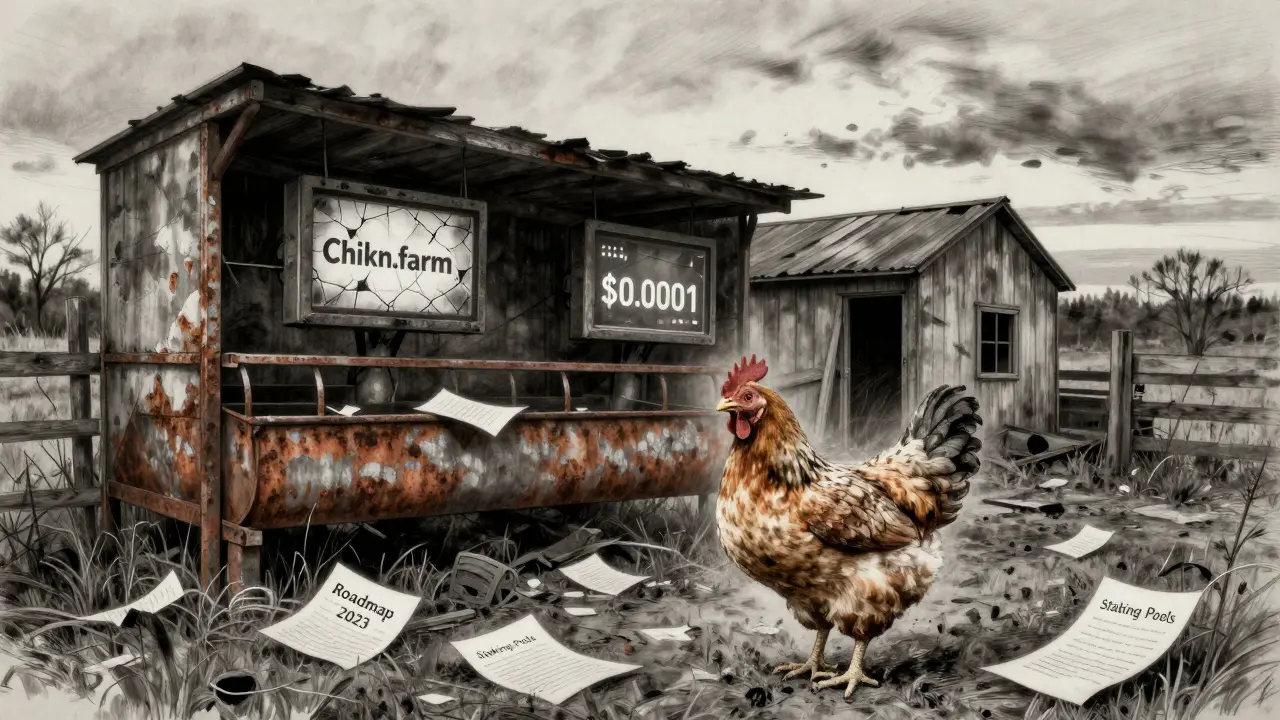
The token was launched in early 2022, right when NFT hype was peaking. Back then, Chikn claimed to be a platform for emerging NFT creators, offering tools to mint, trade, and earn from digital assets. The project’s website, chikn.farm is the official website for the Chikn ecosystem, which includes the FEED token, NFT chickens, and the $EGG reward token, still exists, but updates have been rare since late 2023. The project’s roadmap, once filled with promises of marketplaces, staking pools, and cross-chain expansion, now looks frozen in time.
Technical Basics: How FEED Works
FEED runs on the Avalanche C-Chain, which means it’s compatible with MetaMask and other Ethereum-compatible wallets. The contract address is 0xab592d197acc575d16c3346f4eb70c703f308d1e. Total supply is capped at 14 million tokens, with roughly 13.7 million already created. But here’s the catch: according to CoinMarketCap, the circulating supply is listed as zero. That’s not because all tokens are locked - it’s because the data providers can’t track how many are actually being used. This is a red flag. Most legitimate projects clearly report circulating supply because it’s essential for calculating market cap.
FEED’s only real use case is inside the Chikn ecosystem. You can use it to:
- Buy or upgrade your digital chicken NFTs
- Pay for farming fees or staking deposits
- Potentially vote on future upgrades (though no governance votes have occurred in over a year)
Outside of that, FEED has no utility. You can’t pay for goods, services, or subscriptions with it. No major wallets or exchanges support it. It doesn’t integrate with any DeFi protocols beyond the Chikn app itself. It’s a closed loop - and a very small one at that.
Price History: A 99.9% Crash
FEED’s price tells a brutal story. Its all-time high was $0.03997 on January 12, 2022. That’s when the NFT market was exploding, and Chikn was trending on Twitter. Today, it trades around $0.0001. That’s a 99.75% drop from its peak. To put that in perspective: if you bought $1,000 worth of FEED at its peak, you’d now have about $2.50 left.
The crash didn’t happen overnight. After the 2022 crypto winter hit, trading volume dried up. By February 2025, FEED hit an all-time low of $0.00002347. Since then, it’s bounced back slightly - up about 276% from that low - but that’s not recovery. That’s just a dead coin twitching. The 24-hour price range is now between $0.000053 and $0.000055. It barely moves.
Trading Volume: Almost No One Is Buying
Here’s the kicker: on March 14, 2026, FEED’s 24-hour trading volume was around $8,462 across seven markets. That’s less than what a single Bitcoin miner spends on electricity in a day. The most active trading pair is FEED/WAVAX on the decentralized exchange LFJ. But even that pair only saw $74 in trades in the last 24 hours.
Compare that to other Avalanche-based tokens like AVAX, which trades over $500 million daily. Or even small competitors in the NFT space - they’re still moving tens of millions in volume. FEED? It’s practically a ghost. Low volume means two things: you can’t easily buy or sell it without crashing the price, and there’s zero liquidity. If you decide to cash out, you might not find a buyer at all.
Market Position: Ranked #7039
On CoinMarketCap, FEED sits at position #7039. That’s not just low - it’s buried. There are over 25,000 cryptocurrencies listed. FEED is in the bottom 28%. It doesn’t appear on any major exchanges like Binance, Coinbase, or Kraken. It’s only available on obscure DEXs like LFJ and a couple of others. No institutional investors, no venture capital backing, no media coverage. It survives on a handful of die-hard NFT collectors who still believe in the Chikn dream.
There are 10,540 wallet addresses holding FEED. Sounds like a community? Not really. That’s about the size of a small Discord server. For comparison, Ethereum has over 100 million unique addresses. FEED’s community isn’t growing. It’s just holding on.
Why Does FEED Still Exist?
It’s not dead - it’s in limbo. The Chikn team hasn’t abandoned the project. The website is still up. The contract is still active. But there are no new features, no marketing, no team updates. No blog posts since 2023. No Twitter replies. No Discord activity beyond automated bot messages.
Why? Because it’s a classic case of a project built on hype, not utility. When NFTs were hot, Chikn offered a fun, meme-y concept: digital chickens that lay tokens. It tapped into the same energy that drove Dogecoin and Shiba Inu. But unlike those, Chikn didn’t build a real economy. It didn’t create demand outside its own ecosystem. It didn’t attract developers, influencers, or partnerships. Once the hype faded, there was nothing left to hold interest.
Should You Buy FEED?
Here’s the blunt truth: if you’re looking to invest, avoid FEED. It’s not a smart play. The risk is extreme, and the reward is nearly nonexistent. The token’s price is stuck in a death spiral. There’s no catalyst for recovery. No roadmap. No team activity. No liquidity. It’s not a scam - the contract is real and hasn’t been rug-pulled. But it’s not a project either. It’s a relic.
If you’re a collector of obscure NFTs or you already own Chikn chickens and want to keep your ecosystem running, then holding FEED might make sense. But even then, the value is purely sentimental. There’s no financial upside.
And if you’re thinking of buying FEED because you saw a "100x opportunity" on Reddit? That’s gambling. The odds aren’t in your favor. The token’s market cap is under $1,500. That’s not an investment. That’s a donation to a forgotten idea.
Final Thoughts
Chikn Feed (FEED) is a crypto ghost. It’s a token with no volume, no price movement, no team updates, and no future roadmap. It was born in the peak of NFT mania and died quietly in the aftermath. Its only legacy is a cautionary tale: not every NFT project with a cute mascot has staying power. The blockchain remembers everything - but the market forgets fast.
If you’re curious about the Chikn ecosystem, visit chikn.farm is the official website for the Chikn ecosystem, which includes the FEED token, NFT chickens, and the $EGG reward token. But go in with your eyes open. This isn’t a chance to get rich. It’s a chance to see how quickly crypto dreams can vanish.
Is Chikn Feed (FEED) a scam?
No, FEED is not a scam. The contract is live, the team hasn’t withdrawn funds, and the website is still accessible. But it’s not a functioning project either. It’s a zombie token - technically alive, but with no real activity, updates, or community growth. It’s not malicious, but it’s also not valuable.
Can I trade FEED on Binance or Coinbase?
No. FEED is only available on decentralized exchanges like LFJ, and a few other minor platforms. It’s not listed on any major centralized exchange. That’s a major red flag for any token that claims to have real utility.
What’s the difference between FEED and $EGG?
FEED is the utility token used to interact with the Chikn ecosystem - buying chickens, paying fees, staking. $EGG is the reward token that NFT holders earn when their digital chickens "lay eggs." They’re two separate tokens in the same system. $EGG has even less trading volume than FEED and is nearly impossible to sell.
Why is the circulating supply listed as zero?
Data aggregators like CoinMarketCap can’t track how many FEED tokens are actively being used. The contract allows for token transfers, but there’s no reliable way to distinguish between locked, burned, or inactive wallets. This lack of transparency is common in low-activity tokens and makes market cap calculations unreliable.
Is there any chance FEED will recover?
Unlikely. Recovery requires new users, new features, marketing, and liquidity - none of which are happening. The Chikn team hasn’t posted anything meaningful in over a year. Without a clear plan or community push, FEED will likely continue to drift toward zero value. It’s not a matter of if - it’s a matter of when.
Chikn Feed (FEED) is a textbook example of a project that confused novelty for sustainability. The NFT chicken concept was cute, sure-but utility requires demand, not just aesthetics. The fact that the circulating supply is listed as zero isn’t a data glitch; it’s a statement. No one’s using it. No one’s trading it. No one’s even holding it long-term. The contract is live, yes, but so is a tombstone. And just like a tombstone, it’s got a name, a date, and nothing else.
It’s heartbreaking to watch something so meticulously designed collapse into silence. The tri-token architecture was elegant on paper-chickens, eggs, feed. A self-contained economy. But without community engagement, without transparency, without even a quarterly update, it became a museum piece. I once held a Chikn NFT. I still have the image saved. It’s not an investment anymore. It’s a memory.
Let’s be honest-this wasn’t a project. It was a honeypot. The team never intended to build anything long-term. The website? Still up because they’re waiting for the next sucker. The contract? Not rug-pulled because they don’t need to. The tokens are already in wallets owned by bots or their own addresses. Zero volume? That’s because there’s no real market. Just a graveyard with a ticker symbol. And you’re all still feeding it attention like it’s a pet rock.
I still remember the day I bought my first Chikn NFT. I was so excited. I thought I was part of the future. I named him Cluck Norris. I staked FEED. I watched the eggs roll in. And then… silence. No updates. No new features. Just automated bots saying "thank you for holding." I cried. I didn’t cry because I lost money. I cried because I believed. And that’s worse than any loss. This isn’t crypto. This is emotional labor.
The entire Chikn ecosystem is a metaphor for late-stage capitalism: a hollow shell of aesthetics, sustained by nostalgia and delusion. The tokenomics were never sound. The community was never real. The team? Absent. One must ask: why does this still exist? Not because it has value-but because humans refuse to let go of things they once loved. We mourn digital pets like they were real. And that, my friends, is the true tragedy.
I’ve seen a lot of crypto projects rise and fall. But FEED? It’s one of the few that made me feel something. Not greed. Not FOMO. Just sadness. It wasn’t a scam. It was a dream. And dreams don’t need to be profitable to be meaningful. If you still hold FEED, you’re not an investor. You’re a curator of a forgotten moment. And that’s okay. Not everything has to make money to matter.
the website still works so its not dead right? i mean the contract is there and the chickens are still there and i still log in sometimes just to see if cluckie laid an egg lol
you know what’s wild? i used to think this was dumb. then i realized… i still check the price every day. like a habit. like checking on an ex. i don’t even want it anymore. i just want to know if it’s still breathing.
FEED is like that one friend who never texts back but you still send them memes. you know they won’t reply. but you do it anyway. because it feels like you’re keeping something alive. even if it’s just you and the ghost in the blockchain. 🐔💔
Oh sweet summer child. You think FEED is dead? No. It’s in witness protection. The team changed their names. Moved to Uruguay. Still owns 99% of the supply. The "zero circulating supply"? That’s not a bug. That’s the cover-up. The real joke? You’re all still here. Talking. Trading. Believing. The only thing more pathetic than FEED… is you.
I just want to say thank you to whoever wrote this post. It’s rare to see a project’s obituary written with so much care. FEED was never meant to be the next Bitcoin. It was meant to be a quiet little corner of the internet where people played with digital chickens. And for a while, it was beautiful. Maybe that’s enough.
There’s a chilling beauty in how quietly FEED faded. No drama. No exit. No drama. Just… nothing. No one even bothered to shut it down. The team didn’t vanish-they just stopped caring. And in crypto, that’s the most honest form of failure. Not fraud. Just indifference. The blockchain doesn’t care about your dreams. It only cares if you’re still moving tokens. FEED stopped moving. So the chain moved on.
FEED is not a token. It is a mirror. It reflects our collective obsession with novelty over substance. We chase the shiny chicken, we name it, we feed it, we watch it lay eggs… and when the novelty fades, we pretend we still believe. But deep down? We know. We always knew. The real egg was never in the blockchain. It was in the dopamine hit we got from believing in something that didn’t exist.
🐣Let’s deconstruct the structural deficiencies of FEED’s tokenomics. The tri-token architecture is a classic example of over-engineered complexity without economic equilibrium. The FEED token, as utility, is entirely dependent on the NFT supply curve, which is inelastic. The $EGG reward mechanism creates inflationary pressure without corresponding demand sinks. The lack of burn mechanisms, vesting schedules, or liquidity incentives renders the entire system functionally inert. This isn’t a failed project-it’s a textbook case study in economic misalignment. The market cap is under $1,500? That’s not a bug. That’s a feature. It’s a perfectly efficient dead system.
Some of you are still holding on. I get it. I held too. But let’s be real-FEED isn’t waiting for a comeback. It’s waiting for someone to finally hit "delete" on the website. The team isn’t coming back. The community isn’t growing. The price won’t rise. The only thing left is nostalgia. And nostalgia doesn’t pay for gas fees.
I appreciate your honesty. But maybe that’s the point. Maybe we don’t need to delete it. Maybe we just need to let it rest. FEED was never about money. It was about play. About imagination. About a world where chickens laid crypto. That’s not nothing. That’s not a failure. That’s a moment. And moments don’t need to last to be real.