
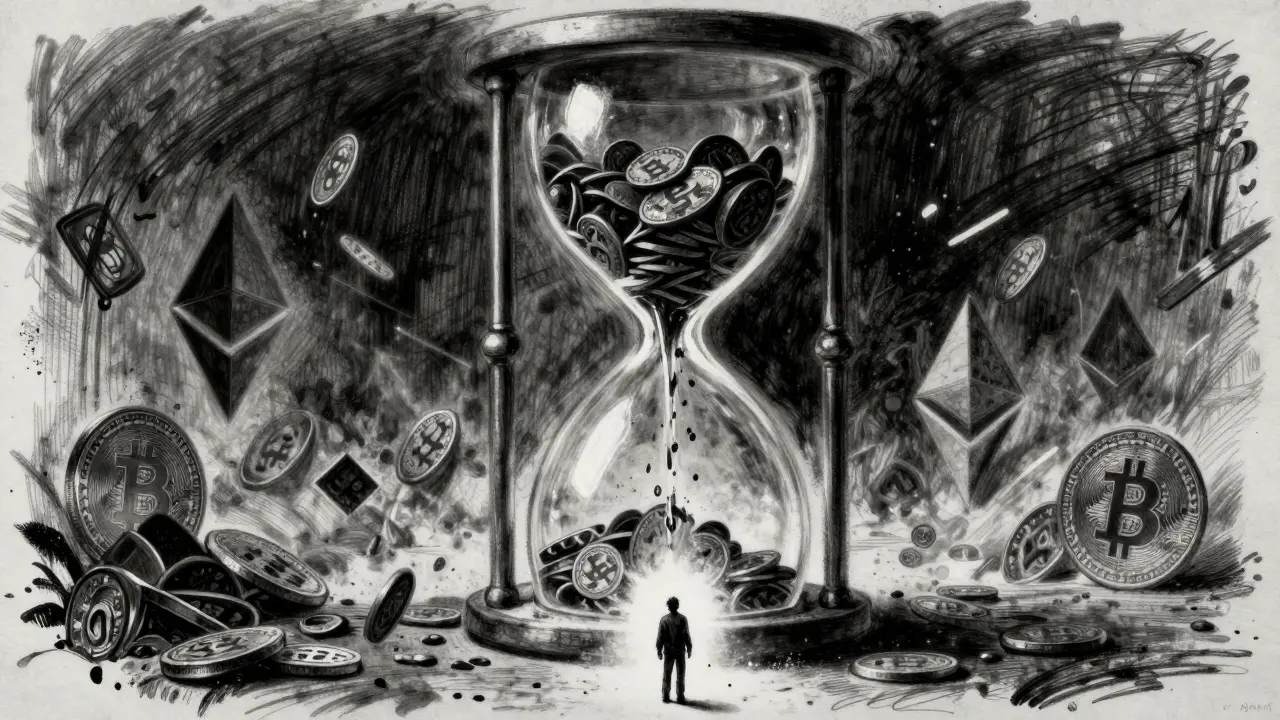
You’ve seen the charts. You’ve heard the hype. But have you actually read the fine print? Most investors skip straight to the price action, chasing green candles and ignoring the engine room of a project: its tokenomics, or the economic model that governs how a token is created, distributed, and used. When that model is broken, no amount of marketing can save your investment. In fact, poorly designed tokenomics is one of the leading causes of catastrophic losses in the crypto space, often hiding behind flashy whitepapers and complex diagrams.
In 2026, the market has matured enough that we can clearly distinguish between projects built for longevity and those designed as short-term liquidity traps. Identifying tokenomics red flags isn’t just about avoiding scams; it’s about understanding the fundamental supply and demand mechanics that will dictate whether your tokens hold value or evaporate into thin air. Let’s look at the specific warning signs that should make you pause before clicking "Buy."
The Infinite Supply Trap
The most glaring red flag is an unlimited or excessively large total supply with no clear mechanism to control inflation. If a project has a maximum supply in the trillions or quadrillions, ask yourself: what creates scarcity? Without scarcity, value dilution is inevitable. Every time new tokens are minted and released into circulation, the percentage ownership of existing holders shrinks, driving down the price unless demand increases exponentially-which rarely happens sustainably.
Consider Dogecoin. While it has a cult following, its infinite supply model means it faces constant annual inflation. This contrasts sharply with Bitcoin, which has a hard cap of 21 million coins, creating a deflationary pressure over time. More recently, Ethereum implemented EIP-1559, a protocol upgrade that burns a portion of transaction fees. This burn mechanism acts as a counterweight to issuance, potentially making Ethereum deflationary during high network activity. If a project lacks any such burn mechanism or controlled emission schedule, you are buying into an asset that is constantly losing purchasing power relative to itself.
- Check Max Supply: Is there a hard cap? If not, what limits the emission?
- Analyze Inflation Rate: What percentage of the circulating supply is added annually?
- Look for Burns: Does the protocol destroy tokens through transactions or fees?
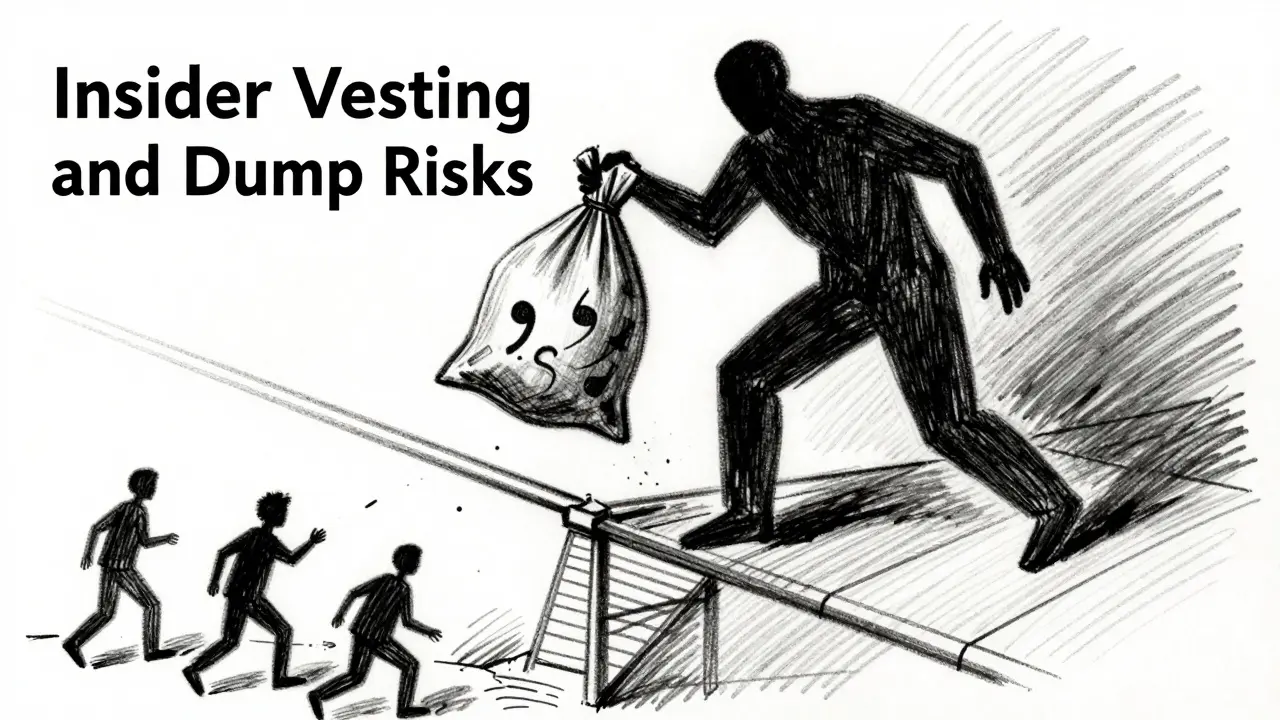
Insider Vesting and Dump Risks
Who holds the tokens matters just as much as how many exist. A major red flag is when a disproportionate amount of the supply is allocated to the team, early investors, or founders, especially if these tokens unlock quickly. This is known as the "vesting schedule." If 40% of the supply is held by insiders and unlocks fully within six months, you are essentially providing exit liquidity for them. The moment those tokens hit the open market, the selling pressure can crash the price, regardless of the project’s actual utility.
Healthy projects implement long vesting periods, often spanning several years, with cliff periods where no tokens are released initially. This aligns the incentives of the team with long-term success rather than quick profits. Always check the token distribution chart on platforms like CoinMarketCap or CoinGecko. If you see large chunks labeled "Team," "Private Sale," or "Reserve" unlocking soon, proceed with extreme caution. The goal is to find projects where the community and public markets hold the majority of the supply, ensuring decentralized price discovery.
Unsustainable APY and Liquidity Traps
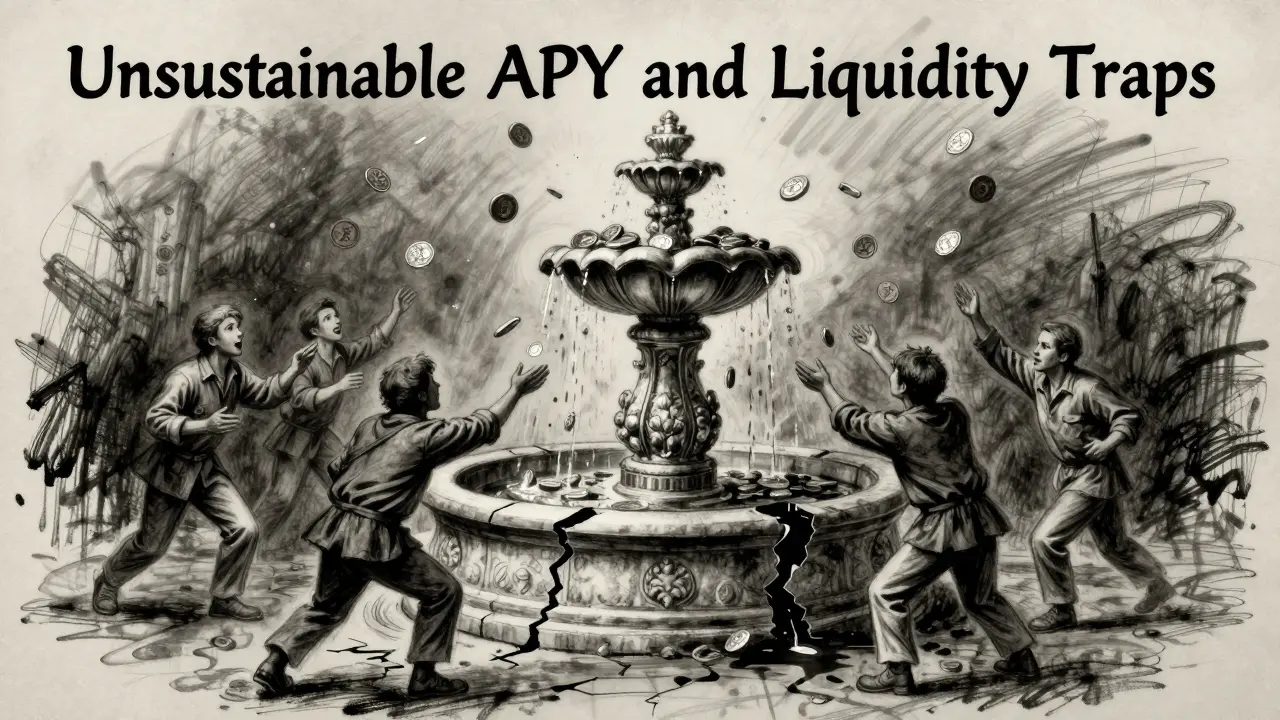
If a project promises Annual Percentage Yields (APY) exceeding 100% without a clear revenue source, run. These yields are not generated from profit; they are printed from the token supply itself. This is a classic Ponzi-like structure where new investor funds pay out returns to earlier investors. Once the inflow of new capital slows down, the yield collapses, and the token price crashes because the underlying economics cannot support the promised returns.
Compare this to established DeFi protocols like Aave or GMX. Their rewards come from real trading fees, lending interest, or protocol revenue. GMX, for instance, uses its token as a sink for fees paid by traders, creating a sustainable cycle where usage drives demand for the token. If you cannot trace the APY back to real-world revenue or protocol fees, it is likely a temporary subsidy funded by inflation-a trap waiting to spring.
| Feature | Healthy Signal | Red Flag |
|---|---|---|
| Total Supply | Fixed cap or deflationary burn | Infinite supply with no burn |
| Vesting Schedule | Long-term (3-5+ years), gradual unlock | Short-term (<1 year), large insider allocation |
| Utility | Governance, fee discounts, staking rewards | No utility, purely speculative |
| Revenue Model | Trading fees, lending interest, subscription | None, relies on token appreciation |
| Complexity | Simple, transparent mechanisms | Over-engineered, confusing layers |
Lack of Genuine Utility
A token must serve a purpose beyond being traded. If a project cannot explain why someone would need to hold its token-whether for governance rights, accessing services, paying fees, or securing the network-it lacks genuine utility. Tokens without utility rely entirely on speculation, meaning their price is driven solely by sentiment and momentum. When the hype dies, the price goes to zero.
Look for projects where the token is integral to the ecosystem. For example, in the DeFi space, tokens often grant voting rights on protocol upgrades or distribute a share of revenue. In gaming, tokens might represent in-game assets or currencies. If the whitepaper is vague about utility or uses buzzwords like "metaverse integration" without concrete examples, treat it as a red flag. Utility creates consistent demand, which supports price stability over time.
Over-Engineered Complexity
Simplicity is a virtue in tokenomics. Projects that introduce 10+ layers of staking, bonding, minting, and burning mechanisms are often trying to hide centralization risks or structural weaknesses behind apparent sophistication. Complex models are harder to audit, more prone to bugs, and easier to manipulate by insiders. They also confuse users, making it difficult to assess true value.
Elegant tokenomics models, like those found in early Bitcoin or refined Ethereum, rely on simple, robust principles. If you need a PhD in economics to understand how a token gains value, it’s probably too risky. Stick to projects with transparent, easy-to-understand mechanisms that align incentives clearly. Complexity is not a feature; it’s often a bug waiting to be exploited.
How to Conduct Your Own Due Diligence
Spotting these red flags requires systematic evaluation. Start by reading the project’s whitepaper and official documentation. Look for sections on "Token Economics," "Supply Distribution," and "Vesting Schedules." Cross-reference this information with data on CoinMarketCap or CoinGecko. Check community forums like Reddit or Discord for discussions about supply concerns or insider dumps. Be skeptical of single-source information; verify claims across multiple platforms.
Remember, regulatory bodies like the CFTC warn against guaranteed returns and lack of transparency. As the industry matures toward mainstream adoption, projects with resilient, transparent tokenomics will survive, while those relying on hype and flawed economics will fail. Your job is to identify the difference before you invest.
What is the biggest tokenomics red flag?
The biggest red flag is an unlimited token supply combined with fast vesting schedules for insiders. This creates massive inflationary pressure and potential dump scenarios, diluting the value of existing holdings.
Why is unlimited supply bad for crypto?
Unlimited supply leads to constant inflation. Without a hard cap or burn mechanism, new tokens continuously enter circulation, devaluing existing tokens unless demand grows infinitely, which is unrealistic.
How do I check a project's vesting schedule?
You can find vesting details in the project’s whitepaper or on data aggregators like CoinMarketCap and CoinGecko under the "Token Info" or "Distribution" section. Look for cliffs and linear unlock periods.
Is high APY always a red flag?
Not always, but APY over 100% without a clear revenue model is highly suspicious. Sustainable yields come from real protocol fees, not from printing more tokens to pay investors.
What makes Ethereum's tokenomics better than older models?
Ethereum’s EIP-1559 update introduced a burn mechanism for transaction fees, creating deflationary pressure during high usage. This contrasts with purely inflationary models that dilute holder value over time.