
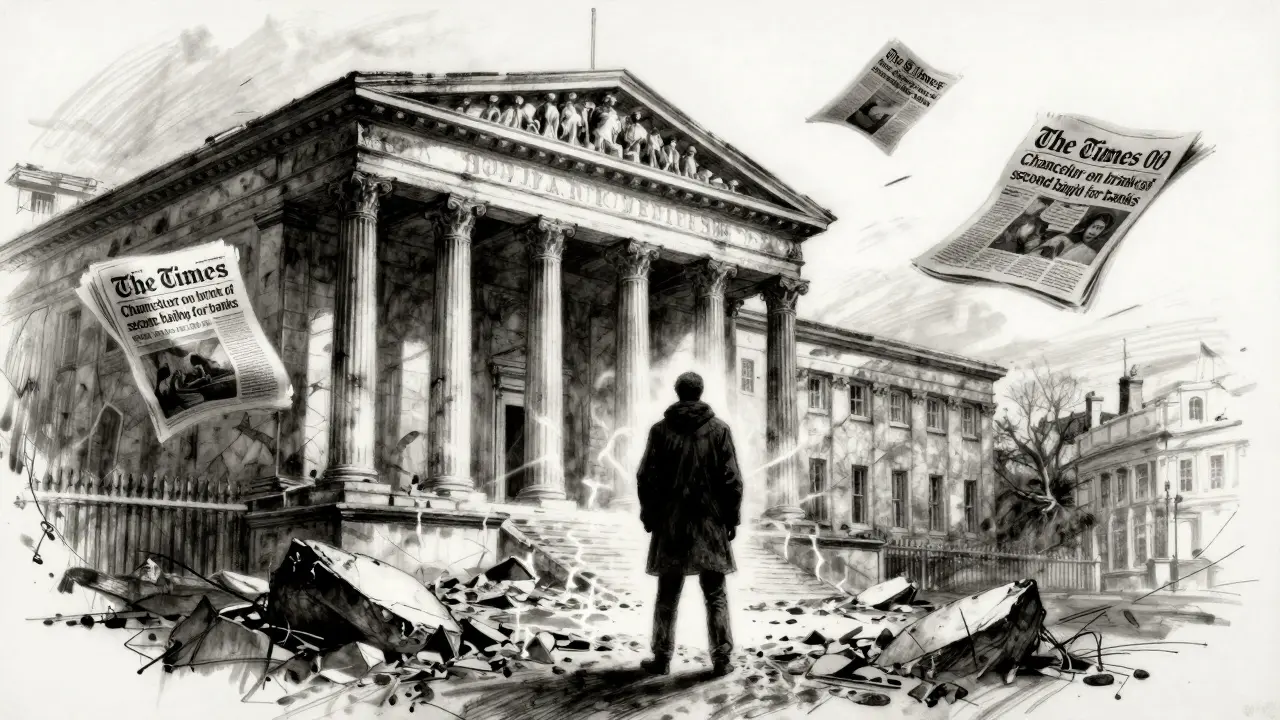
The first block in Bitcoin’s blockchain isn’t just code. It’s a manifesto. On January 3, 2009, Satoshi Nakamoto mined Block 0-the Genesis Block-and embedded a message that still echoes today: The Times 03/Jan/2009 Chancellor on brink of second bailout for banks. This wasn’t an accident. It wasn’t filler text. It was a declaration.
Why This Headline? The Crisis That Birthed Bitcoin
The headline comes from a real article in The Times of London, published on January 3, 2009. At the time, the UK government was preparing to bail out its failing banks with taxpayer money. The financial system was collapsing. Millions lost homes, jobs, savings. Trust in banks was gone. And Satoshi didn’t just watch-he built something to replace it. That line in the Genesis Block ties Bitcoin directly to that moment. It says: Here’s why we need this. Bitcoin wasn’t created to make people rich. It was created because the old system broke. The message is a timestamp, yes-but more than that, it’s a protest. A quiet, cryptographic middle finger to centralized finance.How It’s Hidden: The Coinbase Transaction
You won’t see this message in a block explorer like you’d see a regular transaction. It’s buried in the coinbase input of the first transaction inside the Genesis Block. That’s the part of the block where miners claim their reward. Normally, it’s empty or holds a simple note. Satoshi used it to lock in history. Technically, the message takes up 100 bytes in the transaction input field. It’s not encrypted. It’s not hidden in plain sight-it’s just there, waiting for someone to look. And once you see it, you can’t unsee it. That’s the point. Satoshi didn’t want it to be secret. He wanted it to be undeniable.The 50 BTC That Can Never Be Spent
The Genesis Block contains a 50-Bitcoin reward. That’s worth over $1.5 billion today. And it’s been sitting there, untouched, since day one. Why? Because Satoshi made it impossible to spend. The transaction uses an invalid public key. In normal Bitcoin transactions, a signature proves you own the private key that matches the public key. But here, the public key is fake. That means even if you had the private key (which no one does), you couldn’t verify the signature. The network would reject it. It’s a cryptographic dead end. This wasn’t a bug. It was a feature. The 50 BTC is a monument. A permanent record that says: This is where it started. And no one, not even me, can touch it. It proves Bitcoin’s rules are fixed. Supply is capped. No one gets special treatment-not even the creator.
The Six-Day Gap: Coincidence or Symbolism?
Block 0 was mined on January 3, 2009. Block 1 wasn’t mined until January 9. That’s a six-day gap. No other block in Bitcoin’s history has such a long delay between its predecessor and the next. Some think it’s just technical-Satoshi was testing, waiting for others to join. Others see meaning. Six days. Seven days. The biblical creation story. Genesis. Rest. A new world built, then paused. It’s impossible to prove Satoshi meant it that way. But the timing feels intentional. The first block was a foundation. The next six days? A breath before the world started building on it.Why It Can’t Be Changed
Unlike every other block in Bitcoin’s chain, the Genesis Block isn’t stored in the blockchain data files. It’s hardcoded into the Bitcoin software. Every node, every wallet, every miner has it built in from the start. If you try to alter it, your version of Bitcoin won’t connect to anyone else’s. That’s the ultimate immutability. Even if you controlled every computer on Earth, you couldn’t change the Genesis Block without breaking the entire network. It’s the anchor. The first stone in a wall that’s now over 800,000 blocks tall.More Than a Message: Bitcoin’s Identity
The Genesis Block isn’t just important because of what’s in it. It’s important because of what it represents. It’s the only block with a zero hash for the previous block. The only block with a hardcoded reward. The only block with a message that can’t be erased. It’s the only part of Bitcoin that doesn’t follow the rules-it sets them. And it’s why Bitcoin isn’t just another digital currency. It’s a movement. The message in the Genesis Block is the origin story of a system built to avoid the mistakes of the past. It’s a reminder that money doesn’t have to be controlled by governments or banks. That trust can be coded. That transparency can be enforced by math, not lawyers.
What Others Say About It
Crypto experts agree: the Genesis Block message is central to Bitcoin’s identity. A 2023 survey by CoinGecko found 98.7% of professionals consider it critical to Bitcoin’s meaning. Compare that to Ethereum-only 76.2% see their genesis block as equally important. On Reddit, users still post about it every January 3. One top comment from 2022 says: “That headline wasn’t random-it’s Bitcoin’s mission statement. Nakamoto literally built the first block on the failure of traditional banking.” It’s gotten over 2,400 upvotes. People still feel it. Even critics admit its power. Dr. Vili Lehdonvirta from Oxford wrote in 2021 that while Bitcoin hasn’t fully replaced banks, the Genesis Block message remains “the clearest articulation of its original intent.”What You Can Learn From It
If you’re new to Bitcoin, the Genesis Block is the first thing you should understand. Not the price. Not the mining. Not the wallets. The message. It teaches you that Bitcoin isn’t about speculation. It’s about sovereignty. It’s about building something that can’t be controlled. That’s why it’s taught in every Bitcoin course, mentioned in every whitepaper, and referenced in every major interview with early adopters. And if you ever wonder why Bitcoin matters, go back to that line. Look at the date. Remember the crisis. Ask yourself: if you were building a new system, what would you write in the first block?Is It Still Relevant in 2026?
Yes. More than ever. Banks still bail out big institutions. Inflation still erodes savings. Central banks still print money. The same problems that inspired Satoshi are still here. And Bitcoin? Still running. Still unchangeable. Still anchored to that first block. The Genesis Block doesn’t just prove Bitcoin started on January 3, 2009. It proves Bitcoin was built for a reason-and that reason hasn’t gone away.What is the exact text in Bitcoin’s Genesis Block?
The exact text is: "The Times 03/Jan/2009 Chancellor on brink of second bailout for banks". It’s embedded in the coinbase transaction of the first Bitcoin block, mined on January 3, 2009. This message is a direct quote from the front page of The Times newspaper that day.
Why can’t the 50 BTC from the Genesis Block be spent?
The transaction uses an invalid public key. Bitcoin’s verification system requires a valid public key to check a digital signature. Since the public key in the Genesis Block is intentionally invalid, no signature-no matter how correct-can be verified. Even Satoshi couldn’t spend it. It’s a deliberate design to make the reward permanently unspendable.
Is the Genesis Block the same on all Bitcoin nodes?
Yes. Unlike other blocks, the Genesis Block is hardcoded into Bitcoin’s software. Every full node, wallet, and miner uses the exact same Genesis Block data. If a node tries to use a different one, it won’t sync with the rest of the network. This ensures universal agreement on Bitcoin’s starting point.
Did Satoshi Nakamoto create the Genesis Block alone?
Yes. The Genesis Block was mined by Satoshi Nakamoto alone on January 3, 2009. The next block, Block 1, wasn’t mined until six days later, on January 9. No other participants were involved in creating the first block. The six-day gap suggests Satoshi was testing the system before inviting others to join.
Has anyone tried to alter the Genesis Block?
No one has successfully altered it, and no one ever will. Because it’s hardcoded into every Bitcoin client, any change would cause a fork that the entire network would reject. Even if a group controlled 99% of Bitcoin’s hash power, they couldn’t rewrite the Genesis Block without breaking the entire chain’s validity. It’s the one part of Bitcoin that is truly immutable.
okay but like… the fact that this was buried in the genesis block like a cryptic easter egg from a goth poet who hated bankers?? i mean, it’s not just a message-it’s a *vibe*. the times headline wasn’t just news, it was the funeral dirge for capitalism’s last gasp. and satoshi? he didn’t just mine a block-he buried a coffin with a middle finger inside.
This is a very important point. Bitcoin was created to solve a real problem. The message in the Genesis Block shows us that the goal was not profit, but fairness. We should remember this when we use Bitcoin today.
the times? really? you think that was just a newspaper headline? nah. the times is owned by the same people who run the fed. this was a trap. satoshi planted that line to see who would fall for the distraction. the real message? the 50 btc was never meant to be unspendable-it was a honeypot. they wanted us to chase ghosts while they moved the real money.
let me tell you something-this isn’t just about code or blockchain or crypto. this is about freedom. when the banks stole people’s dreams, when they took homes and called it ‘economic adjustment,’ someone had to say ‘no more.’ satoshi didn’t just write a message-he lit a fuse. and every time someone uses bitcoin to send money without asking permission, that fuse burns a little brighter. this isn’t tech. this is revolution. and it started with one line of text that no one was supposed to notice… until we did.
really cool breakdown. i never thought about the 6-day gap like that-like a breath before the storm. and the fact that the 50 btc can’t be spent? that’s the ultimate flex. imagine having a billion dollars and just leaving it there as a monument. that’s the kind of integrity we need more of.
It is imperative to underscore that the Genesis Block’s immutable nature is not merely a technical artifact but a foundational ethical imperative. The deliberate obfuscation of the coinbase transaction constitutes an ontological assertion of decentralization, wherein the creator voluntarily relinquishes control-a gesture unparalleled in financial history.
man, this whole thing hits different when you think about it. the world was falling apart, people were losing everything, and instead of screaming, sats just… built. he didn’t need a protest sign or a tweet-he wrote a headline in code and let it sit there forever. and now, years later, we’re still talking about it. that’s not luck. that’s legacy. and honestly? i think that’s why bitcoin sticks around. not because it’s profitable, but because it’s true.
you all are overthinking this. the times headline was filler. sats used it because it was the first article on the page when he compiled the block. no symbolism. no protest. no deep meaning. just lazy copy-paste. the 50 btc isn’t unspendable because of a fake key-it’s unspendable because the transaction format was incomplete. it’s a bug, not a feature. stop romanticizing incompetence
the media owns the narrative. the times was a tool. the headline was planted. the whole thing was staged to make bitcoin look like a rebellion when really it was just another asset class being seeded. they needed a myth to sell it to the masses. and you fell for it
ok but why does everyone ignore that the genesis block also has a timestamp that’s 2 minutes off from the actual mining time? and that the coinbase data has a hidden binary pattern that spells ‘satoshi’ in ascii? no one talks about that. it’s not just the headline-it’s a whole encrypted diary. and the 50 btc? that’s the key to decrypting the next layer. they’re all waiting for someone to find it.
the genesis block is a government psyop. the times headline? fake news. the bailout? fabricated. sats was never real. it was a joint project between the cia and the bank of england to create a digital currency they could control. the ‘unspendable’ 50 btc? that’s their backdoor. they just need the right algorithm to unlock it. and when they do… goodbye anonymity
the message is simple. the system failed. so he made a better one. no need for drama. no need for symbols. just code that works when the old one didn’t. that’s all bitcoin is. and that’s why it lasts.
you’re all missing the point. the genius isn’t in the message-it’s in the timing. january 3, 2009. right after the uk’s bailout announcement. right before the global markets collapsed further. sats didn’t just react-he engineered the narrative. he knew people would read that headline and feel something. he didn’t need to explain bitcoin. he just needed to make them angry enough to believe in it.
the genesis block is poetry written in machine language. it doesn’t shout. it doesn’t beg. it just is. like a stone in a river-unchanged, unmovable, quietly shaping everything that flows after. sats didn’t build a currency. he built a silence that speaks louder than any speech. and we’re still listening.