
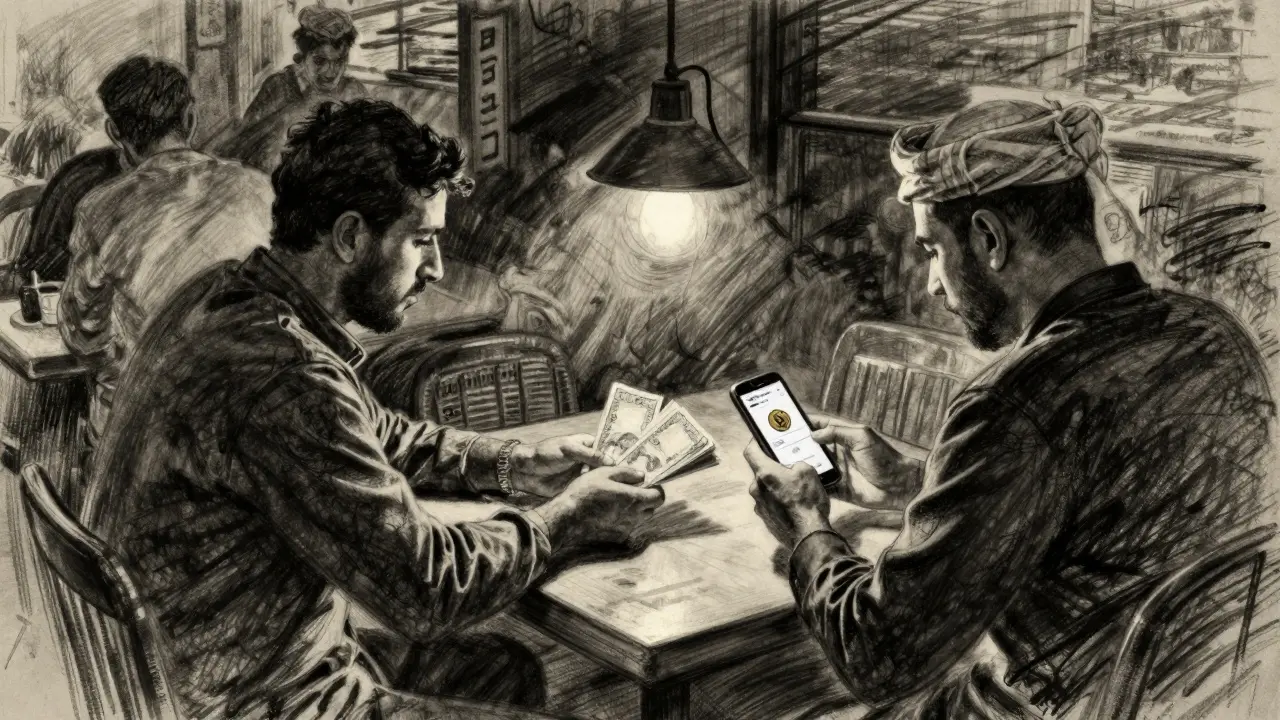
Before September 2025, if you wanted to buy Bitcoin in Jordan, you couldn’t do it through a bank. Not even close. The Central Bank of Jordan had made it clear: cryptocurrencies weren’t welcome in the formal financial system. No exchanges, no crypto wallets linked to local accounts, no deposits from crypto sales. Yet, thousands of Jordanians still traded crypto-every day. How? They didn’t wait for permission. They built their own system, outside the banks, outside the law, and somehow, it worked.
Trading in the Shadows: The Rise of P2P Markets
Jordanians didn’t have access to regulated exchanges like Binance or Coinbase. Those platforms wouldn’t let them deposit JOD, and local banks would freeze accounts if they spotted crypto-related transactions. So people turned to peer-to-peer (P2P) trading. This wasn’t some fancy app. It was WhatsApp groups, Facebook Marketplace posts, and cash meetups in coffee shops in Amman or Irbid. You’d find someone selling Bitcoin. They’d ask for cash in Jordanian dinars. You’d meet at a mall, hand over the money, and they’d send the Bitcoin to your wallet. No middleman. No KYC. No paper trail. It was fast, simple, and risky. But it was the only way. Some traders used local payment apps like Zain Cash or Fawry to move money between accounts, then instantly traded the crypto on international platforms. Others relied on friends of friends-trust networks built over years. If you knew someone who’d done a trade before, you’d ask them to vouch for the seller. Reputation mattered more than regulation.Why the Banks Said No
The Central Bank of Jordan’s stance wasn’t arbitrary. They worried about money laundering, fraud, and the volatility of crypto prices. In a country where 20% of the population lives below the poverty line, the fear was that people would gamble their savings on Bitcoin and lose everything. The CBJ also didn’t want to lose control over the flow of money in and out of Jordan’s economy. Crypto, they argued, bypassed the entire financial infrastructure. But here’s the thing: people were already using crypto. Not just speculators. Small business owners in Zarqa used Bitcoin to pay suppliers in Turkey. Students in Madaba bought Ethereum to fund their online courses. Even freelancers on Upwork started withdrawing earnings in USDT instead of waiting for slow, expensive bank wire transfers. The bank’s ban didn’t stop crypto-it just pushed it underground. And underground markets are dangerous. People got scammed. Wallets got hacked. Cash meetups turned into robberies. There was no recourse. No customer service. No insurance. Just a handshake and a QR code.The Brain Drain: Talent Left for the UAE
Jordan has one of the highest rates of university graduates in the region. But when the government blocked crypto, it also blocked innovation. Talal Tabbaa, a Jordanian tech entrepreneur, co-founded CoinMENA-one of the region’s biggest crypto platforms-because he couldn’t build it at home. The rules didn’t allow it. So he moved to Dubai. He wasn’t alone. Dozens of Jordanian developers, blockchain engineers, and fintech founders packed up and left for the UAE, Bahrain, or even Georgia. Why? Because those places had clear rules. If you wanted to run a crypto exchange, you applied for a license. You followed the law. You grew your business. In Jordan, you had to break it-or leave. The result? Jordan lost a generation of tech talent. Companies that could’ve become regional leaders shut down before they started. Investors looked elsewhere. The country missed its chance to become a fintech hub.
The Turning Point: Law No. 14 of 2025
On September 14, 2025, everything changed. King Abdullah II signed Law No. 14-the Virtual Assets Transactions Regulation Law. For the first time, crypto wasn’t illegal. It was regulated. The law gave clear definitions: Bitcoin, Ethereum, stablecoins, even NFTs with economic value-all counted as virtual assets. It created a licensing system managed by the Jordan Securities Commission (JSC). Now, if you want to run a crypto exchange, custody service, or payment provider in Jordan, you apply. You prove you’re secure. You follow anti-money laundering rules. You have a physical office in Amman. Suddenly, the underground P2P market had competition. Legitimate exchanges like CoinMENA, BitOasis, and local startups could now operate legally. People could buy crypto with their bank accounts. No more cash meetups. No more WhatsApp scams. The law also banned unlicensed promotion of crypto services. That meant shady Telegram groups and fake “crypto consultants” could no longer operate with impunity. The government didn’t just allow crypto-it cleaned up the mess it had ignored for years.What Changed for Regular People?
Before the law, a Jordanian buying Bitcoin had to:- Find a seller through social media
- Meet in person or send cash via untraceable apps
- Hope the seller didn’t disappear
- Pay higher prices due to risk premiums
- Face potential bank account freezes
- Sign up for a licensed exchange like CoinMENA or a local JSC-registered platform
- Deposit JOD directly via bank transfer
- Buy Bitcoin or USDT in minutes
- Store it in a regulated wallet
- Get customer support if something goes wrong
Who Still Uses P2P Today?
Even after the law, some people still trade P2P. Why? Because not everyone trusts banks. Some small vendors still prefer cash. Others live in rural areas with poor internet and no access to licensed exchanges. And some just don’t want to give their ID to anyone. But the difference now is choice. You don’t have to use P2P anymore. You can choose the safe, legal route. That’s the real win.
What’s Next for Jordan?
The law isn’t perfect. There are still delays in licensing. Some small traders struggle with compliance costs. But the direction is clear: Jordan is catching up. The country now has a real shot at becoming a crypto hub in the Middle East. With its educated workforce, stable government, and strategic location, Jordan could attract investment from global firms looking to expand beyond the UAE. The brain drain might finally reverse. For everyday Jordanians, it means more than just trading crypto. It means access. Opportunity. A voice in the future of finance.What About Stablecoins and Payments?
The law specifically allows virtual assets to be used for payments. That’s huge. Before, if you got paid in USDT, you had to convert it to cash through a shady middleman. Now, licensed providers can offer crypto-to-JOD conversion at point-of-sale. A shopkeeper in Aqaba can accept Bitcoin, and the platform instantly turns it into dinars and deposits it into their bank account. This isn’t just about speculation anymore. It’s about real economic utility.Final Thought: The Real Victory
The real story here isn’t how Jordanians traded crypto despite the ban. It’s how they kept going anyway. While the government argued over risks, people built solutions. They didn’t wait for permission. They created a system out of necessity. The 2025 law didn’t invent crypto in Jordan. It caught up to what the people were already doing. And that’s how real change happens-not from the top down, but from the ground up.Was crypto illegal in Jordan before 2025?
Yes. The Central Bank of Jordan banned the use of cryptocurrencies in the formal financial system. Banks couldn’t process crypto-related transactions, and exchanges weren’t allowed to operate. But trading still happened through unregulated peer-to-peer networks.
How did Jordanians buy Bitcoin without banks?
They used peer-to-peer (P2P) methods: cash meetups in cafes, WhatsApp groups, Facebook Marketplace, and local payment apps like Zain Cash. Buyers paid in Jordanian dinars, and sellers sent crypto directly to their wallets. No banks involved.
What risks did Jordanians face trading crypto informally?
They faced scams, theft, and no legal protection. If someone disappeared after receiving cash, there was no way to recover funds. Banks could freeze accounts if they detected crypto activity. Some people were even robbed during cash meetups.
What did the 2025 Virtual Assets Law change?
It made crypto legal and regulated. Licensed exchanges can now operate in Jordan, accept JOD deposits, and offer secure wallets. The Jordan Securities Commission oversees compliance, and users can trade safely through official platforms.
Can Jordanians now use crypto to pay for goods and services?
Yes. The 2025 law explicitly allows virtual assets to be used for payments. Licensed providers can now convert crypto to Jordanian dinars instantly at point-of-sale, making it possible for businesses to accept Bitcoin or USDT without risk.
Why did so many Jordanian crypto founders leave the country?
Because the lack of regulation made it impossible to build a legal crypto business. Founders like Talal Tabbaa moved to Dubai and other regions with clear rules. Jordan lost talent and innovation until the 2025 law created a path forward.
Are P2P crypto trades still common in Jordan after 2025?
They’re rare now, but still exist for people who distrust banks, live in remote areas, or prefer cash. However, with licensed exchanges offering low fees and instant JOD deposits, most users have switched to legal platforms.
What types of crypto are legal in Jordan now?
The law covers Bitcoin, Ethereum, stablecoins (like USDT and USDC), and NFTs with economic value. It excludes digital securities already regulated by the Jordan Securities Commission and central bank digital currencies.


