

When you send ETH or swap tokens on Ethereum, you expect it to be fast, cheap, and secure. But right now, Ethereum’s base layer can’t handle that at scale. That’s where rollups come in. They process hundreds of transactions off-chain and then bundle them into a single proof that gets posted back to Ethereum. It’s like packing a dozen groceries into one bag and checking out once instead of 12 times. But here’s the big question: if everything’s happening off-chain, how do you know no one’s cheating?
How Rollups Keep You Safe Without Trust
Rollups don’t rely on trust. They rely on math. There are two main types: Optimistic Rollups and ZK Rollups. Both are designed to inherit Ethereum’s security, but they do it in completely different ways.Optimistic Rollups assume everything is fine unless someone proves otherwise. That’s where fraud proofs come in. Think of it like a courtroom. A batch of transactions gets submitted to Ethereum. Everyone waits. If something looks off - say, someone tried to steal funds - anyone can file a fraud proof. The system then re-runs just that one transaction on Ethereum to check if it’s valid. If it’s not, the bad actor loses their deposit, and the correct state is restored.
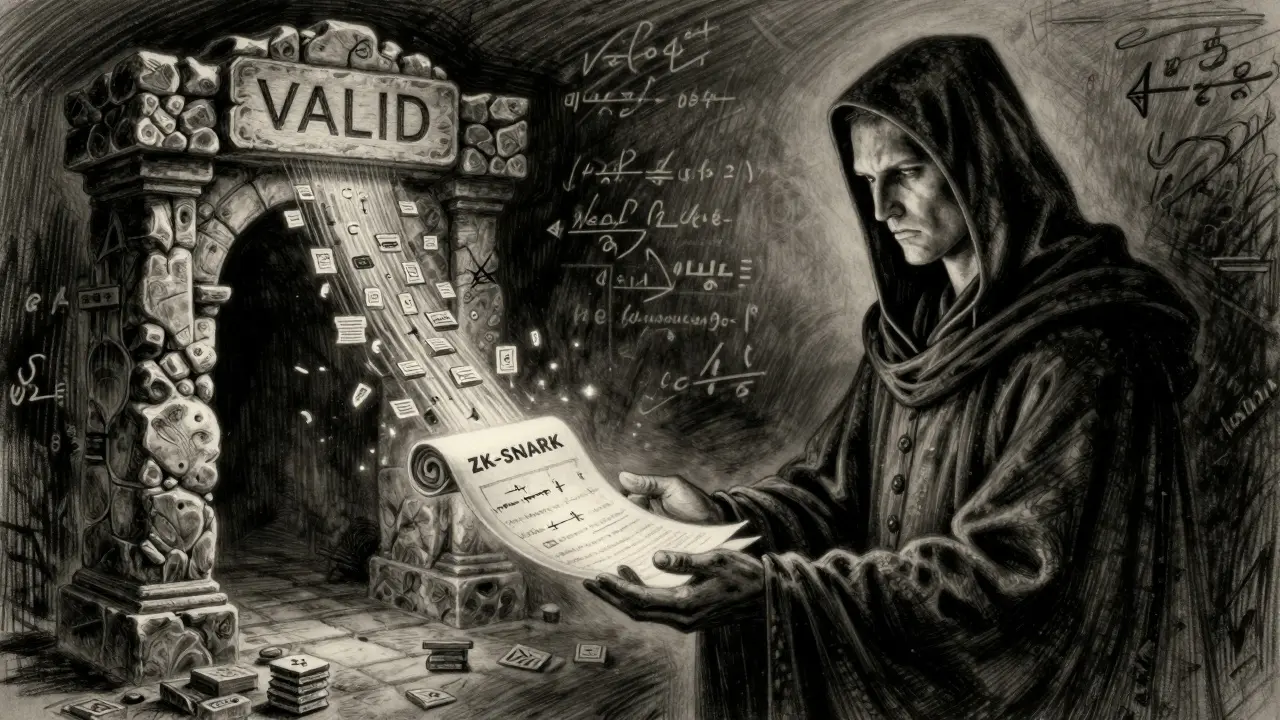
ZK Rollups take the opposite approach. Instead of waiting for someone to catch a lie, they prove the truth upfront. Every batch comes with a cryptographic proof - a ZK-SNARK or STARK - that mathematically shows every transaction in the batch was executed correctly. No waiting. No challenges. Just instant verification. It’s like handing over a sealed, tamper-proof receipt that says, “Everything here is 100% accurate.”
Fraud Proofs in Action: The Optimistic Rollup Safety Net
Optimistic Rollups like Optimism and Arbitrum rely on fraud proofs to enforce security. Here’s how it works in practice:- A sequencer (a node that orders transactions) bundles 100 transactions into a batch and submits the new state root to Ethereum.
- The full transaction data is posted on-chain as calldata, so anyone can reconstruct the state if needed.
- A 7-day challenge window opens (though some, like Base, now use 2 hours).
- If a user spots an invalid state transition - say, someone minted fake tokens - they can trigger a fraud proof.
- The fraud proof is executed on Ethereum using a special contract that replays the disputed transaction step-by-step.
- If the proof succeeds, the bad actor’s bond is slashed, and the chain reverts to the last valid state.
This system only works if there are enough people watching. If no one checks, a malicious operator could sneak in a fake state. That’s why decentralized verifiers matter. Projects like Optimism now offer financial incentives - bounties up to 0.5 ETH - to encourage users to audit batches. One developer on Reddit reported successfully challenging a fraudulent batch in October 2023 and collecting the reward.
But fraud proofs aren’t perfect. They’re expensive. Each fraud proof costs between 500,000 and 1,000,000 gas. That’s roughly $10-$20 in fees at current prices. And if the challenge window is too short - under 48 hours, as Ethereum researcher Barry Whitehat warned - attackers might have enough time to exploit vulnerabilities before anyone notices.
ZK Rollups: Proving Truth, Not Catching Lies
ZK Rollups like zkSync and StarkNet skip the waiting game. Instead of relying on challengers, they generate a cryptographic proof that’s verified on Ethereum before the batch is accepted.Here’s what happens:
- Each transaction is processed off-chain.
- A proving system (like PLONK or STARK) generates a compact proof - often just 180-200 bytes - that says, “These 1,000 transactions were executed correctly.”
- The proof is submitted to Ethereum.
- A smart contract verifies the proof in under 1.1 seconds.
- If valid, the state updates immediately.
No challenge period. No waiting. Finality in under 10 minutes. That’s why ZK Rollups are preferred for high-frequency trading, DeFi, and payments where speed matters.
But there’s a catch. Generating these proofs is computationally intense. It requires specialized hardware - servers costing $5,000 to $15,000 - and deep expertise in zero-knowledge cryptography. Matter Labs estimates it takes 200-300 hours of training just to build a secure ZK Rollup. That’s why most ZK projects are backed by well-funded teams like StarkWare or Matter Labs.
And while ZK Rollups are more efficient for privacy, they’re not magic. A subtle bug in the proving circuit - like the one security researcher samczsun outlined in November 2023 - could allow invalid state transitions to slip through. That’s why audits cost $75,000 to $150,000 per project. Most rollups go through 3-4 rounds before launch.
Speed vs. Security: The Trade-Off No One Talks About
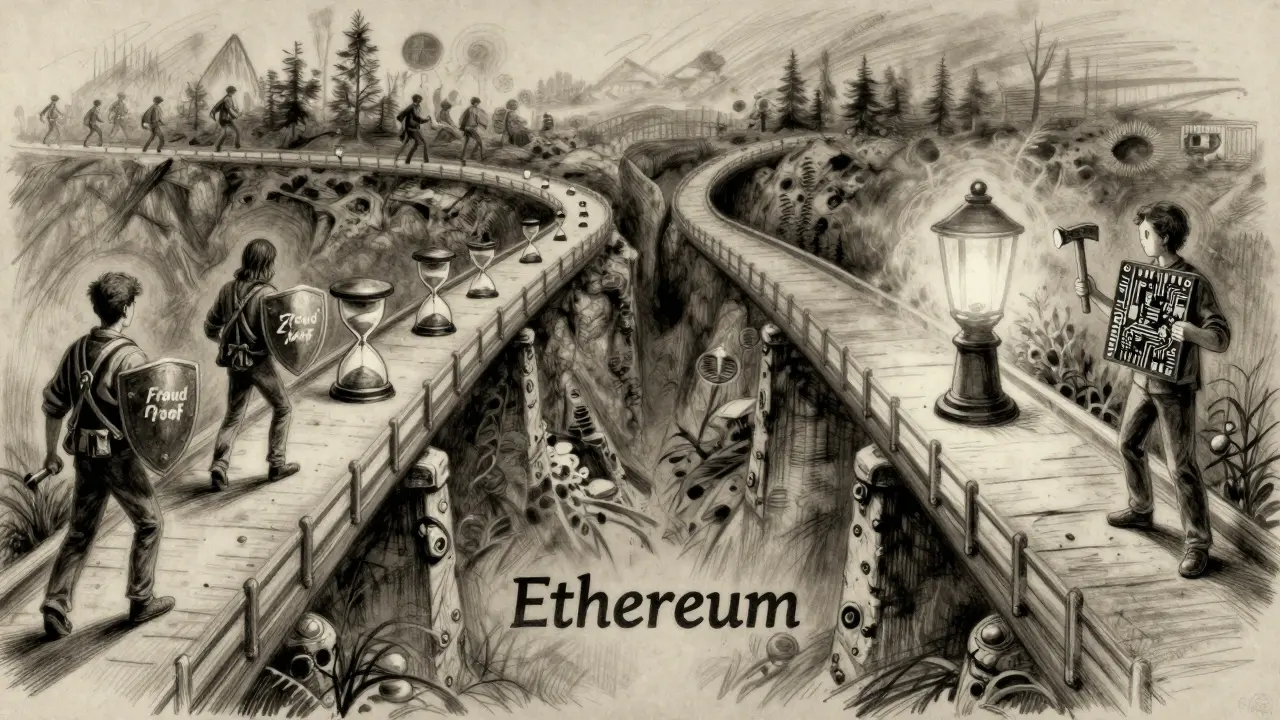
The biggest difference between Optimistic and ZK Rollups isn’t just how they verify - it’s how they affect your experience.With Optimistic Rollups, you get fast deposits (1-2 seconds) but slow withdrawals. The 7-day waiting period is a major pain point. One user on Reddit lost $120 in missed trading opportunities because they had to wait a week to move funds off Arbitrum. That’s why Optimism and Base pushed to cut the challenge window to 2 hours in late 2023. But shorter windows mean less time for fraud proofs to be filed. It’s a trade-off: convenience vs. security.
ZK Rollups flip that. Withdrawals are fast - often under 10 minutes - because the proof is already verified. But the trade-off is complexity. You can’t easily build a custom smart contract on a ZK Rollup without deep cryptographic knowledge. Optimistic Rollups are more developer-friendly. You can deploy Ethereum-compatible code with little change. That’s why 68% of developers surveyed at EthCC 2023 preferred ZK for new projects, but 82% admitted the learning curve was too steep.
What’s Next? The Evolution of Rollup Security
Rollup security isn’t static. It’s evolving fast.In November 2023, Arbitrum introduced recursive fraud proofs, cutting verification gas costs by 63%. That’s huge. It means smaller operators can afford to monitor chains without needing expensive rigs. Optimism’s OP Stack now supports modular security layers, letting projects choose their own challenge periods.
Then there’s cross-rollup security. Right now, moving assets between Optimism and zkSync is risky. Each rollup has its own finality rules. Ethereum Research’s November 2023 paper introduced “Stage 0-2” security levels. Stage 0 means you trust the destination rollup. Stage 2 means you wait for Ethereum confirmation - which can take 12-24 hours. Polymer Hub’s new implementation cuts that to 45 minutes by combining both systems.
And then there’s EIP-4844 - Proto-Danksharding - launching in Q2 2024. It will slash rollup data costs by 90%. That’s a game-changer. Right now, posting transaction data on Ethereum costs $0.03-$0.15 per transaction. With EIP-4844, that could drop to pennies. Suddenly, Optimistic Rollups become even cheaper to operate, and ZK Rollups can afford to post more data, making them even more secure.
Long-term, Delphi Digital predicts ZK Rollups will handle 65% of high-value transactions by 2027. But Optimistic Rollups won’t disappear. They’re better for simple apps, NFTs, and games where speed isn’t critical and developers need simplicity.
What Should You Care About?
If you’re using a rollup:- Check the challenge period. If it’s under 48 hours, ask why. Is it backed by enough verifiers?
- Don’t rush withdrawals on Optimistic Rollups. That 7-day wait is your safety net.
- For high-value swaps, ZK Rollups like zkSync are safer and faster.
- Watch for audits. If a project hasn’t been audited by OpenZeppelin or CertiK, tread carefully.
If you’re building on a rollup:
- Use Hardhat’s Rollup plugin (v1.8.0+) - it cuts dev time by 35%.
- Test chain reorgs. The Degen Chain incident in October 2023 showed how delayed data publishing breaks everything.
- Don’t skip audits. Even a $100,000 audit is cheaper than a $10 million exploit.
Rollups are the future of Ethereum. But they’re not magic. Their security depends on how well they’re built - and how many people are watching. The best rollups don’t just promise safety. They prove it - with math, incentives, and time.
What’s the difference between fraud proofs and validity proofs?
Fraud proofs are used by Optimistic Rollups and work by challenging invalid transactions after they’re submitted. Anyone can file a proof if they spot a lie, and Ethereum re-executes the transaction to verify. Validity proofs, used by ZK Rollups, prove a transaction is correct before it’s accepted. They use cryptographic math (like ZK-SNARKs) to guarantee correctness upfront - no waiting, no challenges.
Why do Optimistic Rollups have a 7-day withdrawal period?
The 7-day window gives time for anyone to detect and challenge a fraudulent state transition using a fraud proof. If someone tries to steal funds by submitting a fake batch, the system needs enough time for honest users to spot it and act. Shorter windows (like 2 hours on Base) reduce this safety net, making them riskier for large amounts.
Are ZK Rollups more secure than Optimistic Rollups?
ZK Rollups are mathematically more secure because they prevent invalid states from ever being accepted. Optimistic Rollups rely on people watching and challenging - if no one does, fraud can slip through. But in practice, both are considered secure if properly implemented. The real difference is in speed, cost, and developer complexity, not raw safety.
Can fraud proofs be hacked?
Yes - but only if there’s a bug in the fraud proof system itself. In 2023, a researcher showed a theoretical attack that could let a malicious operator steal $10 million from a rollup for $1.2 million by exploiting a timing flaw in state root verification. That’s why audits are critical. The system only works if the code is flawless.
What’s the role of Ethereum in rollup security?
Ethereum acts as the ultimate truth layer. It stores transaction data (for Optimistic Rollups), verifies validity proofs (for ZK Rollups), and enforces penalties on bad actors. Without Ethereum, rollups would be independent chains with no security guarantees. Rollups don’t replace Ethereum - they lean on it.
Will EIP-4844 make fraud proofs obsolete?
No. EIP-4844 will make posting data on Ethereum 90% cheaper, which helps both rollup types. But fraud proofs still serve a purpose: they allow anyone to challenge bad actors without needing complex cryptography. ZK Rollups need validity proofs; Optimistic Rollups need fraud proofs. Both will coexist.
How do I know if a rollup is safe to use?
Check three things: 1) Has it been audited by a top firm like OpenZeppelin? 2) Is the challenge period reasonable (at least 48 hours for Optimistic Rollups)? 3) Is there active community monitoring? Projects with public bounty programs and active Discord channels are more likely to catch fraud early.
Interesting breakdown. I’ve been using Arbitrum for months and never thought about how the 7-day window actually protects me. Kinda like insurance you didn’t know you had.
The notion that ‘math’ ensures security is a dangerous oversimplification. Cryptographic systems are only as secure as their implementation-and history has shown that even the most elegant proofs collapse under poor engineering.
Love how you emphasized community monitoring. Too many people think security is just code, but it’s also people showing up. That’s what makes this ecosystem alive.
Optimistic rollups are a joke. Waiting 7 days to withdraw? That’s not innovation-that’s feudalism with gas fees. ZK is the only real path forward. Anyone still defending Optimistic is either naive or paid by L2 VC.
bro i just wanna swap my tokens fast and not think about fraud proofs or snarks or whatever. why does everything have to be so complicated??
fraud proofs? more like fraud waiting games. they call it security but it’s just a casino where you bet your money on someone else being awake enough to catch the thief.
Let’s not pretend ZK rollups are flawless. The proving infrastructure is a black box controlled by a handful of well-funded labs. You’re not trusting math-you’re trusting a private server farm in Palo Alto that you can’t audit. This isn’t decentralization. It’s crypto feudalism with better marketing.
I really appreciate how you clarified the trade-offs between speed and complexity. Most people act like ZK is magic, but the truth is, it’s just a different kind of burden-shifted from users to developers.
optimistic rollups are fine if you dont mind waiting 7 days for your money like its 2017. zks are the future. end of story.
Someone just said ZK rollups are more secure? Please. You’re ignoring the fact that if the proving circuit has a bug, it’s game over-and no one can challenge it. Fraud proofs at least let the crowd vote on truth. ZK? You just have to trust the wizards.
But here’s the real question-why does Ethereum even need to be the truth layer? What if we built a new consensus mechanism that doesn’t rely on a single chain? What if we… decentralized the decentralization?
There’s an existential tension here that no one’s naming: we’re outsourcing trust to mathematics, but mathematics is a human construct. The ZK-SNARKs we rely on were invented by people with biases, funding, and blind spots. We call it ‘trustless,’ but we’re just trusting a different kind of authority-one that speaks in elliptic curves instead of words. Is that progress, or just a more elegant cage?
Oh my god, you guys are still debating this? I used to be an Optimism guy, then I tried zkSync and now I just cry every time I see a 7-day withdrawal countdown. It’s like waiting for your ex to text back-except you’re losing money while you wait.
so zks are faster but harder to build. optimistics are slower but easier. guess which one the big players picked? surprise: the one that lets them charge more.
People act like EIP-4844 is gonna fix everything but let’s be real-cheaper data doesn’t fix bad incentives. If nobody’s watching the fraud proofs, it doesn’t matter how cheap calldata is. Security isn’t a cost problem-it’s a coordination problem. And humans are terrible at coordination unless there’s money involved.
Don’t get me started on how India and other countries are trying to copy this tech without understanding the math. You can’t just hire a few devs and call it a ZK rollup. This isn’t React. This is nuclear-grade cryptography. America built this. Don’t let it be diluted.
It’s not about which is better-it’s about using the right tool for the job. ZK for high-value swaps, Optimistic for games and NFTs. Simple.
Imagine if we just used a central bank instead of all this. At least they’d fix mistakes before you lose your life savings. But nooo, we need math that only 3 people in the world understand.
One thing everyone’s missing: the real innovation isn’t the proof system-it’s the financial incentives. The fact that someone can earn 0.5 ETH just for catching a fraud? That’s the secret sauce. It turns passive users into active watchdogs. That’s not just tech-that’s behavioral engineering at scale.
There is a deeper philosophical layer here: if security requires constant human vigilance, then we are not truly building trustless systems-we are building systems that require perpetual human labor to function. Is that sustainable? Or are we just pretending to transcend human weakness?