

Remember the days when swapping tokens meant waiting for a counterparty to show up? Those days are long gone. Today, you can trade almost any token instantly on a Bancor Network is a decentralized exchange protocol that uses smart contracts to provide continuous on-chain liquidity without requiring counterparties. It was founded by Eyal Hertzog, Guy Benartzi, and Galia Benartzi and launched its initial coin offering in June 2017, raising $153 million. But here is the real question: after years of upgrades, hacks, and fierce competition from giants like Uniswap, is Bancor still worth your time and gas fees?
I have spent weeks testing the platform, digging into its code updates, and comparing it against the current market leaders. The short answer is yes-but with some major caveats. Bancor isn't just another copycat decentralized exchange (DEX). It has unique features like single-sided liquidity provision and impermanent loss protection that actually solve real problems for traders. However, it also suffers from lower liquidity depth than its competitors, which can hurt you if you are moving large amounts of money.
What Makes Bancor Different From Other DEXs?
Most decentralized exchanges use a standard Automated Market Maker (AMM) model where you need two tokens to create a liquidity pool. If you want to provide liquidity for ETH/USDC, you need both ETH and USDC. Bancor flips this script. With Bancor’s Single-Sided Liquidity Provision is a feature allowing liquidity providers to deposit only one type of token into a pool while the protocol handles the balancing via smart contracts., you can deposit just ETH. The smart contract automatically balances the pool. This sounds too good to be true, right? It reduces friction for new users who don’t want to go through the hassle of acquiring multiple tokens first.
Then there is the issue of Impermanent Loss (IL). Every DeFi user knows IL-that annoying phenomenon where providing liquidity results in less profit than just holding the tokens. Bancor offers Impermanent Loss Protection is a mechanism within the Bancor protocol that compensates liquidity providers for losses incurred due to price divergence compared to holding.. For stablecoin pools, they cover up to 100% of these losses. For volatile pairs, they offer partial coverage. This is a massive advantage over platforms like Uniswap or PancakeSwap, where you bear the full brunt of IL.
But let’s talk about the tech under the hood. Bancor v3.0, launched in March 2022, introduced concentrated liquidity. This means you can allocate your capital within specific price ranges rather than spreading it out across all possible prices. According to Bancor’s technical documentation, this boosts capital efficiency by up to 4,000x. In plain English, you get more yield for the same amount of deposited assets because your money is working harder in the zones where most trades happen.
Fees, Gas Costs, and Trading Experience
Let’s get down to brass tacks: how much does it cost to use Bancor? The trading fees are competitive. Standard pools charge 0.10%, while stablecoin pools are even cheaper at 0.05%. Compare that to Uniswap’s standard 0.30% fee, and Bancor looks attractive on paper. However, fees are only half the story. You also have to pay Ethereum gas fees.
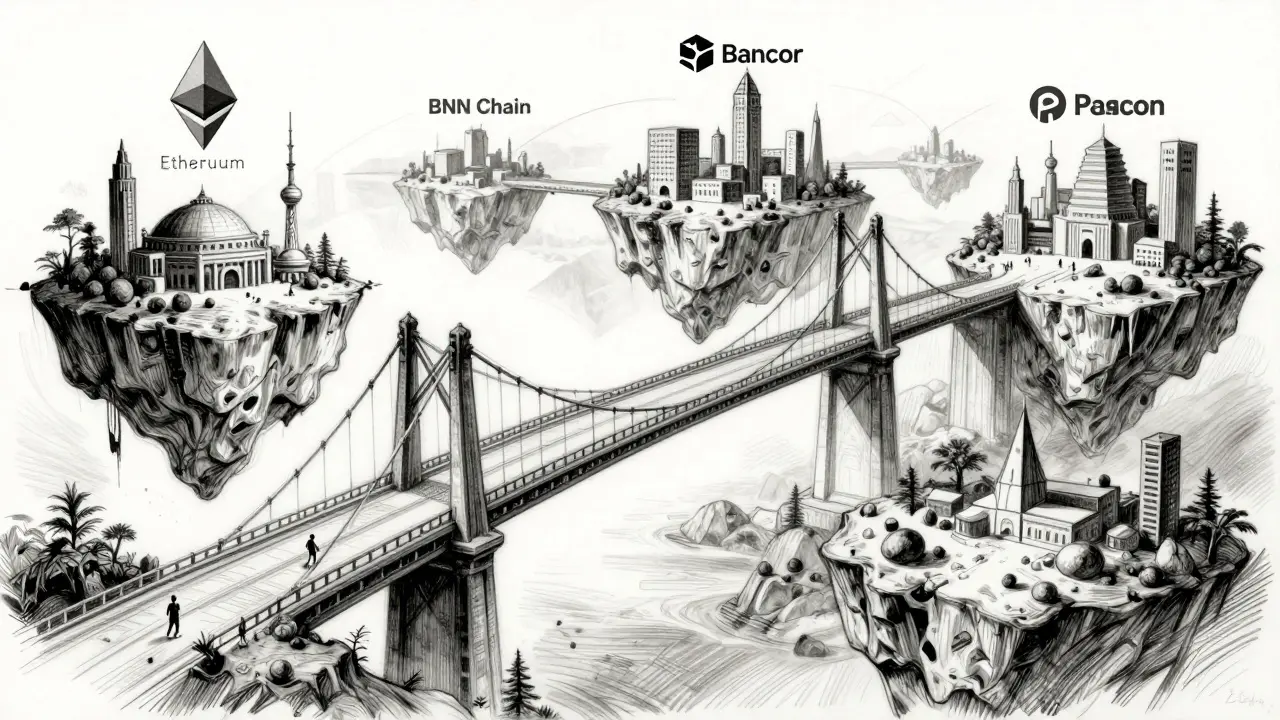
If you are trading on the Ethereum mainnet, expect to pay between $1.20 and $3.50 per transaction during normal congestion levels, based on data from late 2023. During peak times, those numbers can skyrocket. That is why Bancor expanded to other chains. As of 2026, Bancor operates on BNB Chain is a blockchain network developed by Binance that supports smart contracts and decentralized applications with lower transaction costs than Ethereum, Polygon, Avalanche, and Moonbeam. On BNB Chain, transactions confirm in 3-5 seconds and cost pennies. This multi-chain approach is crucial for keeping costs low for everyday traders.
User experience is mixed. Advanced traders love the single-click swaps and the ability to manage complex liquidity positions. Beginners, however, often find the interface confusing. Setting up a wallet like MetaMask takes about 15-20 minutes if you are new to crypto. Configuring single-token exposure parameters adds another 10-15 minutes. If you prefer plug-and-play simplicity, Bancor might feel clunky compared to centralized exchanges like Coinbase or Binance.

Bancor vs. The Competition: A Head-to-Head Comparison
You cannot evaluate Bancor in isolation. You need to see how it stacks up against the big dogs. Here is a breakdown of how Bancor compares to Uniswap V3, PancakeSwap, and Curve Finance as of late 2023 data, which remains relevant for understanding their structural differences.
| Feature | Bancor Network | Uniswap V3 | PancakeSwap | Curve Finance |
|---|---|---|---|---|
| Trading Fee (Standard) | 0.10% | 0.30% | 0.25% | Variable (Low) |
| Stablecoin Fee | 0.05% | 0.05% | 0.04% | 0.04% |
| Impermanent Loss Protection | Yes (Up to 100% for stables) | No | No | Minimal |
| Single-Sided LP | Yes | No | No | No |
| Total Value Locked (TVL) | $1.2 Billion | $4.2 Billion | $1.8 Billion | $1.5 Billion |
| Supported Chains | Ethereum, BNB, Polygon, Avalanche, Moonbeam | Ethereum, Arbitrum, Optimism, etc. | BNB Chain, Ethereum, Arbitrum | Ethereum, Polygon, Arbitrum, etc. |
As you can see, Bancor lags behind in Total Value Locked (TVL). Uniswap dominates with $4.2 billion, while Bancor sits at $1.2 billion. Lower TVL means less liquidity depth. If you are trying to swap $50,000 worth of a smaller token, you will likely face higher slippage on Bancor (averaging 2.5%) compared to Uniswap (1.8%). For small trades under $10,000, the difference is negligible, with slippage around 0.35%.
However, Bancor wins on safety nets. No other major DEX offers comprehensive impermanent loss protection. If you are a conservative investor looking to earn yield on stablecoins without worrying about IL eating your profits, Bancor is currently the best option in the market.
Security and Trust: Should You Worry?
Security is paramount in DeFi. Bancor has had a rocky past. In April 2020, the protocol suffered a hack resulting in a $23.5 million loss. That incident shook the community. Since then, Bancor has implemented robust security measures. They use time-locked governance upgrades, meaning no single person can change the code instantly. Treasury management relies on multi-signature wallets, requiring multiple keys to authorize transactions.
The team also focuses heavily on transparency. Their GitHub repository has over 1,200 stars and nearly 400 forks, indicating active developer interest and scrutiny. Smart contracts are regularly audited. While no system is 100% hack-proof, Bancor’s post-2020 track record has been solid. They have not experienced any major exploits since implementing their enhanced security protocols.
Regulatory concerns also loom large. The SEC has scrutinized many DeFi tokens. Bancor’s legal team filed a 'Howey Test Analysis' in July 2023, arguing that the BNT token is not a security under U.S. law. This proactive stance helps legitimize the project, but regulatory landscapes shift quickly. Always do your own research regarding local laws before participating.
Who Is Bancor Best For?
Not every trader needs Bancor. Here is who should consider using it:
- Yield Farmers Seeking Safety: If you want to provide liquidity to stablecoin pairs and hate impermanent loss, Bancor’s protection mechanism is invaluable.
- Users with Single Assets: If you only hold ETH or BNB and want to start earning yield immediately without buying a second token, Bancor’s single-sided LP feature saves you time and fees.
- Cross-Chain Traders: If you frequently move assets between Ethereum, BNB Chain, and Polygon, Bancor’s integrated cross-chain functionality simplifies the process.
Who should avoid it?
- High-Volume Traders: If you are moving millions of dollars daily, the lower liquidity depth will result in significant slippage. Stick to Uniswap or centralized exchanges.
- Absolute Beginners: The learning curve is steep. If you struggle with MetaMask and gas fees, Bancor’s interface might overwhelm you.
Future Outlook: What Lies Ahead?
Bancor is not standing still. The roadmap includes a Bancor 3.1 upgrade featuring gasless swaps and enhanced cross-chain capabilities. They plan to integrate with Solana, Polkadot, and Cosmos by 2025. This expansion could significantly boost adoption and liquidity.
Market analysts are divided on the BNT token’s potential. Some predict modest growth, citing increased DeFi adoption. Others remain skeptical, pointing to intense competition. CoinPedia forecasts a bullish scenario where BNT reaches $38 by 2030, though this is highly speculative. More conservatively, WalletInvestor suggests a target of $0.82 by late 2025. Regardless of price predictions, the utility of the Bancor network continues to grow, making it a key player in the DeFi ecosystem.
Is Bancor Network safe to use in 2026?
Yes, Bancor is considered safe. After a significant hack in 2020, the team implemented rigorous security measures including multi-sig wallets and time-locked governance. While no DeFi platform is immune to risks, Bancor has maintained a strong security record since its overhaul.
How does Bancor protect against impermanent loss?
Bancor offers an Impermanent Loss Protection fund. For stablecoin pools, it covers up to 100% of IL. For volatile asset pools, it provides partial coverage. This feature is unique among major DEXs and appeals to risk-averse liquidity providers.
Can I provide liquidity with only one token on Bancor?
Yes. Bancor’s single-sided liquidity provision allows you to deposit just one token (e.g., ETH). The smart contract automatically manages the balance, removing the need to acquire a second token pair.
Which blockchains does Bancor support?
Bancor operates on Ethereum, BNB Chain, Polygon, Avalanche, and Moonbeam. Future updates aim to add Solana, Polkadot, and Cosmos, enhancing its cross-chain capabilities.
Are Bancor trading fees lower than Uniswap?
Generally, yes. Bancor charges 0.10% for standard pools and 0.05% for stablecoins. Uniswap typically charges 0.30% for standard tiers. However, always factor in Ethereum gas fees, which can vary significantly.
Wake up sheeple. Bancor is just another honeypot designed to bleed you dry while the elites cash out on the sidelines. They talk about 'security' and 'audits' but it's all smoke and mirrors. The 2020 hack wasn't an accident, it was a controlled burn to test the waters. Now they're back with shiny new features like 'single-sided liquidity' which sounds great until you realize the smart contracts are probably riddled with backdoors that only the devs can access. Don't trust the SEC filings or their legal teams. They're playing chess while you're playing checkers. Keep your assets in cold storage or better yet, bury them in your backyard.
I actually tried setting up a single-sided pool last week and it was surprisingly straightforward once I got past the initial wallet configuration. The impermanent loss protection is a game changer for stablecoins, honestly. If you're holding USDC anyway, why not earn yield without worrying about price divergence? It feels safer than throwing money into Uniswap V3 pools where you have to constantly rebalance.
The article fails to mention the catastrophic gas inefficiencies during high volatility periods!!! While Bancor boasts about its IL protection, the underlying mechanics require complex oracle feeds that introduce significant latency!!! This latency creates arbitrage opportunities for MEV bots who will happily front-run your transactions!!! Furthermore, the concentration of liquidity in specific ranges means that if the price moves outside your designated zone, your capital becomes entirely inert!!! You are not earning yield; you are parking dead capital!!!
Another day, another mediocre DEX trying to reinvent the wheel with half-baked solutions. Bancor’s TVL is a joke compared to Uniswap. The 'innovation' here is just repackaging old AMM concepts with fancy marketing speak. Real degens know where the liquidity lives. Bancor is for tourists who want hand-holding and safety nets. Boring. Predictable. Overrated.
Look, I’m not saying Bancor is perfect, but the peace of mind from the IL protection is worth the slightly lower yields for me. I’ve seen too many friends lose their shirts on impermanent loss in volatile pairs. Bancor lets you sleep at night. Plus, the multi-chain support on BNB Chain makes it cheap enough to experiment with smaller amounts. It’s a chill vibe for steady growth rather than moonshot gambling.
You’re all missing the point. Bancor isn’t safe, it’s just regulated enough to feel safe. The 'protection' is funded by the protocol treasury, which is essentially a Ponzi scheme subsidized by new users. When the market turns bearish, that fund dries up instantly. And don’t get me started on the governance model. Time-locked upgrades sound secure until you realize the voters are mostly whales manipulating the outcome. It’s a illusion of control.
Hey everyone! Just wanted to say that Bancor’s UI has improved so much since 2022. I swapped some ETH for USDC on Polygon yesterday and it was super smooth. Gas fees were basically nothing. If you’re hesitant because of the learning curve, just watch a quick tutorial on YouTube. It’s totally worth it for the low fees and the IL protection. Happy trading guys! 🚀
Typical American tech bro nonsense. You think this 'decentralized' stuff is free from regulation? Think again. The SEC is circling like sharks. Bancor might be popular now, but when the hammer drops on these tokens being classified as securities, the whole platform will collapse. Stick to centralized exchanges where you can at least sue someone if things go wrong. This crypto wild west is a disaster waiting to happen.
i dont get why ppl complain about the interface. its kinda confusing at first but u figure it out. i like that i can just put in eth and not worry about buying usdc first. saves me time. also the fees are low so thats good. not gonna lie though, i still prefer binance for big trades cuz bancor feels slow sometimes.
The notion that Bancor offers 'superior' liquidity provision mechanisms is laughable to anyone with a basic understanding of financial engineering. The single-sided deposit feature merely obscures the inherent risks of asymmetric exposure. Moreover, the claim of 100% IL protection for stablecoins is contingent upon the solvency of the protection fund, which is historically volatile and undercapitalized. It is a fragile construct masquerading as stability. True sophistication lies in Curve’s convexity functions, not Bancor’s gimmicks.
Bancor is the digital equivalent of a rusted anchor dragging through the mud of DeFi. It clings to the past, hoping the tides of innovation won’t sweep it away. The 'Impermanent Loss Protection' is a band-aid on a bullet wound. You’re not protecting your capital; you’re anesthetizing your awareness of the rot beneath. The code is a labyrinth of compromises, each one a nod to regulatory fear rather than technical excellence. Swim elsewhere, unless you enjoy drowning slowly.
Listen up, folks. Bancor is a decent tool if you know what you’re doing, but don’t let these armchair experts fool you into thinking it’s risk-free. The real issue is liquidity depth. If you’re moving serious money, Bancor will slip you to death. Use it for small caps or stablecoin yields, sure. But for major trades? Stick to the giants. Uniswap eats Bancor for breakfast every single day. Know your limits.
I appreciate the detailed breakdown here. It’s refreshing to see a balanced view that acknowledges both the strengths and weaknesses of Bancor. The comparison table is particularly helpful. I’ve been using PancakeSwap mostly, but the IL protection on Bancor is intriguing for my stablecoin holdings. Might give it a try on BNB Chain next week. Thanks for sharing this info!
Ugh, another article praising Bancor. Can we stop pretending it’s competitive? The TVL numbers don’t lie. Uniswap is king for a reason. Bancor is a niche product for people who are afraid of losing money but too lazy to learn how to hedge properly. It’s boring, it’s slow, and it’s overhyped. Save your time and scroll past this mess.
This is a really thoughtful analysis. I love that Bancor focuses on reducing friction for new users with single-sided liquidity. It makes DeFi more accessible. However, I agree that beginners should start small. The learning curve is steep, but the rewards can be worth it. Keep educating yourself and stay safe out there!
While I understand the appeal of Bancor’s unique features, such as the single-sided liquidity provision and the impermanent loss protection mechanism, it is crucial to consider the broader implications of relying on a protocol with a significantly lower total value locked compared to its competitors, which may indicate a lack of widespread confidence or deeper liquidity issues that could surface during times of extreme market volatility, potentially leading to substantial slippage and unexpected losses for those who are not fully aware of these underlying structural vulnerabilities.
We must look beyond the mere mechanics of trading and consider the philosophical implications of decentralization. Bancor attempts to bridge the gap between traditional finance and the chaotic freedom of crypto. Yet, does it truly empower the individual, or does it merely create a new layer of complexity that benefits the few who understand the code? We need systems that foster trust without requiring blind faith in algorithms. Is Bancor that system, or is it just another cog in the machine?