
Bitcoin doesn't use SHA-256 because it's flashy or new. It uses it because, after decades of scrutiny, no one has broken it. When Satoshi Nakamoto designed Bitcoin in 2008, they didn't pick a random algorithm. They chose SHA-256 for one reason: it’s the most trusted hash function on the planet.
What SHA-256 Actually Does
SHA-256 takes any amount of data-whether it’s a single word or a 10GB file-and turns it into a fixed 256-bit string. That string looks like this: a1b2c3...f9e8d7. It’s always 64 characters long, no matter the input. That’s the magic. Change one letter in your message? The whole output flips completely. Even if you add a single space, the result is totally different.
This isn’t encryption. You can’t reverse it. You can’t take the hash and get back the original data. That’s not the point. The point is to prove something happened. If two people have the same hash, they have the same data. No tricks. No exceptions.
Why SHA-256 for Bitcoin?
Bitcoin’s whole security model depends on this. Every transaction gets hashed. Every block gets hashed. Miners don’t just collect transactions-they race to find a hash that meets a strict rule. That rule? The hash must start with a certain number of zeros. The more zeros, the harder it is.
SHA-256 makes this possible because it’s slow on purpose. Not slow like a buggy computer. Slow like a locked vault. Each hash takes a few microseconds to compute. But when you need to try trillions of guesses before finding the right one? That’s where the real work begins.
Bitcoin doesn’t even use plain SHA-256. It uses double SHA-256: SHA-256(SHA-256(data)). Why? To block a rare but dangerous attack called a length-extension attack. It’s like putting a second lock on a door. One lock is strong. Two locks make it nearly impossible to pick.
How SHA-256 Works Under the Hood
It’s not magic. It’s math. SHA-256 breaks data into 512-bit chunks. For each chunk, it runs 64 rounds of calculations. Each round uses a mix of bitwise operations-AND, OR, XOR, shifts-and eight pre-defined numbers. Those numbers? They come from the fractional parts of the square roots of the first eight prime numbers. That’s not random. It’s deliberate. These values were chosen to avoid hidden patterns. No one can guess them. No one can tweak them.
The algorithm starts with eight initial hash values:
- h0 = 0x6a09e667
- h1 = 0xbb67ae85
- h2 = 0x3c6ef372
- h3 = 0xa54ff53a
- h4 = 0x510e527f
- h5 = 0x9b05688c
- h6 = 0x1f83d9ab
- h7 = 0x5be0cd19
These aren’t pulled from thin air. They’re mathematically derived. That’s why every SHA-256 implementation in the world produces the same result. It’s deterministic. Predictable. Reliable.
Why Not Something Faster or Newer?
People ask: Why not use SHA-3? Or BLAKE2? They’re newer, faster, and some say more secure. But Bitcoin isn’t a lab experiment. It’s a $1.2 trillion network. Changing the hash function isn’t like updating your phone’s OS. It’s like replacing the foundation of a skyscraper while people are still living inside.
SHA-256 has been tested for over 20 years. The NSA designed it. Cryptographers worldwide have tried to break it. There are theoretical attacks-like one that might work with 2^250 operations-but even that’s far beyond what any supercomputer today can do. NIST, the same group that certifies U.S. government security standards, still says SHA-256 is secure as of April 2023.
And here’s the kicker: Bitcoin’s security isn’t just about the algorithm-it’s about the network. With over 650 exahashes per second of mining power, no single entity can overpower it. That’s more computing power than the top 500 supercomputers combined. That’s why Bitcoin has never suffered a 51% attack. Smaller SHA-256 chains like Bitcoin Cash got hit because they had less hash power. Bitcoin’s massive scale is its shield.

The Downside: ASICs and Centralization
SHA-256’s biggest weakness isn’t security. It’s efficiency. Because it’s simple and fast to compute, specialized hardware called ASICs took over mining. These chips are designed to do one thing: crunch SHA-256 hashes. They’re 10,000 times faster than a regular computer.
That’s good for security. Bad for decentralization. Today, the top 10 mining pools control 95.3% of Bitcoin’s hash rate. Individual miners? They’re mostly out. A single Antminer S19 XP costs $4,200 and uses 3,000 watts of power. For most people, it’s not worth it.
That’s why Litecoin switched to Scrypt. Ethereum used Ethash. Both were designed to be memory-hard-so you couldn’t build ASICs for them. But Bitcoin didn’t go that route. They chose stability over decentralization. And so far, the trade-off has worked.
What About Quantum Computers?
People worry: What if quantum computers break SHA-256?
Right now, the most powerful quantum computer has about 1,121 qubits. To crack SHA-256, you’d need millions. IBM and Google aren’t even close. Experts like Jonas Schnelli from Bitcoin Core say SHA-256 will likely stay safe for 15-20 years. Even if quantum computing advances, Bitcoin could switch to a post-quantum hash function. But that’s a future problem. Right now, it’s not even on the table.
Why No One Has Changed It
Bitcoin developers have debated this. A lot. But every proposal to replace SHA-256 has failed. Why? Because the cost of change is too high. Every node, every miner, every wallet-all of them would need to update. One mistake, one fork, one disagreement, and the network splits.
Pieter Wuille, a core Bitcoin developer, put it simply: “Changing the hashing algorithm would require near-unanimous consensus.” And consensus in Bitcoin? That’s harder than winning the lottery.
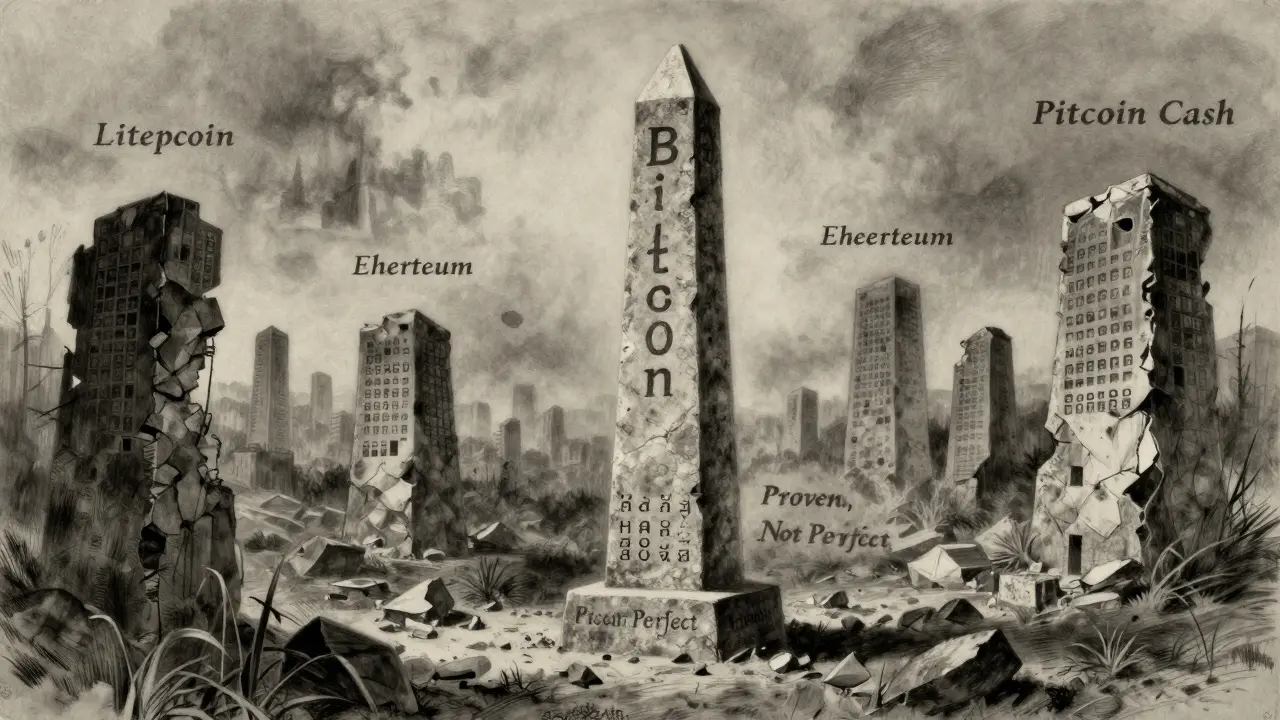
So SHA-256 stays. Not because it’s perfect. But because it’s proven. Because it’s simple. Because it’s worked for 15 years without a single failure.
The Bigger Picture
SHA-256 isn’t just a tool for Bitcoin. It’s the reason Bitcoin exists. Without it, there’s no mining. Without mining, no blockchain. Without the blockchain, no trustless system. It’s the anchor.
Compare it to other blockchains. Ethereum moved to proof-of-stake and ditched hashing altogether. Solana uses a different algorithm. But Bitcoin? It still relies on the same math from 2008. And it’s still the most secure network in crypto history.
That’s not luck. That’s design.
| Blockchain | Hashing Algorithm | Year Adopted | ASIC Resistance | Network Security (Hash Rate) |
|---|---|---|---|---|
| Bitcoin | Double SHA-256 | 2009 | No | 650 EH/s (2024) |
| Bitcoin Cash | Double SHA-256 | 2017 | No | 2.5 EH/s (2024) |
| Litecoin | Scrypt | 2011 | Yes | 600 TH/s (2024) |
| Ethereum (pre-Merge) | Ethash | 2015 | Yes | 1.2 EH/s (2022) |
| Monero | RandomX | 2019 | Yes | 2.5 GH/s (2024) |
Common Misconceptions
- “SHA-256 is outdated.” It’s not. It’s been battle-tested longer than any other crypto hash. No practical attacks exist.
- “ASICs ruin Bitcoin.” They centralize mining, yes. But they also make attacks astronomically expensive. More ASICs = more security.
- “Double hashing is unnecessary.” It prevents length-extension attacks. Without it, you could forge block headers with clever tricks. Double hashing shuts that down.
- “SHA-256 is slow.” It’s not slow. It’s deliberately slow. That’s the point. If hashing were easy, anyone could fake blocks.
What Developers Need to Know
If you’re building a Bitcoin app, you’ll run into SHA-256 everywhere. But there’s a gotcha: byte order. Bitcoin stores hashes backwards. So if you calculate a hash and see a1b2c3..., the blockchain explorer will show ...c3b2a1. It’s confusing at first, but it’s just how Bitcoin does it. The Bitcoin Core codebase has examples in 47 files. The Learn Me A Bitcoin guide explains it clearly.
Also, don’t try to build your own SHA-256 implementation unless you’re ready to spend 8-12 hours learning it. Even then, use a trusted library. One mistake in bit shifting or padding, and your whole system breaks.
Final Thought
Bitcoin doesn’t need to be the most advanced. It needs to be the most reliable. SHA-256 isn’t flashy. It’s not new. But it’s the reason your Bitcoin still exists after 15 years. No hacks. No crashes. No broken hashes. Just one algorithm, running the same way, every single day.
That’s not an accident. That’s intention.
Why does Bitcoin use double SHA-256 instead of just SHA-256?
Bitcoin uses double SHA-256 to prevent length-extension attacks. These are rare but dangerous exploits where an attacker could manipulate a hash by extending its input. By hashing the hash, Bitcoin adds an extra layer of security that makes such attacks practically impossible. This design choice was made early on and has held up without issue for over 15 years.
Can SHA-256 be broken by quantum computers?
Not anytime soon. Current quantum computers have around 1,000 qubits. Breaking SHA-256 would require millions. Experts estimate it would take at least 15-20 years before quantum computers could even attempt it. Even then, Bitcoin could upgrade its hashing algorithm-though no such plan exists today because the risk is too low to justify the disruption.
Why didn’t Bitcoin use Scrypt or Ethash instead?
Scrypt and Ethash were designed to resist ASICs and promote decentralization. But Bitcoin prioritized security and simplicity over mining accessibility. SHA-256 had been thoroughly analyzed by cryptographers for years. Scrypt was newer and less proven. Bitcoin’s goal wasn’t to make mining easy-it was to make the network unbreakable.
Is SHA-256 the reason Bitcoin mining is centralized?
Yes, indirectly. SHA-256’s efficiency made ASICs possible. ASICs are so powerful that only companies with millions in capital can compete. This led to mining being dominated by a few large pools. But this centralization is a trade-off: the same ASICs that centralize mining also make the network incredibly secure. A 51% attack on Bitcoin would cost billions.
Has SHA-256 ever been hacked in Bitcoin’s history?
No. Not once. Not even close. Despite thousands of attempts, no one has found a flaw in SHA-256 that lets them forge blocks, alter transactions, or fake proof-of-work. Even when smaller SHA-256 coins like Bitcoin Cash were attacked, Bitcoin’s massive hash rate made it immune. The algorithm itself has never failed.
Why hasn’t Bitcoin switched to SHA-3 or another algorithm?
Changing the hashing algorithm would require every node and miner to update at the same time. One mistake could split the network. Bitcoin’s codebase has been built around SHA-256 since day one. The cost and risk of switching far outweigh any theoretical benefits. Plus, SHA-256 is still secure. There’s no urgent reason to change.
How does SHA-256 prevent double-spending?
SHA-256 doesn’t prevent double-spending by itself. It enables the system that does. Each transaction is hashed and included in a block. Miners compete to find a valid hash for the block. Once confirmed, changing any transaction would require redoing all the hashes from that point forward. The computational power needed makes it impossible for anyone to rewrite history.
What’s the difference between a hash and a signature in Bitcoin?
A hash turns data into a fixed-size digest-it doesn’t prove ownership. A digital signature uses a private key to prove you control a Bitcoin address. SHA-256 hashes transaction data. ECDSA signatures prove you authorized the spend. They work together: hashing ensures data integrity; signing ensures identity.
Do all Bitcoin forks use SHA-256?
Most do-Bitcoin Cash, Bitcoin SV, and others. But not all. Some forks changed the algorithm to differentiate themselves. However, those that stuck with SHA-256 inherited Bitcoin’s security. Those that switched often became targets for 51% attacks because they had less mining power.
Is SHA-256 used outside of Bitcoin?
Yes. It’s used in TLS/SSL certificates, file integrity checks, password storage (with salt), and government systems. The U.S. government uses SHA-256 for securing classified data. Its widespread adoption outside crypto is why it’s so trusted-it’s been vetted across industries for over two decades.
Next Steps for Learners
- Try hashing your name with SHA-256 using an online tool. Change one letter and see how the output changes.
- Look up a Bitcoin block on a blockchain explorer. Find the block hash and transaction hash. Notice how they’re written backwards.
- Read the Bitcoin whitepaper section on Proof-of-Work. It’s only two paragraphs-but they explain everything.
- Compare SHA-256’s hash rate to other algorithms. See how much more power Bitcoin uses-and why that matters.
omg i just hashed my cat's name and it turned into this crazy string like a magic spell 🤯 i never realized how wild it is that changing one letter flips the whole thing. bitcoin is basically crypto wizardry and i love it
you know what blows my mind the most? that same algorithm is protecting your bank login and government secrets. it's not just for bitcoin. it's the unsung hero of the digital world. no drama no hype just pure math holding everything together 💪
so we're celebrating a 20-year-old algorithm like it's revolutionary? please. sha-256 is the equivalent of using a flip phone in 2024. the fact that bitcoin still clings to it shows how stuck in the past this whole thing is. innovation died in 2009
people think math is neutral but every number chosen here was selected by men in rooms with no transparency. the square roots of prime numbers? sounds like a cult ritual. we're trusting ancient calculations designed by nsa insiders who probably had ulterior motives. this isn't security it's indoctrination
i get why people are attached to sha-256. it's simple. it's proven. but i also wonder if we're romanticizing stability too much. maybe there's a middle ground where we preserve security while allowing room for evolution. not every change has to be a nuclear option
ASICs are the real villain here. they turned mining into a corporate arms race. it's not even about the algorithm anymore. it's about who owns the machines. the whole decentralization dream? dead. we're just pretending while billionaires mine in warehouses under neon lights
the fact that you're all treating sha-256 as some sacred artifact is terrifying. the u.s. government helped design this. the nsa has backdoors in everything. if they wanted to break bitcoin they already have. they're just waiting for the right moment to collapse the entire system. this isn't freedom. it's a trap.
double sha-256? that's just paranoia dressed up as security. you think length-extension attacks are real? they're theoretical. we're adding layers of complexity because we're afraid of ghosts. meanwhile the whole network is running on hardware built by chinese factories with unknown firmware. who's really protecting us?
just wanted to say i tried hashing my grandma's recipe for apple pie. the output was wild. but then i realized - this is how we're securing the future. not with flashy tech but with stubborn, boring, reliable math. that's kind of beautiful in a weird way
soooo... if you change one space in a transaction... it becomes a totally different hash? 😱 that's like magic. i just used a sha-256 generator on my phone and now i feel like a hacker. 🤖💻
you're all missing the point. sha-256's deterministic nature is what enables merkle trees and block validation. without it, you lose logarithmic verification efficiency. the computational complexity isn't a feature - it's the foundation of the entire consensus mechanism. this isn't about nostalgia - it's about information theory
if you think sha-256 is safe you're delusional. every time someone says 'no one has broken it' they're ignoring that the system is only as strong as its weakest link. and the weakest link? the miners. the pools. the corporations. the government. this isn't decentralized. it's a monopoly with a blockchain facade.
While I deeply appreciate the technical rigor of this exposition, I find myself gravely concerned by the ontological implications of relying upon a cryptographic primitive that, while mathematically sound, is nonetheless subject to the anthropogenic constraints of institutional trust. The very notion of a 'trusted' algorithm is, in my view, an oxymoron. Trust, by definition, precludes verification. And verification, in turn, precludes faith. Thus, we find ourselves in an epistemological paradox wherein the security of the network is predicated upon the absence of doubt - a condition which, in human affairs, is invariably ephemeral.