
Have you ever stumbled upon a cryptocurrency that seems to vanish the moment you try to dig deeper? That is exactly what happens when you look into Red The Mal, also known by its ticker symbol RED. It is a digital asset that exists in the shadows of the broader crypto market. Unlike Bitcoin or Ethereum, which dominate headlines and have clear utility, Red The Mal offers almost zero transparency regarding its purpose, team, or technology. Yet, it still has a price, a supply, and a handful of traders who are willing to take the risk.
If you are reading this, you likely saw the name pop up on a tracking site or heard about it from someone chasing high-risk gains. You probably want to know two things: Is this a hidden gem waiting to explode, or is it a dead token with no future? The short answer is that Red The Mal is an extremely illiquid, low-cap asset with significant red flags. It lacks the fundamental pillars that usually sustain a healthy cryptocurrency project.
The Quick Reality Check: Key Takeaways
- Extreme Illiquidity: Daily trading volume is often less than $10, making it nearly impossible to sell large amounts without crashing the price.
- Data Discrepancies: Prices vary wildly between exchanges like Coinbase, CoinGecko, and Bybit, indicating thin order books.
- No Fundamental Info: There is no public whitepaper, development team, or clear use case for the RED token.
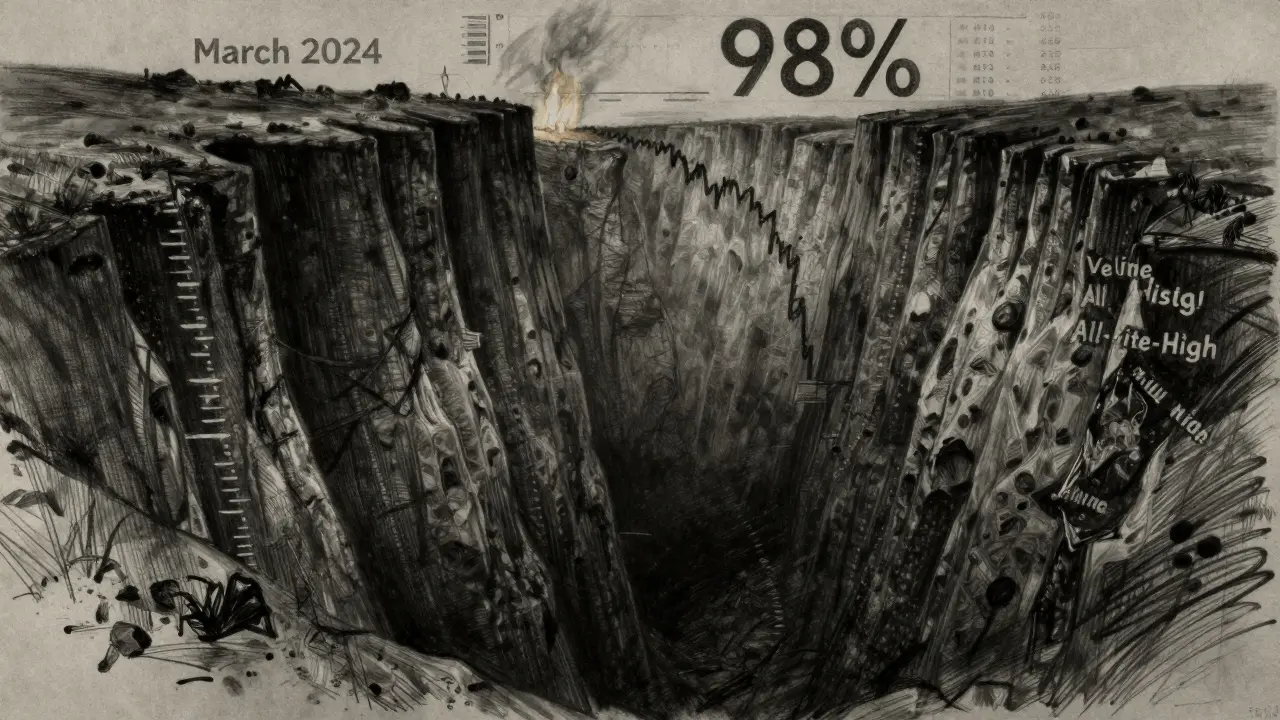
- Massive Decline: The token is down over 98% from its all-time high in March 2024.
- Trading Venue: Most activity occurs on Raydium, a decentralized exchange built on the Solana blockchain.
Who Made Red The Mal? The Mystery Behind RED
In the world of cryptocurrency, trust is built on transparency. We know who created Bitcoin (Satoshi Nakamoto, pseudonymously), we know the teams behind Ethereum and Solana, and we can read their roadmaps. With Red The Mal, there is a complete void. As of May 2026, there is no verifiable information about the founding team, the launch date, or the technical specifications of the network it runs on.
This absence of data is not just a minor oversight; it is a major warning sign. In legitimate projects, even early-stage ones, developers publish a whitepaper or at least maintain an active social media presence explaining their vision. For Red The Mal, search results yield nothing but market data. There are no community forums discussing features, no GitHub repositories showing code updates, and no expert analyses reviewing the tech. This suggests one of two scenarios: either the project is in its very earliest stages with minimal adoption, or it is a dormant token where interest has completely dried up.
It is crucial not to confuse Red The Mal (RED) with other similarly named coins. For instance, there is a different cryptocurrency called Red Coin (RDD), which was designed for peer-to-peer transactions with social media integration. These are entirely separate entities. Mixing them up could lead to buying the wrong asset or misunderstanding the value proposition. Always check the ticker symbol and contract address before transacting.
Supply Mechanics: How Many RED Tokens Exist?
Understanding supply dynamics is essential for evaluating any cryptocurrency. For Red The Mal, the numbers tell a story of scarcity that might seem attractive at first glance but requires careful scrutiny. The total maximum supply cap for RED is set at 99,680,785 tokens. Currently, approximately 99,680,315 tokens exist in total, meaning nearly 100% of the maximum supply is already minted.
The circulating supply-the number of tokens actually available for trade-is reported around 99,659,527 RED. However, even this figure comes with caveats. Some data sources note that circulating supply data is not consistently reported across platforms. This inconsistency is common in micro-cap tokens where wallet distributions may be opaque. If a small number of wallets hold a majority of these 99 million tokens, the market becomes highly susceptible to manipulation. A single large seller could dump their holdings and crash the price instantly, given the lack of buyers.
Price Volatility and Market Data Chaos
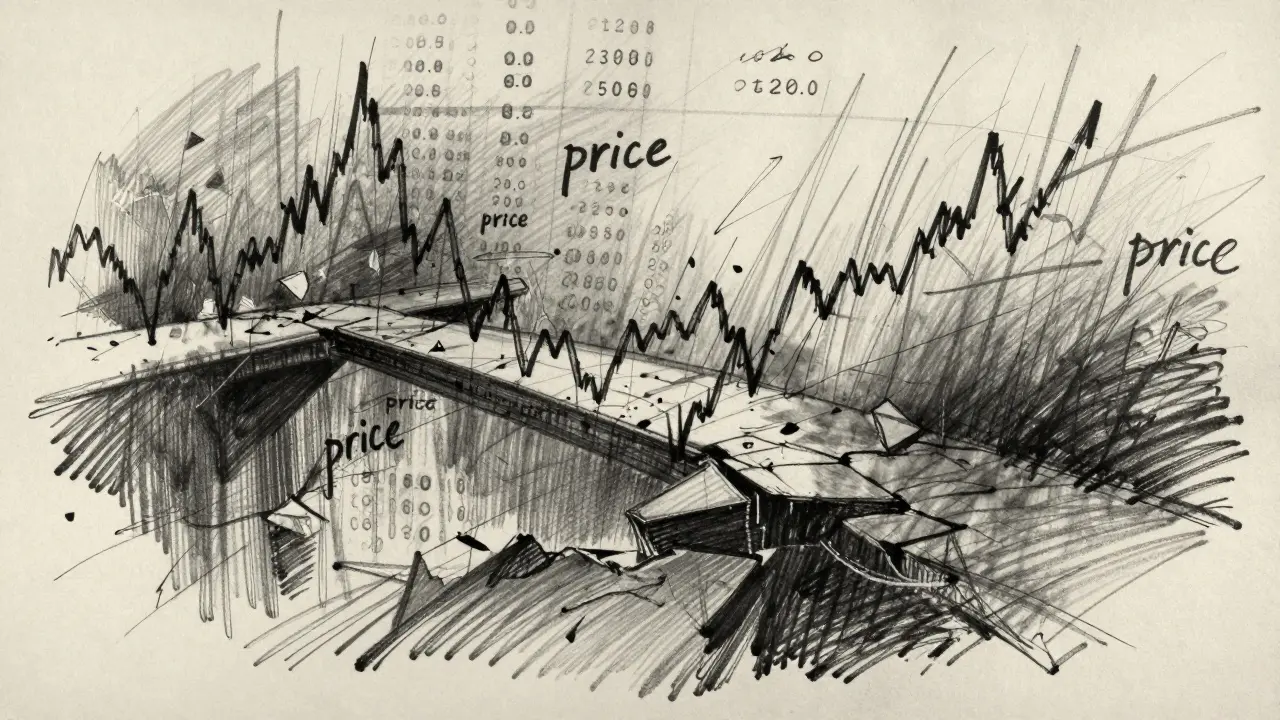
If you check the price of Red The Mal today, you will likely see conflicting numbers depending on which platform you visit. This fragmentation is a hallmark of illiquid assets. Here is how the pricing looks across major trackers as of recent data:
| Platform | Price (USD) | Notes |
|---|---|---|
| Coinbase | $0.000908 | Highest listed price |
| CoinGecko | $0.000284 | Significant discrepancy |
| Crypto.com | $0.000443 | Middle ground |
| Bybit | $0.000271 - $0.000282 | Lowest range |
Why do these prices differ so much? It comes down to liquidity. On deep markets like Bitcoin, the price is consistent everywhere because millions of dollars change hands every second, aligning the price globally. On thin markets like Red The Mal, a single buy order of $50 can spike the price on one exchange while leaving another unchanged. This makes "market price" a relative term rather than a fixed value. For a trader, this means you might buy at $0.0009 on one platform and immediately see your asset valued at $0.0002 on another. You cannot rely on standard arbitrage strategies here because the spreads are too wide and the volumes too low to execute efficiently.
Historical Performance: From Peak to Trough
To understand the risk profile of Red The Mal, we need to look at its history. The token reached its all-time high (ATH) on March 19, 2024, when it traded at $0.0652. Compare that to current levels hovering around $0.0003 to $0.0009. This represents a decline of approximately 98.6%.
A drop of this magnitude is typical for many meme coins or speculative assets that fail to gain traction. However, the fact that it continues to trade at such low volumes after such a massive crash suggests that investor confidence is near zero. There is no "bounce back" narrative currently driving momentum. While some short-term fluctuations occur-such as a 4% increase in 24 hours reported by Coinbase or a 7% weekly gain-these moves are statistically insignificant in the context of a multi-year downtrend. They are noise, not signal.
Liquidity Crisis: Can You Actually Trade RED?
Liquidity refers to how easily you can buy or sell an asset without affecting its price. For Red The Mal, liquidity is virtually non-existent. Let’s look at the trading volume numbers:
- 24-Hour Volume: Ranges from $1.85 to $90.24 depending on the source.
- 7-Day Volume: Approximately $27.20.
- 30-Day Volume: Around $128.79.
Think about that. In an entire month, less than $130 worth of Red The Mal changed hands across all platforms. This is exceptionally low. Even popular altcoins trade in the millions daily. What does this mean for you? If you decide to buy $100 worth of RED, you might be responsible for more than half of the day's entire trading volume. Your purchase alone would drastically inflate the price, creating a false sense of value. Conversely, if you try to sell, you might find no buyers at your desired price, forcing you to accept a fraction of your investment just to exit the position.
The most active trading pair is RED/SOL on Raydium. Raydium is an automated market maker (AMM) on the Solana blockchain. This tells us that RED is likely a SPL token on Solana. Trading on decentralized exchanges (DEXs) like Raydium offers anonymity and ease of access, but it also removes the safety nets found on centralized exchanges like Binance or Coinbase Pro. There is no customer support to help you if something goes wrong, and smart contract risks are inherent.
Note that major centralized platforms like Crypto.com explicitly state that RED is not tradable on their platform. This further isolates the token to niche DEX users who are comfortable navigating complex interfaces and accepting higher risks.
Risk Assessment: Should You Buy RED?
Let’s be direct. Investing in Red The Mal is not investing; it is gambling. And it is gambling with poor odds. Here are the specific risks you face:
- Information Asymmetry: Without a team or roadmap, you have no way to verify if the project is legitimate or a scam.
- Exit Liquidity Risk: With daily volumes under $100, getting your money out is difficult. You might get stuck holding tokens that become worthless.
- Price Manipulation: Low float and low volume make the token easy for "whales" (large holders) to manipulate. They can pump the price briefly to attract buyers, then dump their holdings.
- No Utility: There is no evidence that RED solves any problem or provides any service. It appears to be a speculative vehicle only.
If you are an experienced trader looking for extreme speculation, you might allocate a tiny amount of capital-money you are fully prepared to lose-to track its movements. But for the average investor seeking growth or stability, Red The Mal offers no value. The potential for loss far outweighs the potential for gain.
How to Track Red The Mal Safely
If you still wish to monitor Red The Mal, do so with caution. Do not connect your primary wallet containing significant funds to obscure dApps. Use a burner wallet specifically for high-risk interactions. When checking prices, cross-reference multiple sources. Never trust a single aggregator blindly, as their data feeds can lag or error out due to the thin liquidity.
Keep an eye on the Solana ecosystem trends. Since RED trades against SOL, any major shifts in Solana’s performance or network congestion could indirectly affect the trading experience on Raydium. High gas fees or network outages on Solana could freeze your ability to swap tokens at critical moments.
Is Red The Mal (RED) a scam?
While there is no definitive proof that Red The Mal is a malicious scam, it exhibits many characteristics of high-risk or abandoned projects. The lack of a development team, missing whitepaper, and extreme price decline suggest it may be a "zombie" token or a speculative asset with no real backing. Proceed with extreme caution.
Where can I buy Red The Mal?
Red The Mal is primarily traded on decentralized exchanges, with Raydium being the most active venue. It is not available on major centralized exchanges like Crypto.com. To trade it, you will need a compatible wallet (like Phantom or Solflare) and some Solana (SOL) to pay for transaction fees.
Why is the price of RED different on every website?
The price discrepancies are due to extremely low liquidity. Because very few trades occur daily, each individual transaction can significantly impact the local price on a specific exchange. Aggregators pull data from different sources, leading to varied quotes. This is normal for micro-cap tokens but dangerous for traders expecting price consistency.
What is the total supply of Red The Mal?
The maximum supply cap for Red The Mal is 99,680,785 RED tokens. Nearly 100% of this supply is already in circulation, with approximately 99,659,527 tokens actively circulating. This means no new tokens can be minted, but it also implies that existing holders control the entire market.
Is Red The Mal related to Red Coin (RDD)?
No, they are completely different cryptocurrencies. Red Coin (RDD) is an older project focused on peer-to-peer payments and social media integration. Red The Mal (RED) is a distinct token with no known connection to RDD. Confusing the two can lead to purchasing the wrong asset.
I find the entire premise of chasing 'hidden gems' in crypto to be utterly exhausting and frankly, a bit sad. It is not about being contrarian for the sake of it, but rather recognizing that most of these micro-cap tokens are just digital dust waiting to settle.
You are absolutely correct regarding the liquidity issues! The spread between Coinbase and Bybit is not just a discrepancy; it is a structural failure of the market depth. When you have less than $100 in daily volume, every single trade moves the price by double digits. This makes any technical analysis completely irrelevant because the chart is driven by noise, not signal. Traders need to understand that slippage will eat their entire position if they try to exit quickly.
The moral decay of this industry is palpable when people willingly throw money into black holes like Red The Mal. It is pretentious to think one can outsmart a system designed to bleed retail investors dry. There is no utility here, only greed masquerading as opportunity. I refuse to dignify such speculative garbage with my time or capital. It is a reflection of our collective lack of financial discipline.
Oh, spare me the high horse, Arun. You sound like a broken record playing the same tune about 'moral decay.' If people want to gamble on zombie tokens, let them. It is their money, not yours. Your self-righteousness is tiresome and adds nothing to the conversation. Go back to judging people from your ivory tower.
It is important to maintain a respectful distance from assets that lack fundamental backing. The data presented in the article clearly indicates a severe lack of transparency. One should approach such investments with extreme caution and perhaps consider more established avenues for capital preservation.
hey guys, i was lookin at the contract address on solscan and its pretty bare bones. no renounced ownership either which is a red flag right? the dev wallet still holds like 40% of the supply. thats huge. anyone else check the tokenomics deeper?
Lex is right. The concentration of supply is terrifying. I feel drained just thinking about how many people get rekt by these whale dumps. It is so simple really. The whales buy low, pump it up slightly to attract attention, then dump everything on the latecomers. It is a vampire economy feeding on hope. Why do people keep falling for it?
We must consider the philosophical implications of value in a vacuum. If a token has no utility, no team, and no community, does it truly exist? Or is it merely a symbol of our desire for easy wealth? Red The Mal seems to represent the void where substance should be. It is an exercise in futility.
Your metaphysical musings are irrelevant to the practical reality of market mechanics. The token exists because there is a buyer and a seller, however irrational. To dismiss it as a 'void' ignores the tangible losses incurred by those who engage with it. Precision matters. The risk is real, not abstract.
This is typical Western chaos. No regulation, no oversight, just pure speculation. In India, we are building real tech ecosystems. These ghost tokens are a waste of global resources. Stay away from this nonsense.
Let us not be too harsh on everyone. Some people might just be curious about how decentralized exchanges work. It is okay to learn from mistakes, even small ones. Maybe someone buys $1 worth just to see how Raydium functions. We should encourage safe exploration rather than shutting down curiosity entirely.
Pramendra, you are naive. Curiosity costs lives in finance. I lost thousands on similar scams. Do you think I am joking? This stuff ruins families. Stop sugarcoating disaster.
Hey Harvey! 😊 I hear your pain, and it is valid. Losing money is incredibly stressful. But remember, you are not alone in this journey. Many traders face these challenges. Let us focus on learning from this experience. 💪 You can bounce back stronger if you take breaks and reassess your strategy. Sending good vibes your way! 🌟
Chloe is right! We are all in this together. Let us support each other through the tough times. Knowledge is power, and sharing experiences helps us all grow. Keep your head up! 🚀
Look, the elite circle of traders knows better than to touch this. :P It is beneath us. Stick to blue chips. Don't be foolish.
Bevon is correct. Only the informed survive. Ignorance is expensive. Read the whitepaper if there was one. Since there is none, stay away. It is that simple. No excuses.
On the bright side, at least we have clear data now! The transparency of the risks is actually helpful. Knowing exactly why something is bad helps us avoid it. Let us stay positive and keep learning! :) Every day is a chance to improve our financial literacy!
Just observing from the sidelines. The price action is fascinatingly erratic. It is like watching a stock ticker have a seizure. Not investing, just enjoying the show.
Yeah, it's wild. 📉 Just watch, don't touch. Stay safe everyone! 👍
The technical architecture of Solana allows for such rapid deployment of tokens, which contributes to this clutter. From a developer perspective, the lack of code repositories confirms abandonment. Smart contracts require maintenance. Without updates, vulnerabilities remain unpatched. It is a security risk to interact with dormant codebases.
Felix raises a great point about security. As a fellow observer, I appreciate the detailed breakdown. It helps us understand the underlying risks beyond just price charts. Thank you for sharing your expertise. It makes the community safer.