
Music by Virtuals (MUSIC) isn’t another Bitcoin. It’s not even another Ethereum. It’s a meme token built on the Base blockchain that claims to turn songs and videos into tradeable digital assets. Sounds bold? Maybe. But here’s the cold truth: as of early 2026, MUSIC has lost over 97% of its peak value, trades on just a handful of small exchanges, and has no real proof it’s changing how artists get paid.
What MUSIC Actually Does (On Paper)
The idea behind Music by Virtuals is simple: let creators turn their music into blockchain tokens. Instead of selling a song outright or relying on streaming royalties, you could split ownership of a track into 10,000 MUSIC tokens. Fans buy those tokens, own a piece of the song, and maybe even get royalties or voting rights on future uses. It’s like NFTs for audio - but with more promises and fewer working examples. This isn’t just theory. The project says it’s part of the Virtuals Protocol, which tries to link AI agents, digital avatars, and music IP. In theory, a virtual artist could release a track, tokenize it, and fans trade shares like stocks. Sounds futuristic? Maybe. But no major artist has used it. No record label has signed on. And there’s zero public evidence of a single song being successfully tokenized and monetized this way.Price History: A Rollercoaster With No Riders
MUSIC had its moment. On January 2, 2025, it hit an all-time high of $0.047. That was the peak of hype - fueled by social media buzz, a few influencers, and the general crypto rally of late 2024. By November 27, 2024, it had crashed to $0.0002856. That’s a drop of over 99%. Since then, it’s bounced around between $0.00094 and $0.00142. As of January 2026, it’s trading at roughly $0.0011. That’s still 97.6% below its peak. Why the crash? Simple. The hype ran out. People bought because they saw the price go up, not because they believed in the tech. When the market cooled, there was no real demand left. No utility. No adoption. Just speculation.Supply and Market Stats: Tiny, But Not Invisible
MUSIC has a fixed supply of 1 billion tokens. Almost all of them - 997.6 million - are already in circulation. That means there’s no inflation risk from new minting. But it also means there’s no reserve to stabilize the price. Market cap? Around $1.1 million. That’s less than a single tweet from Elon Musk can move in Bitcoin. Daily trading volume? Between $6,000 and $42,000. For comparison, even small coins like Shiba Inu trade over $100 million daily. There are about 125,000 wallet holders. That’s not nothing - but it’s also not a community. It’s a group of speculators waiting for the next pump. No forums, no developer updates, no roadmap. Just price charts and Discord channels filled with “TO THE MOON” memes.
Where You Can Buy MUSIC (And Where You Can’t)
You won’t find MUSIC on Binance. Or Coinbase. Or Kraken. Not even on KuCoin. Those platforms have strict listing standards - and MUSIC doesn’t meet them. Not because it’s illegal. Because it’s not credible. The only places you can trade it are smaller, less regulated exchanges like MEXC and some decentralized apps on the Base chain. That’s a red flag. Low liquidity means your buy order might not fill. Your sell order might crash the price. Slippage is common. And if you need to cash out fast? Good luck. The contract address is 0xc655...c53504. You can verify it on Base blockchain explorers. But verifying a contract doesn’t mean it’s safe. It just means the code exists.Why MUSIC Isn’t a Real Investment (Yet)
Let’s be clear: MUSIC isn’t a currency. It’s not a payment tool. It doesn’t have staking. It doesn’t have a treasury. It doesn’t pay dividends. It’s not backed by anything tangible. The only value it has is belief. And belief is fragile. When the next meme coin hits Twitter - maybe one tied to a celebrity or a viral TikTok trend - all the money will flood out of MUSIC and into the next shiny thing. The idea of tokenizing music IP? That’s legit. Artists deserve better ways to earn from their work. But MUSIC hasn’t built that. It’s just slapped the word “music” on a meme coin and hoped people would care. Compare it to projects like Audius or Royal, which actually let artists tokenize royalties and give fans real financial stakes. Those have real partnerships, legal structures, and user bases. MUSIC? Nothing.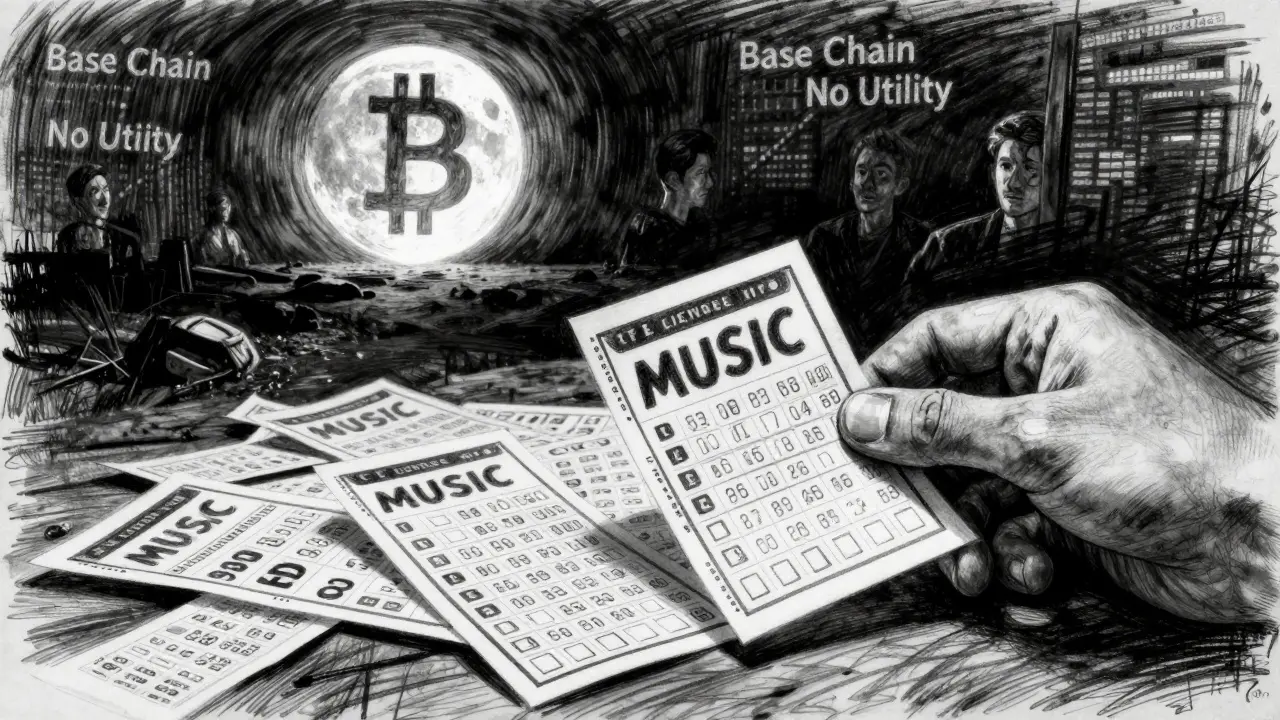
What Could Change Everything?
If MUSIC suddenly announced a deal with a major indie label - say, a band releasing a full album as tokenized tracks with 10% royalties going to holders - that would be news. If a well-known producer started using it to fund their next EP, that would mean something. If the team published a technical whitepaper explaining how royalties are calculated, how ownership is tracked, or how disputes are resolved - that would build trust. None of that has happened. And it’s been over a year since launch.Bottom Line: Don’t Bet on MUSIC
If you’re looking to invest in crypto because you believe in music’s future - look elsewhere. There are real projects solving real problems. If you’re looking for a quick gamble? Sure, you can throw $20 at MUSIC. But treat it like a lottery ticket. Not an investment. Don’t go all-in. Don’t borrow money. Don’t expect it to recover. The music industry needs innovation. But MUSIC isn’t it. Not yet. Maybe never.Is MUSIC coin a good investment?
No, not as a serious investment. MUSIC has lost over 97% of its peak value, has no real utility, and isn’t listed on major exchanges. Its price moves on hype, not fundamentals. Only risk small amounts you can afford to lose.
Can I use MUSIC to buy music or pay artists?
No. There are no known platforms or artists accepting MUSIC as payment. The project claims to tokenize music IP, but no actual music has been successfully tokenized or sold using it. It’s purely a speculative token.
Why is MUSIC not on Binance or Coinbase?
Major exchanges require projects to meet strict standards: clear use cases, active development, legal compliance, and community traction. MUSIC has none of these. It’s a low-volume meme coin with no real product, so it doesn’t qualify for listing.
What’s the total supply of MUSIC?
The maximum supply of MUSIC is 1 billion tokens. As of early 2026, 997.6 million are in circulation, meaning nearly all tokens have been released. There’s no inflation, but also no reserve to support price stability.
Does MUSIC have a team or roadmap?
No public team members, no official website with bios, and no published roadmap exist. The project’s documentation is minimal. Without knowing who’s behind it or what they plan to build next, it’s impossible to assess long-term viability.
Is MUSIC based on Ethereum?
No. MUSIC runs on the Base blockchain, which is built by Coinbase and uses Ethereum’s security but with lower fees. This makes it cheaper to trade but doesn’t add any value to the token itself.
Can I stake MUSIC to earn rewards?
No. There are no staking, yield farming, or reward programs for MUSIC. The token has no mechanism to generate passive income. Any site claiming otherwise is likely a scam.
What’s the difference between MUSIC and NFTs for music?
NFTs for music are usually one-of-a-kind digital collectibles - like a signed album cover or a limited edition track. MUSIC is a fungible token, meaning each unit is identical and tradeable like a stock. The goal of MUSIC is fractional ownership, not collectibility. But unlike real music NFT platforms, MUSIC hasn’t delivered on either.
Has anyone made money from MUSIC?
Yes - early buyers who bought under $0.005 and sold near the January 2025 peak made big profits. But those days are over. Most people who bought after the peak are underwater. The token’s low liquidity makes it hard to exit without losing value.
Should I buy MUSIC because it’s cheap?
No. A low price doesn’t mean a good deal. A $0.001 coin can stay at $0.001 forever - or drop to $0.0001. What matters is utility, demand, and credibility. MUSIC has none of these. Buying because it’s cheap is like buying a broken watch because it’s $5 instead of $500.
It’s not even a bad investment-it’s not an investment at all. It’s a digital campfire where people shouted ‘TO THE MOON’ until the wood ran out.