

Have you seen the ticker GOLD pop up on your exchange and wondered what it actually does? You aren't alone. In the crowded world of cryptocurrency, names like "GoldenBoys" sound promising, but they can also be confusing. Is it backed by real gold? Is it just another joke coin? Or is there some actual technology behind it?
The short answer is that GoldenBoys (GOLD) is a bit of everything-and nothing at all. It’s an ERC-20 token deployed on the Base blockchain, designed to mix decentralized finance utility with internet meme culture. But before you click "buy," you need to understand that this isn't Bitcoin. It isn't even a major altcoin like Ethereum. It is a micro-cap asset with extremely thin liquidity, meaning prices can swing wildly or stop moving entirely.
The Core Identity: What Actually Is GoldenBoys?
To understand GOLD, you have to look past the name. The project describes itself as a hybrid. On one side, it leans into the world of Decentralized Finance (DeFi), aiming for integration with protocols like Balancer. On the other side, it embraces the chaotic energy of meme coins.
Technically, the main version of GoldenBoys lives on Base, a layer-2 network built on top of Ethereum. This choice matters. Base offers faster transaction speeds and lower fees than the main Ethereum network, which makes it attractive for smaller projects trying to get traction. The smart contract was written in Solidity v0.8.20 and deployed back in August 2023. That’s nearly three years ago in crypto time, yet the token remains relatively obscure.
The supply model is fixed. There are exactly 1,000,000 GOLD tokens in existence. No more will ever be minted. This non-inflationary cap is a standard feature for many modern tokens, intended to create scarcity. However, scarcity only creates value if people want to buy the asset. Currently, demand appears very low.
The Ticker Trap: Why You Might Be Looking at the Wrong Coin
Here is where things get tricky. If you search for "GOLD" or "GoldenBoys" on blockchain explorers, you won’t find just one coin. You’ll find several unrelated contracts sharing the same name and ticker symbol. This fragmentation is a major risk for investors.
| Attribute | GoldenBoys (Base Chain) | GoldenBoys (Ethereum Legacy) | Golden Boys (Ethereum Alt) |
|---|---|---|---|
| Blockchain | Base (Layer 2) | Ethereum Mainnet | Ethereum Mainnet |
| Total Supply | 1,000,000 | 358,267 | 2,000,000,000 |
| Known Holders | Low (Thinly Traded) | ~67 | ~459 |
| Primary Use Case | DeFi Utility / Meme | Unclear / Experimental | Unclear / Experimental |
| Liquidity Status | Very Low | Negligible | Negligible |
The table above highlights the confusion. The Ethereum-based versions have supplies ranging from 350k to 2 billion tokens. They have dozens or hundreds of holders, but almost no trading volume. When data aggregators show a price of $0.00000000 for GOLD, they are likely tracking one of these dead or dormant Ethereum contracts, not the active Base chain version.
If you intend to trade the active GoldenBoys, you must verify the contract address. Buying the wrong version means you likely own a token that cannot be sold anywhere.
Market Reality: Liquidity and Price Volatility
Let’s talk about money. As of mid-2026, GoldenBoys is listed on several platforms, including Bybit, Coinbase, LCX, and Crypto.com. Seeing a listing on Coinbase often gives retail traders a false sense of security. Just because an exchange lists a token doesn’t mean it is liquid.
The numbers tell a stark story. On Bybit, the 24-hour trading volume for GOLD has been reported as low as $1.15 USD. Yes, one dollar. At a price point hovering around $0.82 to $1.82 (depending on the fiat currency and exchange), a market cap of roughly $800,000 sounds substantial until you realize almost nobody is buying or selling.
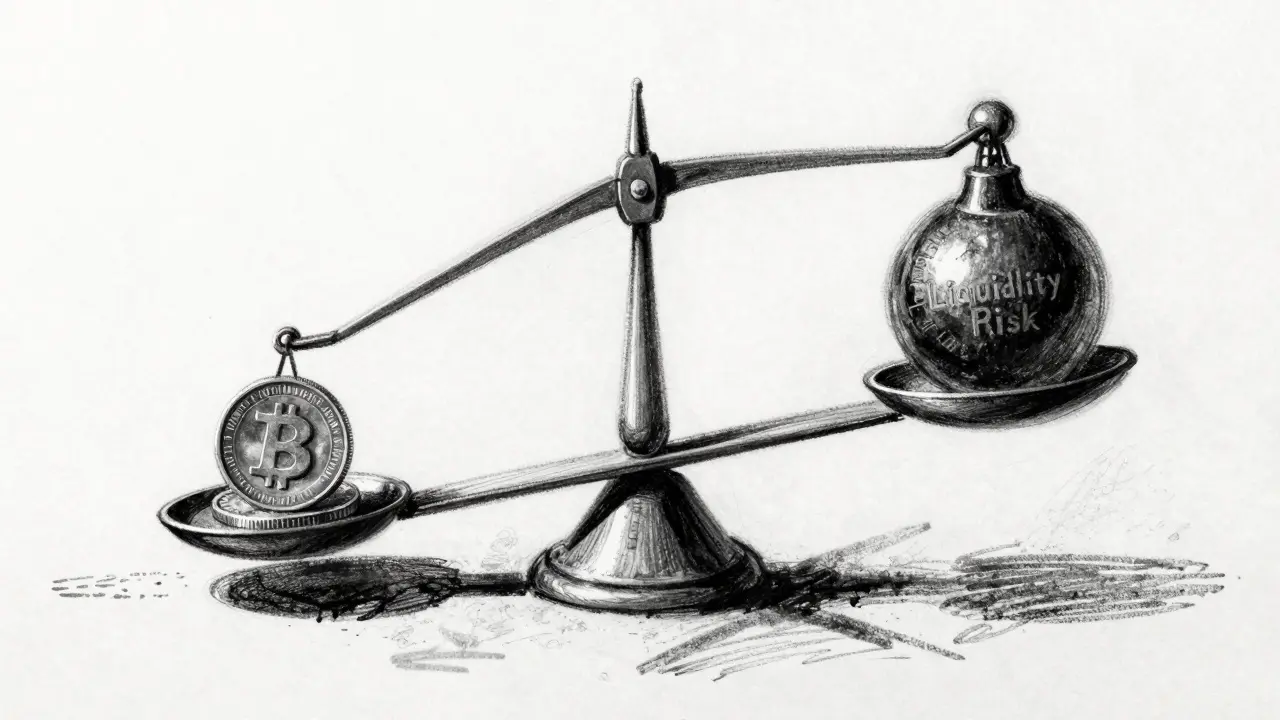
This lack of liquidity is dangerous. Imagine you buy 1,000 GOLD tokens. If you try to sell them quickly, there may not be enough buyers on the order book to absorb your sale. Your sell order could crash the price significantly, or worse, fail to execute entirely. Other platforms like Bitget and CoinPaprika have shown zero volume and zero price for periods, indicating that trading activity is sporadic at best.
Cross-listings exist in multiple currencies-USD, CAD, EUR, and BRL-but the valuations are consistent only when you account for exchange rates. The underlying issue remains the same: there is very little active interest in this asset compared to major cryptocurrencies.

Utility vs. Hype: Does It Do Anything?
Proponents of GoldenBoys argue that it bridges the gap between boring DeFi tools and fun meme culture. The stated goal is to integrate with the Balancer ecosystem. Balancer is an automated market maker (AMM) protocol. In theory, GOLD could be used in liquidity pools, offering yield to providers who hold both GOLD and another asset.
However, evidence of this utility is scarce. There is no publicly available whitepaper detailing specific fee structures, governance rights, or staking rewards. Most descriptions on exchanges are generic marketing copy: "Buy, sell, convert, and invest." This is boilerplate text applied to thousands of assets on platforms like Coinbase.
Without a clear roadmap or published technical documentation, it is hard to distinguish between genuine development and vaporware. The absence of independent security audits is another red flag. In DeFi, code is law. If the smart contract has vulnerabilities, users’ funds are at risk. Since no major audit firms have published reports on the GoldenBoys contract, users are essentially trusting the anonymous developers implicitly.
Risks and Regulatory Context
Trading micro-cap tokens like GOLD carries significant risks beyond just losing money. First, consider the regulatory landscape. While LCX, a regulated exchange in Liechtenstein, lists GOLD, this does not mean the token itself is approved by securities regulators like the SEC or ESMA. It simply means LCX has decided to list it.
Second, look at the information asymmetry. Major research houses do not cover GOLD. Forbes listings sometimes misidentify such tokens as exchanges due to automated template errors. There are no academic papers or deep-dive technical blogs analyzing its long-term viability. You are operating in the dark, relying on fragmented data from exchanges that may not even be tracking the correct contract.
Finally, the "meme" aspect introduces behavioral risk. Meme coins are driven by community sentiment and social media trends, not fundamentals. If the online buzz dies down-which happens quickly for niche projects-the price can collapse to near zero with no recovery in sight.
How to Approach Trading GoldenBoys
If you are determined to explore GoldenBoys despite the risks, follow these practical steps to protect yourself:
- Verify the Contract Address: Never rely solely on the ticker symbol "GOLD." Copy the exact contract address from a trusted source like the official Base block explorer or the exchange’s detailed asset page. Double-check it against known scam addresses.
- Check Liquidity Depth: Before buying, look at the order book. Are there buy orders waiting below the current price? If the spread is wide or the depth is shallow, expect high slippage.
- Use Small Positions: Treat any investment in GOLD as speculative capital you can afford to lose completely. Do not leverage it.
- Monitor Multiple Sources: Don’t trust a single exchange’s price. Compare prices across Bybit, Coinbase, and LCX to ensure you aren’t getting a bad deal due to isolated volatility.
- Secure Your Wallet: If you move GOLD off-exchange to a self-custody wallet, ensure your wallet supports Base chain ERC-20 tokens. MetaMask and similar wallets work well for this, but you must configure the network settings correctly.
Final Thoughts on the GOLD Token
GoldenBoys (GOLD) occupies a strange niche in the 2026 crypto market. It is too small to matter for institutional investors, too complex for casual meme-chasers who prefer simpler narratives, and too under-documented for serious DeFi enthusiasts. It exists in the gray area between a failed experiment and a dormant community project.
The technology stack-Base chain, ERC-20 standard-is solid and compatible with modern infrastructure. The problem isn’t the tech; it’s the adoption. Without a growing user base, active liquidity pools, or clear utility beyond speculation, GOLD remains a high-risk, low-reward asset. For most investors, sticking to established tokens with transparent roadmaps and deep liquidity is a safer bet. But if you enjoy hunting for hidden gems and accept the possibility of total loss, GOLD offers a tiny slice of the wild west of decentralized finance.
Is GoldenBoys (GOLD) backed by physical gold?
No. Despite the name and ticker, GoldenBoys is not backed by physical gold. It is a digital token whose value is determined purely by market supply and demand, similar to other meme or utility tokens.
Which blockchain is GoldenBoys on?
The primary and most active version of GoldenBoys is deployed on the Base blockchain, a Layer-2 solution for Ethereum. There are older, less active versions on the Ethereum mainnet, but they are distinct assets.
Why is the trading volume for GOLD so low?
GoldenBoys is a micro-cap token with limited adoption. Low trading volume indicates that few people are actively buying or selling it, which leads to high volatility and difficulty executing large trades.
Can I buy GoldenBoys on Coinbase?
Yes, Coinbase lists GoldenBoys (GOLD). However, availability may vary by region, and the liquidity on the platform might still be thin compared to major cryptocurrencies.
What is the maximum supply of GOLD?
The maximum supply of the Base-chain GoldenBoys token is capped at 1,000,000 tokens. This supply is fully issued, meaning no new tokens will be created.
Is GoldenBoys a safe investment?
No investment in micro-cap tokens is considered safe. GOLD lacks extensive auditing, has low liquidity, and faces competition from larger projects. It should be viewed as highly speculative.
Does GoldenBoys have a whitepaper?
There is no widely accessible or prominent whitepaper for GoldenBoys. Most information comes from exchange listings and brief descriptions, lacking detailed technical specifications or economic models.