
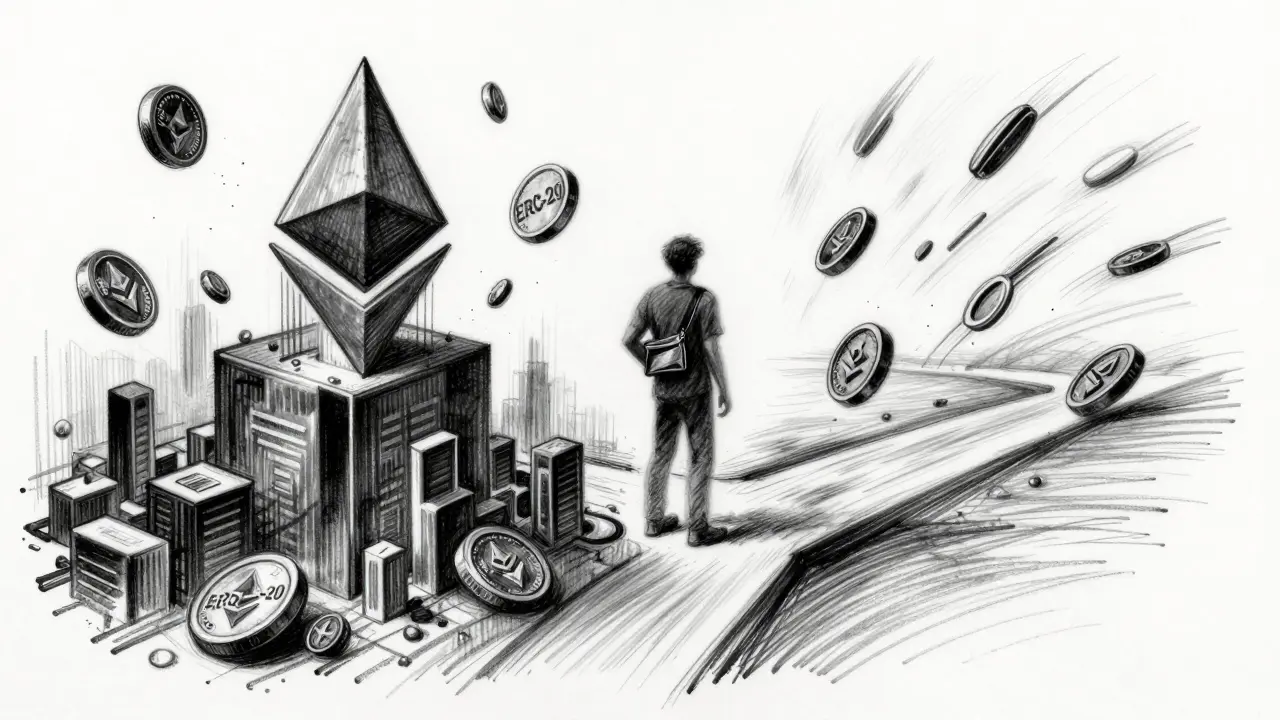
You want to trade tokens on Uniswap v2 using the Binance Smart Chain (BSC) network.
Here is the hard truth: you can’t. That combination doesn’t exist.
This is one of the most common mix-ups in the crypto world right now. Uniswap v2 is built exclusively for the Ethereum blockchain. If you are looking for a decentralized exchange that runs on BSC, you are actually looking for PancakeSwap.
Mixing these two up can cost you real money. You might try to connect your wallet to the wrong network, send funds to an incompatible address, or pay high Ethereum gas fees when you could have paid pennies on BSC. Let’s clear this confusion once and for all so you know exactly which tool fits your job.
The Core Confusion: Uniswap vs. PancakeSwap
To understand why you can't use Uniswap on BSC, we have to look at how decentralized exchanges (DEXs) work. A DEX isn't just a website; it's a set of smart contracts living on a specific blockchain. These contracts talk to each other, but they generally cannot talk directly to contracts on a completely different blockchain without complex bridges.
Uniswap v2 launched in November 2018 as an upgrade to the original Uniswap protocol. It was designed from the ground up to interact with ERC-20 tokens on Ethereum. Its code is hardcoded to listen to Ethereum events.
Binance Smart Chain (now often called BNB Chain) is a separate blockchain. It uses its own token standard, BEP-20. While BSC is compatible with Ethereum tools (meaning you can use MetaMask on both), the underlying ledgers are distinct. Therefore, the Uniswap smart contracts do not exist on BSC.
If you need to trade on BSC, PancakeSwap is the direct equivalent. It clones the Uniswap model but adapts it for BSC’s speed and low costs. Think of Uniswap as the Apple Store experience (premium, secure, expensive) and PancakeSwap as the budget-friendly alternative (fast, cheap, widely used).
Deep Dive: How Uniswap v2 Actually Works
Since you asked about Uniswap v2, let’s review what makes it special on Ethereum. It uses an Automated Market Maker (AMM) model. This means there is no order book. There are no buyers waiting to match sellers. Instead, you trade against a pool of liquidity provided by other users.
When you swap Token A for Token B, you pull Token B out of the pool and push Token A into it. The price changes automatically based on the ratio of assets in the pool. This ensures liquidity is always available, even for obscure tokens.
Uniswap v2 introduced two killer features that changed DeFi:
- Flash Swaps: This allows you to borrow any amount of tokens from a pool without upfront collateral. You must return the borrowed amount plus a fee by the end of the transaction. If you can’t repay, the transaction reverts. This is mostly used by bots for arbitrage-buying low on one exchange and selling high on another instantly.
- Oracle Functionality: Uniswap provides Time-Weighted Average Price (TWAP) data. Other protocols use this to get a reliable price feed that is harder to manipulate than a single spot price check.
These features make Uniswap v2 powerful, but they come with a catch: the Ethereum network is slow and expensive during peak times.
The Cost Problem: Gas Fees Explained
This is where most users get burned. On Ethereum, every action costs "gas." Miners process transactions, and you pay them in ETH. When the network is busy, gas prices skyrocket.
On Uniswap v2, a simple token swap might cost $5, $50, or even $100 in gas fees depending on congestion. If you are trying to swap $20 worth of tokens, paying $10 in fees is a 50% loss before you even consider slippage.
In contrast, transactions on BNB Chain typically cost less than $0.10. This is why retail traders prefer BSC for small trades. The difference isn't just convenience; it's economic viability.
| Feature | Uniswap v2 | PancakeSwap |
|---|---|---|
| Blockchain | Ethereum | Binance Smart Chain (BSC) |
| Token Standard | ERC-20 | BEP-20 |
| Avg. Transaction Fee | $5 - $100+ (Variable) | $0.05 - $0.20 (Stable) |
| Block Time | ~12 seconds | ~3 seconds |
| Liquidity Depth | Very High (Institutional grade) | High (Retail focused) |
| Native Token | UNI | CAKE |
Security and Trust: Who Is Safer?
Security is subjective in crypto. Both platforms are non-custodial, meaning you control your private keys. Neither company holds your funds. However, their security profiles differ due to their underlying chains.
Ethereum has the largest network of auditors and developers. The Uniswap v2 contracts have been battle-tested since 2018. They are considered extremely secure. The risk here is usually user error (sending funds to the wrong address) or phishing sites pretending to be Uniswap.
BSC is faster but has historically had more bridge hacks and centralization concerns because it relies on a smaller set of validators. However, PancakeSwap itself has maintained a strong security record. They regularly audit their code and offer bug bounties.
For large institutional trades (millions of dollars), Ethereum/Uniswap remains the gold standard due to deeper liquidity and higher trust in the base layer. For daily trading of smaller amounts, BSC/PancakeSwap offers sufficient security at a fraction of the cost.
User Experience: Wallets and Interface
Using either platform requires a Web3 wallet like MetaMask, Trust Wallet, or the official Uniswap Wallet.
The interface for Uniswap v2 is clean and minimal. You paste a token address, enter an amount, and click Swap. It’s straightforward. However, if you are new to crypto, the concept of "slippage tolerance" can be confusing. Slippage is the difference between the expected price and the executed price. On volatile tokens, you may need to increase this setting to ensure your trade goes through.
PancakeSwap’s interface is similar but includes more gamification elements, such as yield farming dashboards, lotteries, and NFT collections. This can be overwhelming for beginners but appealing to degens looking for extra yield.
One critical tip: Always double-check the URL. Scammers create fake domains like `uniswap-v2.com` or `pancakeswap-official.net`. Always bookmark the official sites (`app.uniswap.org` and `pancakeswap.finance`) to avoid draining your wallet.
Which One Should You Choose?
Your choice depends entirely on what you are holding and what you want to do.
Choose Uniswap v2 (Ethereum) if:
- You hold ERC-20 tokens (like USDC, WETH, or UNI) and don't want to bridge them.
- You are making large trades ($10,000+) where deep liquidity minimizes price impact.
- You prioritize maximum security and established track records over speed.
Choose PancakeSwap (BSC) if:
- You hold BEP-20 tokens (like BNB, CAKE, or BUSD).
- You are making small to medium trades where gas fees matter.
- You want faster transaction confirmations.
- You are interested in yield farming and staking rewards.
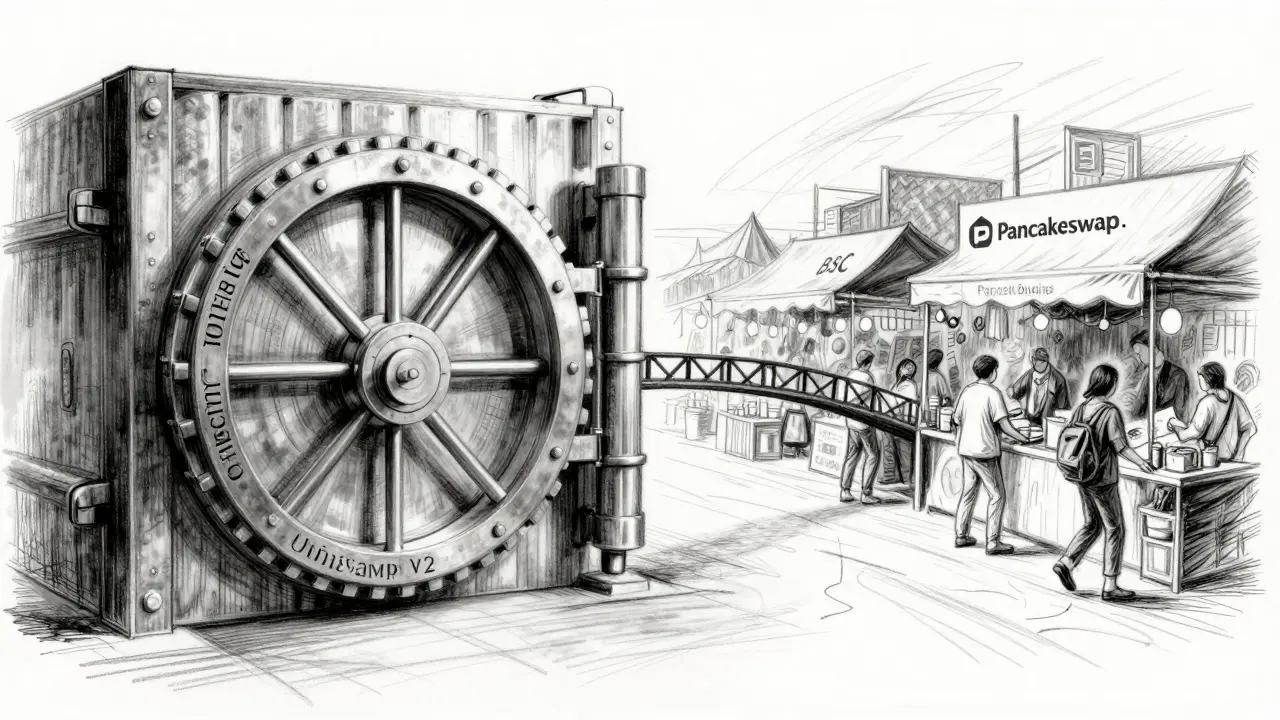
If you have Ethereum tokens but want to trade on BSC, you must first use a bridge service (like the official BNB Bridge or third-party options like Multichain/Rubic) to convert your ERC-20 tokens to BEP-20 tokens. This process takes time and incurs fees, so factor that into your decision.
Frequently Asked Questions
Can I use Uniswap v2 on Binance Smart Chain?
No. Uniswap v2 is built specifically for the Ethereum blockchain. It interacts only with ERC-20 tokens. To trade on Binance Smart Chain, you should use PancakeSwap, which is the BSC equivalent of Uniswap.
Is Uniswap v2 safer than PancakeSwap?
Both platforms are highly secure and non-custodial. However, Ethereum (Uniswap's home) has a larger decentralized validator network, making it theoretically more resistant to attacks. BSC (PancakeSwap's home) is faster but more centralized. For most users, the risk lies in user error or phishing, not platform failure.
Why are gas fees so high on Uniswap?
Gas fees on Uniswap are determined by the Ethereum network, not Uniswap itself. When many people use Ethereum simultaneously, miners raise prices to prioritize transactions. This makes small trades expensive. BSC has much lower demand per block, keeping fees near zero.
What is the difference between ERC-20 and BEP-20 tokens?
ERC-20 is the token standard for Ethereum, while BEP-20 is the standard for Binance Smart Chain. They are not interchangeable. You cannot send an ERC-20 token directly to a BEP-20 address. You must use a bridge to convert them between networks.
Should I use Uniswap v2 or v3?
If you are a trader, v3 offers better capital efficiency and tighter spreads but is more complex. V2 is simpler and still widely used for its reliability. Most users today interact with v3 interfaces, but the core mechanics remain similar. For BSC, stick to PancakeSwap v2 or v3 depending on your comfort level.