
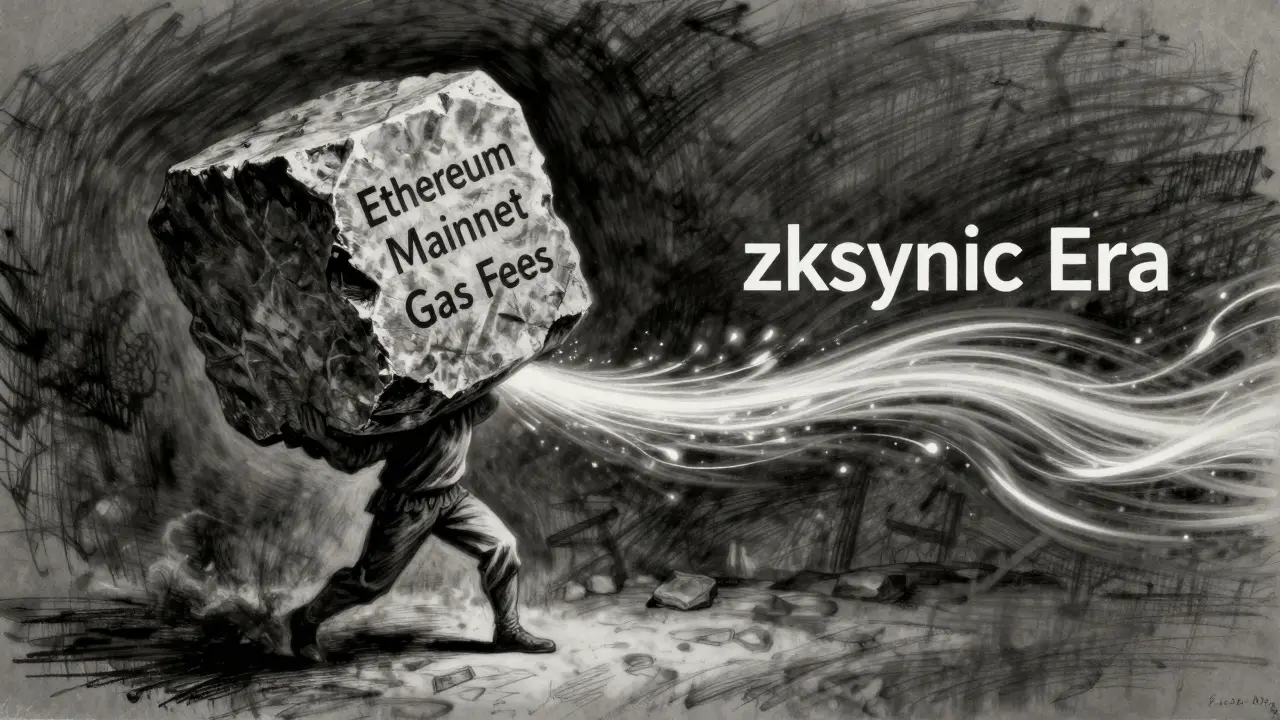
Most people trying to get into decentralized finance (DeFi) on Ethereum eventually hit a wall: the gas fees. It is a frustrating experience to find a great project only to realize the transaction cost is higher than the trade itself. This is why SyncSwap is a decentralized exchange (DEX) built on the zkSync Era network that uses zero-knowledge rollups to make trading fast and incredibly cheap. By shifting the heavy lifting off the main Ethereum chain, it manages to keep fees as low as a penny without sacrificing the security that makes Ethereum the gold standard.
Key Takeaways
- Market Leader: Dominates the zkSync ecosystem with over 35% market share.
- Extreme Efficiency: Leverages zkRollups for near-instant finality and minimal gas costs.
- Multi-Chain Reach: Now supports not just zkSync Era, but also Scroll, Linea, Taiko, and Sophon.
- High Liquidity: Boasts a Total Value Locked (TVL) regularly fluctuating between $63 million and $82 million.
- Upcoming Token: A native SYNC token is planned with a fixed supply of 100 million.
How SyncSwap Actually Works
At its core, SyncSwap is an Automated Market Maker (or AMM), a type of exchange that uses mathematical formulas to price assets instead of a traditional order book. This means you aren't waiting for a specific buyer or seller to match your price; you're trading against a pool of assets provided by other users.
The real magic happens because it sits on zkSync Era, a Layer 2 scaling solution that bundles thousands of transactions together and proves their validity to Ethereum using zero-knowledge proofs. This architecture allows the platform to handle billions in volume-over $8 billion to date-while keeping the interface snappy. If you've ever used a DEX on the Ethereum mainnet and waited minutes for a confirmation, the speed here will feel like a breath of fresh air.
Is it Better Than the Competition?
When you look at the zkSync landscape, SyncSwap isn't just another player; it's the house. While other DEXs struggle to find a footing, SyncSwap has captured roughly 37% to 40% of the chain's total TVL. This is a big deal because high liquidity means less slippage-that annoying gap between the price you expect and the price you actually get during a trade.
| Feature | SyncSwap | Standard L2 DEX |
|---|---|---|
| Market Share | ~35-40% | Low to Moderate |
| Network Support | Multi-chain (Scroll, Linea, etc.) | Single chain focus |
| Typical Fees | Often < $0.01 | Variable L2 fees |
| Ecosystem Tools | Integrated Launch Pad | Basic Swapping |

Making Money with Liquidity Providing
For those not just looking to swap tokens, SyncSwap offers a way to put your idle assets to work. By becoming a liquidity provider, you deposit pairs of tokens into the AMM pools. In exchange, you earn a slice of the trading fees. In the early days, some pools saw wild APRs of 1,700%, though those were outliers. Today, you can still find highly attractive rates, such as the OT and USDC pair which has hovered around 94.1%.
However, you need to be aware of impermanent loss. This happens when the price of your deposited assets changes significantly compared to when you deposited them. It's the primary risk of providing liquidity in any AMM. If you're a conservative investor, sticking to stablecoin pairs is usually the safest bet to avoid this volatility.
The SYNC Token and Airdrop Speculation
One of the most talked-about topics in the community is the native SYNC token. The team has confirmed a total supply of 100 million tokens. While they haven't dropped a specific date for the launch or an official airdrop announcement, the pattern in DeFi is pretty clear: early adopters, heavy traders, and consistent liquidity providers are usually the ones rewarded.
The SYNC token is expected to move the platform toward a governance model. This means holders could potentially vote on which pools get more incentives or how the protocol evolves. For users, this transforms the experience from just using a tool to actually owning a piece of the infrastructure.

Beyond Swapping: The SyncSwap Launch Pad
SyncSwap is positioning itself as a "one-stop-shop DeFi hub." A key part of this strategy is the SyncSwap Launch Pad. Instead of new projects having to struggle to find liquidity from scratch, they can use this facility to tap into the existing user base and infrastructure of the DEX. This creates a virtuous cycle: more quality projects launch on the platform, which attracts more users, which in turn provides more liquidity for the next project.

Practical Steps to Get Started
If you've never used a Layer 2 DEX, the process is straightforward, but there are a few hurdles to watch out for:
- Set up a compatible wallet: You'll need a wallet like MetaMask or Rabby that supports the zkSync Era network.
- Bridge your funds: Use the official zkSync bridge to move ETH from the Ethereum mainnet to the Era network. This is the most expensive step because you're paying a mainnet fee.
- Connect to SyncSwap: Head to the platform and connect your wallet. Ensure you are on the correct network (Era, Scroll, etc.) depending on where your funds are.
- Execute your trade: Select the token you have and the one you want. Check the slippage tolerance in the settings-usually 0.5% is fine for major pairs, but you might need to increase it for volatile new tokens.
Is SyncSwap safe to use?
SyncSwap is built on zkSync Era, which inherits the security of the Ethereum mainnet via zero-knowledge proofs. The protocol is open-source and has handled over $8 billion in volume, which suggests a high level of operational stability. However, as with all DeFi, you face smart contract risk and the potential for impermanent loss if you provide liquidity.
What are the transaction fees on SyncSwap?
Thanks to the zkRollup technology of zkSync Era, fees are significantly lower than on Ethereum. Many swaps cost only a few cents, often as low as one penny, depending on network congestion.
Which networks does SyncSwap support?
While it started as a zkSync Era exclusive, SyncSwap has expanded its multi-network support to include Scroll, Linea, Taiko, and Sophon.
When will the SYNC token be released?
The development team has confirmed the token's existence and a total supply of 100 million, but they have not yet announced a specific release date or airdrop schedule.
What is the difference between a DEX and a CEX?
A Centralized Exchange (CEX) like Coinbase requires you to deposit funds into their account. A Decentralized Exchange (DEX) like SyncSwap allows you to trade directly from your own wallet, meaning you always maintain control of your private keys.
Troubleshooting and Final Tips
If you find that your transaction is "stuck" or failing, the first thing to check is your ETH balance. Even though fees are low, you must have a small amount of native ETH on the specific Layer 2 network you are using to pay for the gas. You cannot pay for a zkSync transaction using ETH held on the main Ethereum chain.
For those moving large sums, avoid trading everything in one go during periods of extreme volatility. Even with SyncSwap's deep liquidity, a massive trade can push the price in an unfavorable direction. Breaking your trade into smaller chunks over a few minutes can often result in a better average entry price.
Bridging is always the most tedious part of the L2 experience, but it is a necessary evil for the speed you get in return.
definitely agree with the bridging part just a bit of a pain at first but once you're over it the fees are a total game changer
The low fees are great for people who just want to trade small amounts without losing half their portfolio to gas.
Sure, "low fees" is the bait. These L2s are just centrally managed honey-pots for the elites to rug us. Just wait until the sequencer goes dark and you realize your "security" is just a pinky promise from some dev in a hoodie. Total cabal move to fragment liquidity across five different chains just to keep us chasing airdrops while they print the real money. It is all a simulated game designed to keep the plebs in line using fancy jargon like zero-knowledge proofs to hide the fact that they actually control the keys. Wake up people, the centralized nature of these rollups is a ticking time bomb and the SYNC token will just be another pump-and-dump scheme to exit liquidity into the hands of the venture capitalists who orchestrated this whole circus from the start. Honestly, the only way to be safe is cold storage on mainnet even if it costs a fortune, because at least you aren't trusting a middleman who can freeze your funds on a whim based on some arbitrary "compliance" rule. Don't be fooled by the shiny UI and the penny fees because the real cost is your sovereignty and the complete erosion of what Bitcoin actually started. It is a circus and we are the clowns paying for the tickets with our own hard-earned crypto.
Imagine thinking a sequencer is a global conspiracy. It is just a piece of software, not a shadow government.
Sandeep is right. The sheer ignorance of some people here is staggering. I have analyzed the architecture of zkSync and it is objectively superior to these paranoid fantasies. India is producing some of the best blockchain developers who actually understand how this works, unlike some people who just read conspiracy blogs. If you can't handle the technical nuances of L2s, maybe you should stick to saving coins in a physical jar under your bed.
It is truly lamentable to witness such hostility in a space meant for financial liberation. 😔 We must remember that greed is the root of all instability, and chasing airdrops is merely a modern form of digital avarice. ⚖️
Oh, the absolute tragedy of it all! Imagine the sheer, unadulterated agony of waiting three minutes for a mainnet transaction to clear. My soul practically shrivels in anticipation of the SYNC token launch, and the suspense is simply eating me alive! It is a rollercoaster of emotions and I am just clinging for dear life to the hope of a massive airdrop!
Let's just ride the wave and see where this goes! 🚀 The potential for the SYNC token to bring actual governance is such a huge leap forward for the community!
I really think it's wonderful that more people are finding ways to get into DeFi without needing to be millionaires first, and SyncSwap seems to be doing a great job of opening those doors for everyone regardless of where they are from in the world. It is just so inspiring to see technology lower the barriers to entry so that a student in a small village or a retiree in a big city can all participate in the same financial ecosystem with the same low fees, which is what the original dream of the internet was all about anyway.
its just crazy how we think about money now like we just shift numbers across a screen but its actually a whole new way of thinking about value and society and i love how l2s make it feel like the future is already here even if we dont all lapped the concepts yet lol
The multi-chain expansion is an absolute power move! SyncSwap is basically colonizing the L2 space with an aggressive level of efficiency that I find genuinely impressive!
For anyone confused about the ETH balance issue, just remember to keep a small buffer on the L2 chain so you don't get stranded.
Solid overview.