

Imagine borrowing $10 million to buy Bitcoin, selling it for a profit, and paying back the loan-all before your coffee gets cold. That is the power of flash loans, which are uncollateralized loans that must be repaid within a single blockchain transaction block. If you fail to repay, the entire transaction reverts as if it never happened. It sounds like magic, but it is actually smart contract code.
In 2026, flash loans have moved past their experimental phase. They are no longer just toys for early adopters; they are institutional-grade tools powering the backend of global decentralized settlement. But here is the hard truth: making money with them is harder than ever. The easy money is gone. Today, profitability depends on speed, low fees, and sophisticated strategy rather than just finding obvious price gaps.
How Flash Loans Actually Work
To understand the profitability, you first need to understand the mechanics. A flash loan allows you to borrow assets from a liquidity pool without putting up any collateral. The catch? You must return the borrowed amount plus a small fee within the same transaction block.
This atomicity is what makes them risk-free for lenders. If your strategy fails-if you don’t make enough profit to cover the repayment-the smart contract automatically reverses the action. You lose only the gas fee paid to the network. This mechanism eliminates counterparty risk, allowing protocols to lend out massive sums of capital instantly.
The primary platforms facilitating this in 2026 include Aave, which dominates due to its deep liquidity and support across Ethereum and Layer 2 networks. Another key player is Balancer, which distinguishes itself by offering zero-fee flash loans. This distinction is critical when executing strategies with thin margins, where even a small percentage fee can wipe out potential profits.
The Core Strategy: Cross-Exchange Arbitrage
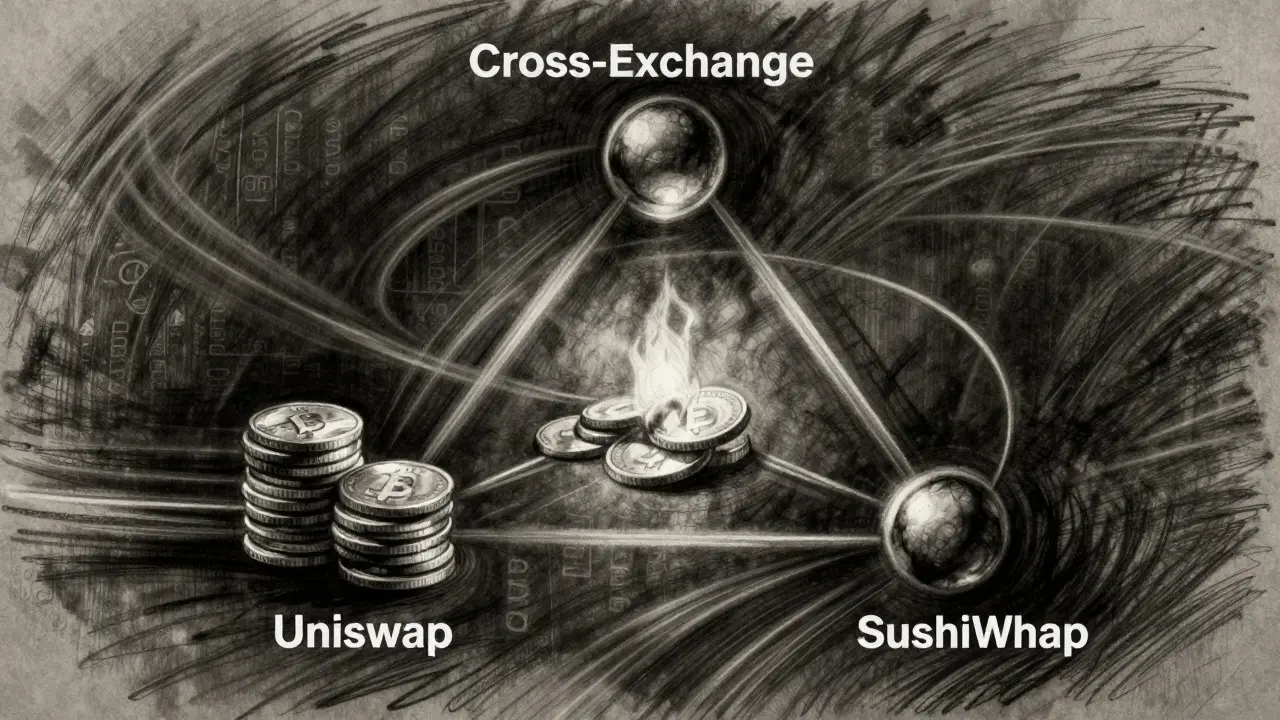
Cross-exchange arbitrage remains the most straightforward and widely adopted flash loan strategy. The concept is simple: find a token trading at different prices on two different decentralized exchanges (DEXs), buy it where it is cheap, sell it where it is expensive, and keep the difference.
Here is how a realistic 2026 scenario might look:
- Identify Discrepancy: You notice Ethereum (ETH) is trading at $3,450 on Uniswap but $3,500 on SushiSwap.
- Borrow: You take a flash loan of $345,000 worth of ETH from Aave.
- Buy Low: You use the loan to buy 100 ETH on Uniswap at $3,450 each.
- Sell High: You immediately sell those 100 ETH on SushiSwap at $3,500 each.
- Repay & Profit: You repay the $345,000 loan plus the 0.09% Aave fee ($310.50) and pay network gas costs. The remaining balance is your profit.
In this example, the gross difference is $5,000. After fees and gas, you might net around $4,600. Sounds great, right? The problem is that these large, obvious gaps are rare. Hundreds of automated bots scan the market milliseconds after prices diverge. By the time a human sees the opportunity, a bot has likely already executed the trade.
Triangular Arbitrage: Exploiting Price Triangles
When cross-exchange opportunities dry up, traders turn to triangular arbitrage. This strategy involves three cryptocurrency trades within a single transaction to exploit price discrepancies across three different token pairs on a single exchange.
For instance, you might start with USDC, swap it for ETH, then swap ETH for DAI, and finally swap DAI back to USDC. If the conversion rates between these pairs are slightly misaligned, you end up with more USDC than you started with. This method is particularly useful when coordinating across separate exchanges is too costly or complex due to high gas fees or bridge delays.
Liquidity Provision and Yield Farming
Arbitrage isn't the only way to make money. Some strategies focus on collecting fees directly from the protocol.
Liquidity Provision via Flash Loans: You borrow a large sum, deposit it into a liquidity pool on a DEX like Uniswap or Balancer, collect a proportionate share of the trading fees generated during that specific transaction block, withdraw your liquidity, and repay the loan. Profits per transaction are modest, but doing this repeatedly in high-volume pools can accumulate meaningful returns. This works best in lower-liquidity pools with high demand, where your deposited funds represent a larger percentage of the total pool, capturing a disproportionately larger fee share.
Yield Farming Amplification: This involves borrowing funds via flash loan, depositing them into yield farming protocols that offer immediate reward distributions, collecting the reward tokens, selling them for profit, and repaying the loan. Crucially, this only works for limited-time incentive programs or immediate distribution mechanisms. Long-term yield farming is incompatible with flash loans because the loan must be repaid in the same block.
Defensive Strategies: Collateral Swapping
Not all flash loan usage is about generating new profit; some is about preserving existing capital. Collateral swapping allows users to protect DeFi loan positions from liquidation during sudden price declines.
If the value of your collateral drops dangerously close to the liquidation threshold, you can use a flash loan to acquire alternative collateral, repay your existing position, and migrate your debt to a different protocol or asset class within a single transaction. This eliminates the risk of losing your principal to liquidation penalties during temporary volatility spikes.
The Cost Factor: Gas Fees and Platform Charges
Profitability is heavily dictated by costs. In 2026, the choice of blockchain is just as important as the strategy itself.
| Network | Avg. Gas Cost | Liquidity Depth | Best For |
|---|---|---|---|
| Ethereum | High ($5 - $50+) | Very High | Large volume arbitrage |
| Arbitrum | Low ($0.10 - $1) | High | Frequent small trades |
| Optimism | Low ($0.10 - $1) | High | Frequent small trades |
| Solana | Very Low (<$0.01) | Medium | High-frequency micro-arbs |
| BNB Chain | Low ($0.10 - $0.50) | Medium | Specific BSC-based tokens |
Ethereum commands the most extensive DeFi liquidity but charges substantially higher gas fees. Layer 2 solutions like Arbitrum and Optimism offer dramatically reduced transaction costs while maintaining Ethereum security guarantees. This makes them increasingly attractive for strategies where gas costs eat into thin margins. Solana offers near-instant finality and negligible fees, making it ideal for high-frequency strategies, though its ecosystem is less interconnected than Ethereum’s.
Security and "Flash Loan 2.0"
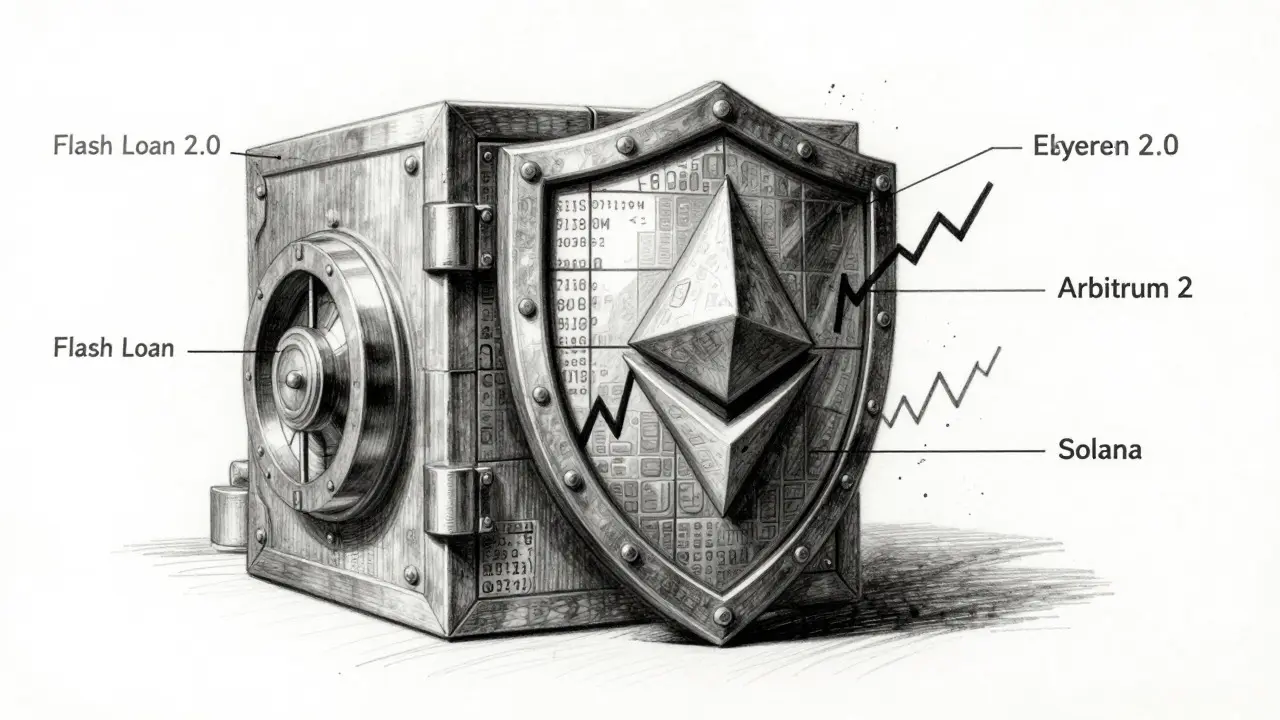
As profitability becomes harder to achieve, security becomes paramount. The 2026 landscape emphasizes "Flash Loan 2.0" standards. These incorporate integrated oracle protections and reentrancy guards to mitigate sophisticated price manipulation attacks.
Historically, attackers used flash loans to manipulate the price of an asset on a thin liquidity pool, tricking other protocols into lending against inflated values. Modern platforms now prioritize robust security frameworks. Academic analysis indicates that while flash loans facilitate high-efficiency arbitrage, they necessitate advanced security layers. Top-tier platforms are shifting toward standardized audit protocols to legitimize these instruments as regulatory clarity improves.
Is It Still Profitable in 2026?
Yes, but the barrier to entry has shifted from capital to technology. You no longer need millions in cash to start; you need a well-optimized bot system. Consistent profitability typically derives from executing numerous small trades repeatedly over extended periods, accumulating profits through volume rather than magnitude.
Single successful cross-exchange arbitrage transactions might generate anywhere from several hundred to several thousand dollars. However, relying on infrequent large trades is a recipe for failure in today’s competitive environment. Thousands of competing bots operate simultaneously, meaning execution speed and optimization are your only real advantages.
For the average retail trader, the complexity of coding and deploying these bots may outweigh the potential gains. For developers and institutional participants, however, flash loans remain a vital liquidity instrument that powers the backend of the global decentralized settlement layer.
What is the minimum amount needed to start a flash loan strategy?
Technically, you need zero capital for the loan itself. However, you need enough cryptocurrency to pay for gas fees. On Ethereum, this could range from $10 to $100 depending on network congestion. On Layer 2s like Arbitrum or Solana, gas fees are fractions of a cent, making the entry cost nearly negligible.
Are flash loans safe for beginners?
They are financially safe because if the transaction fails, you only lose the gas fee. However, they are technically complex. Beginners often struggle with smart contract development and the rapid pace of market changes. It is recommended to start with testnets before risking mainnet gas fees.
Which platform is best for zero-fee flash loans?
Balancer is known for offering zero-fee flash loans. This can be advantageous for strategies with very thin margins where even Aave's 0.09% fee would consume the entire profit. However, always check the current liquidity depth on Balancer compared to Aave for your specific asset pair.
Can I use flash loans to leverage long-term investments?
No. Flash loans must be repaid within a single transaction block, which takes seconds. They are unsuitable for long-term holding strategies. They are designed for instantaneous actions like arbitrage, collateral swapping, or liquidations.
How do gas fees impact flash loan profitability?
Gas fees are the primary overhead cost. On Ethereum, high gas fees can render small arbitrage opportunities unprofitable. This is why many traders prefer Layer 2 networks like Arbitrum or Optimism, where gas costs are significantly lower, allowing for profitable execution of smaller margin trades.
What is triangular arbitrage?
Triangular arbitrage involves trading three different currency pairs on a single exchange to exploit pricing inefficiencies. For example, swapping USDC to ETH, then ETH to DAI, and finally DAI back to USDC, aiming to end up with more USDC than you started with.
Do I need to write code to use flash loans?
Yes. Flash loans are executed via smart contracts. You need to write and deploy a custom smart contract that defines the logic of your strategy (borrow, trade, repay). While some user interfaces exist for simple interactions, profitable strategies usually require custom-coded bots for speed and efficiency.
What are the risks of flash loan attacks?
The primary risk for borrowers is losing gas fees on failed transactions. For protocols, the risk is price manipulation if oracle protections are weak. However, modern "Flash Loan 2.0" standards have largely mitigated major attack vectors by implementing better reentrancy guards and oracle checks.