Imagine holding a Bitcoin wallet that suddenly becomes frozen because it touched a sanctioned address three years ago. This isn't science fiction; it is the daily reality for thousands of users navigating the OFAC sanctions list, which now tracks over 1,200 specific cryptocurrency wallet addresses as of 2025. The Office of Foreign Assets Control (OFAC), operating under the U.S. Department of Treasury, has evolved from targeting banks to hunting down digital footprints on blockchains. If you hold crypto, trade on DeFi platforms, or run an exchange, understanding how these lists work is no longer optional-it is essential for keeping your assets safe.
The core problem is simple: money moves fast, but compliance often lags behind. OFAC’s mandate is to prevent designated individuals, entities, and countries from accessing the U.S. financial system. In the crypto world, this means identifying specific wallet addresses across 17 different networks, from Bitcoin (XBT) to Ethereum (ETH) and even privacy coins like Monero (XMR). The stakes are high. Missing a sanctioned address can lead to heavy fines, frozen assets, or legal action. Let’s break down exactly what is on the list, how it works, and what you need to do to stay compliant.
What Is the OFAC Crypto Sanctions List?
At its heart, the Specially Designated Nationals (SDN) list is a database of people, companies, and yes, crypto wallets, that are banned from doing business with the U.S. When OFAC adds a crypto address to this list, it effectively freezes any funds in that wallet if they touch the U.S. financial system. But here is the catch: unlike a bank account, a crypto wallet doesn’t have a name attached to it by default. It is just a string of characters.
This creates a unique challenge. Traditional sanctions target institutions-banks, corporations, governments. Crypto sanctions must identify specific pseudonymous addresses across multiple blockchain networks. As of 2025, the list covers 17 major cryptocurrencies, including stablecoins like USD Coin (USDC) and USD Tether (USDT), which are heavily used for cross-border transfers. The expansion is rapid. In January 2025, OFAC began sanctioning Decentralized Autonomous Organizations (DAOs) and protocols without formal governance structures. This was a massive shift, signaling that even decentralized systems are not immune to regulatory reach.
The technical backbone of this system is the sdn_advanced.xml file. This XML feed is the source of truth for compliance teams. It contains detailed metadata about each sanctioned entity, including their names, aliases, and associated wallet addresses. For developers and compliance officers, parsing this file is the first step in building any screening tool. The data is updated frequently, sometimes multiple times a week, meaning static lists become obsolete almost instantly.
How Wallet Screening Works in Practice
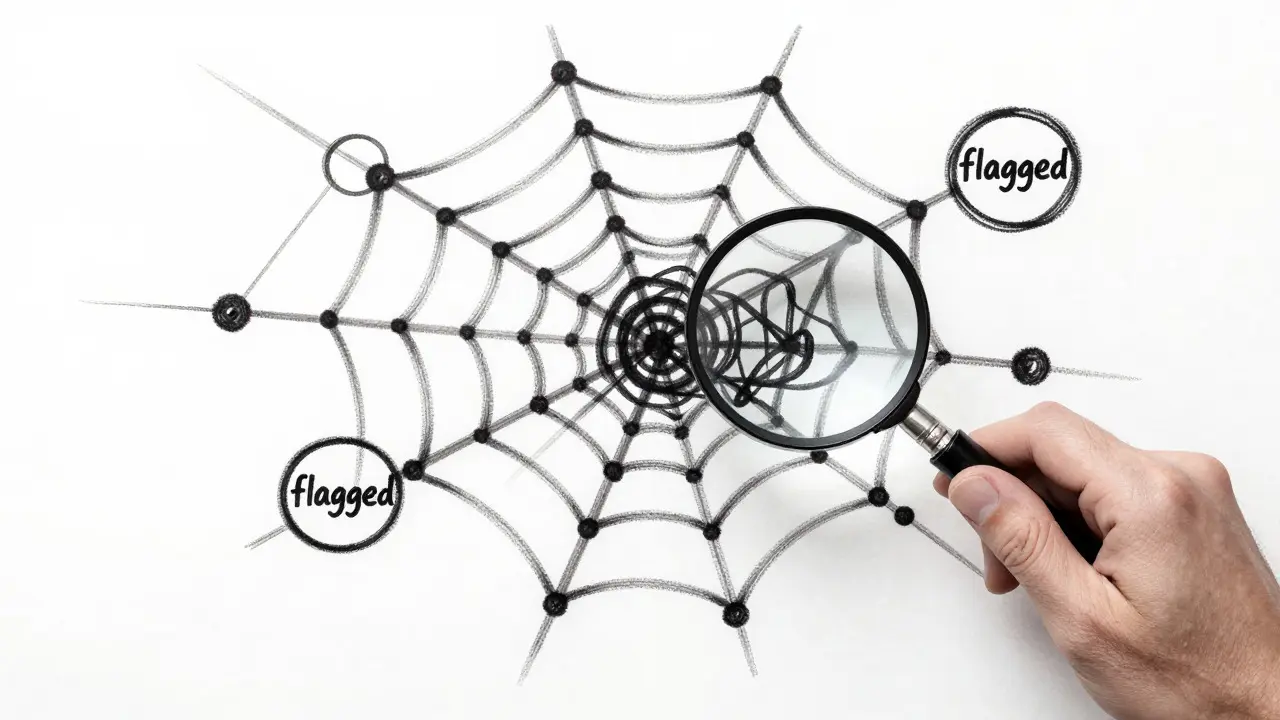
So, how does a random user end up flagged? It usually comes down to transaction history. Blockchain analysis firms use sophisticated algorithms to trace funds. If your wallet receives funds from a known sanctioned address, your wallet might be tagged as "high risk." This doesn’t mean you are guilty, but it means you are on the radar.
In March 2025, OFAC endorsed three new wallet screening technologies specifically designed for DeFi platforms. These tools look at more than just direct transfers. They analyze complex interactions between smart contracts. For example, if you swap tokens on Uniswap using funds that originated from a sanctioned Lazarus Group heist, the screening software can flag that interaction. The goal is real-time monitoring. Platforms like Scorechain have achieved update times as fast as 15 minutes after an OFAC release, setting the industry standard for speed.
Here is a practical breakdown of what screening systems check:
- Direct Matches: Does your wallet address appear exactly on the SDN list?
- Indirect Exposure: Have you received funds from a sanctioned address within the last N blocks?
- Mixing Services: Did your funds pass through a known mixer or tumbler associated with illicit activity?
- Stablecoin Flows: Are there large USDT or USDC transfers linked to sanctioned Iranian or Russian entities?
The introduction of Layer 2 network support in the OFAC Blacklist v2.0 (launched May 2025) addressed a critical gap. Previously, many users moved funds to Arbitrum or Optimism to hide their trails. Now, those transactions are visible and screenable. This means hiding on a sidechain is no longer a viable strategy for evading detection.
Real-World Cases: From Garantex to AI Bots
Theory is one thing, but real-world enforcement shows the teeth of the system. Consider the case of Garantex, a darknet exchange sanctioned in 2022. After being hit with sanctions, its executives tried to continue operations through a successor exchange called Grinex. In March 2025, U.S., German, and Finnish law enforcement jointly seized over $26 million in cryptocurrency controlled by Garantex. Indictments were unsealed against executives Aleksandr Mira Serda and Aleksej Besciokov. This demonstrated that international cooperation is key to catching sanctioned entities who try to hop between jurisdictions.
Another striking example involves the Lazarus Group, the North Korean state-sponsored hacking collective. In Q1 2025, they moved $200 million in stolen assets through sanctioned DeFi protocols. Because these protocols lacked traditional KYC (Know Your Customer) checks, the group assumed they were safe. They were wrong. The immutable nature of the blockchain allowed investigators to trace the flow of funds back to the initial hack, leading to further designations.
Perhaps the most futuristic case occurred in February 2025, when OFAC sanctioned an AI-powered autonomous trading bot. This bot was used by a sanctioned entity to launder $60 million. This was the first time an artificial intelligence system was directly targeted by sanctions. It signals a new frontier: if your algorithm trades with bad actors, the algorithm itself can be penalized.
| Case Name | Date | Key Action | Asset Value | Notable Feature |
|---|---|---|---|---|
| Garantex / Grinex | March 2025 | Seizure & Indictment | $26M+ | International raid (US, DE, FI) |
| Lazarus Group | Q1 2025 | Tracing via DeFi | $200M | Nation-state actor using DEXs |
| AI Trading Bot | February 2025 | Sanctioned Entity | $60M | First AI system sanctioned |
| Tether Freeze | March 2025 | Asset Freeze | $450M | Stablecoin linked to Iran |
Compliance for Exchanges and Users
If you run a crypto exchange or a DeFi protocol, compliance is no longer a checkbox; it is a continuous operation. The Crypto Compliance Guidance 2025 mandates real-time monitoring for all U.S.-based exchanges. This means integrating OFAC’s XML feeds into your backend infrastructure. The learning curve for implementing comprehensive screening systems typically ranges from 3 to 6 months, requiring investment in both technology and specialized personnel.
For individual users, the risk is lower but not zero. You don’t need to worry about every minor transaction, but you should be cautious about receiving large amounts of unknown crypto. Here are some best practices to keep your wallet clean:
- Check Before You Receive: Use free online tools to scan incoming addresses against the SDN list before accepting large transfers.
- Avoid Privacy Coins for Large Transfers: While Monero offers privacy, it is also heavily scrutinized. Large XMR movements often trigger manual reviews.
- Keep Records: Maintain a clear record of where your funds came from. If you bought your BTC from Coinbase, you have a paper trail. If you got it from a P2P deal with a stranger, you don’t.
- Monitor News: Follow OFAC announcements. New designations happen weekly. Knowing who is newly sanctioned helps you avoid accidental exposure.
One major pain point is the false positive rate. Because blockchain analysis relies on probabilistic models, you might get flagged simply because you traded on a popular exchange that also handles sanctioned funds. In such cases, having documentation ready is crucial. Be prepared to prove the origin of your funds if a compliance team reaches out.
The Future: Smart Contracts and Global Coordination
Where is this heading? The proposed regulations from May 2025 suggest that smart contract developers could be held liable for enabling sanctions evasion. This is a game-changer for DeFi. Currently, if a developer writes a contract that accidentally allows a sanctioned entity to move funds, the blame falls on the user or the platform. Under these new rules, the code itself could be a liability. Developers will need to build in compliance checks directly into their smart contracts.
Internationally, coordination is tightening. The joint directive released by OFAC and the Financial Action Task Force (FATF) in April 2025 aims to standardize crypto sanctions enforcement globally. This reduces the ability of sanctioned entities to jump from one jurisdiction to another. With six international raids conducted in 2024 alone, the era of hiding in offshore crypto hubs is coming to an end.
Looking ahead, expect the scope to expand further. Privacy coins, emerging Layer 2 solutions, and even metaverse economies are likely targets. The long-term viability of the current framework depends on OFAC’s ability to adapt to rapidly evolving technology while maintaining international cooperation. For now, the message is clear: transparency is the only way to stay safe.
What happens if I send crypto to a sanctioned address?
If you send crypto to a sanctioned address, your funds may be frozen if they enter the U.S. financial system. Even if they don’t, your wallet might be flagged as high-risk by exchanges and compliance tools, making it difficult to sell or transfer your assets later. It is best to verify recipient addresses before sending large sums.
Do privacy coins like Monero help evade OFAC sanctions?
Not really. While Monero hides transaction details, it is heavily monitored by OFAC. Large movements of XMR often trigger manual investigations. Furthermore, most centralized exchanges require KYC, so you can’t easily off-ramp privacy coins without revealing your identity. The permanent nature of blockchain records still provides clues for investigators.
How often is the OFAC crypto list updated?
The list is updated frequently, often multiple times a week. Major compliance platforms aim to sync changes within 15 minutes of an official release. For businesses, relying on a static CSV file downloaded once a month is risky and non-compliant with the 2025 guidance.
Are DAOs subject to OFAC sanctions?
Yes. Since January 2025, OFAC has expanded its criteria to include DAOs and decentralized protocols without formal governance structures. If a DAO’s treasury holds sanctioned assets or facilitates transactions for designated entities, it can be targeted.
What is the difference between the SDN list and the OFAC Blacklist?
The SDN (Specially Designated Nationals) list is the primary legal document containing sanctioned individuals and entities. The "OFAC Blacklist v2.0" refers to the enhanced technical database and alert system launched in May 2025, which includes real-time alerts and better support for Layer 2 networks. They are closely related, with the Blacklist serving as the operational tool for screening.