

Have you ever searched for a new place to trade Bitcoin, only to find an app that promises the world but delivers... nothing? You type in iExchange, expecting a platform where you can buy, sell, and hold your digital assets. Instead, you might be looking at something entirely different. This is exactly what happens when users stumble upon iExchange in 2026. It sounds like a legitimate exchange, right? But if you dig just a little deeper, the picture changes completely.
The biggest trap here isn't a hidden fee or a slow withdrawal process. The trap is identity. Most people assume iExchange is a centralized cryptocurrency exchange (CEX) similar to Binance or Coinbase. They aren't. In reality, the primary entity known as "iExchange" available on major app stores is actually a mobile application designed primarily as a cryptocurrency calculator and currency converter. It does not facilitate actual trades. It doesn't hold your funds. It doesn't connect you to the blockchain. If you are looking to invest your hard-earned money, confusing a calculator with a bank is a costly mistake.
What Is iExchange Really?
Let’s clear up the confusion immediately. When you search for "iExchange" on the iOS App Store, you will likely find an app titled iExchange: Crypto Calculator. This application is rated 18+ and markets itself as a tool to help you "dive deep into market trends" and "monitor capitalization." That’s it. It is a utility app, much like a weather forecast app tells you it might rain, but it doesn’t bring an umbrella to your house.
For beginners entering the crypto space in 2026, this distinction is critical. A calculator app provides data visualization. It helps you convert $100 USD into its equivalent in Ethereum based on current market prices. However, it lacks the core infrastructure of a trading platform. There is no order book. There are no trading pairs like BTC/USD or ETH/GBP. There is no fiat gateway to deposit real money. If you try to click "Buy" on a true exchange, you enter a payment flow. On iExchange, you simply see a number change on your screen.
This mislabeling creates a significant risk. Users often download these apps because they look professional. The interface might feature sleek charts and dark modes that mimic professional trading terminals. But without the backend infrastructure-servers connected to liquidity pools and banking partners-you are just looking at a simulation. Always check the developer name and the app description carefully. If it says "Calculator," "Converter," or "Tracker," it is not an exchange.
Why You Need a Real Exchange (And Not Just a Calculator)
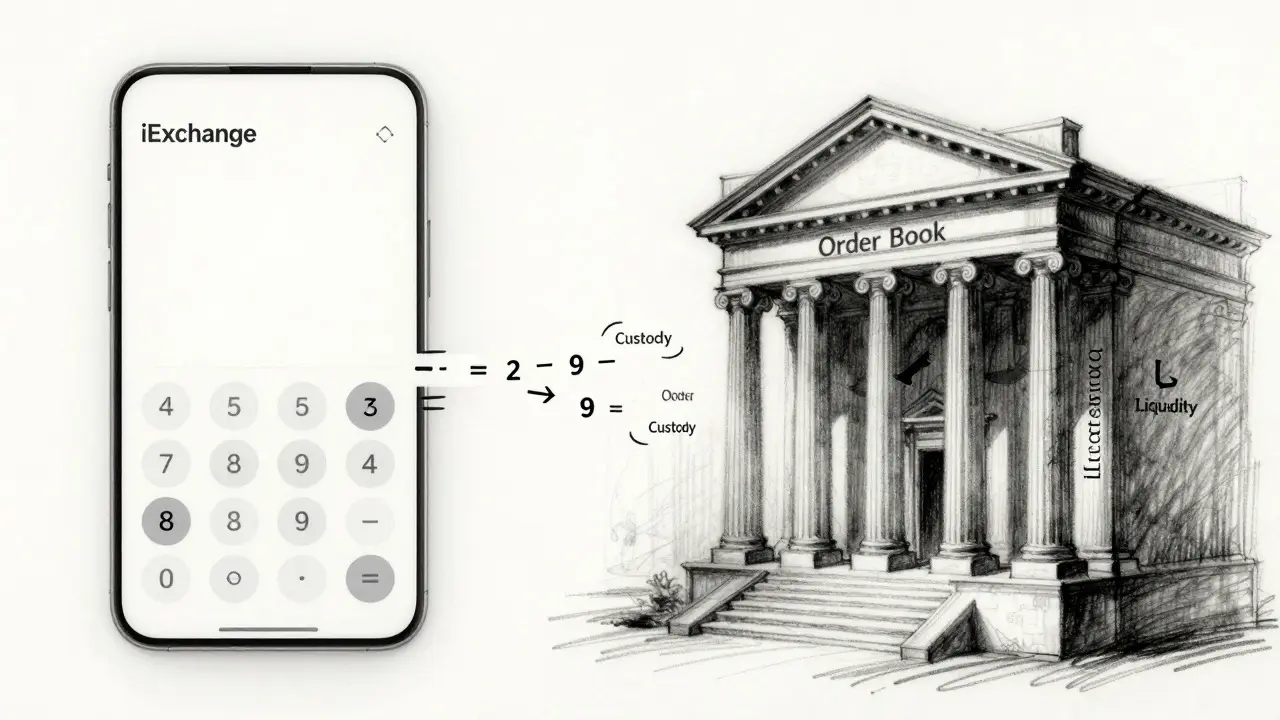
To understand why iExchange falls short for investors, we need to look at what a legitimate cryptocurrency exchange actually does. Established platforms like Kraken, Coinbase, or Binance provide a suite of services that go far beyond calculation.
- Order Books: Real exchanges match buyers with sellers. You see the depth of the market, allowing you to place limit orders at specific prices.
- Fiat Gateways: You need a way to move money from your bank account into crypto. Legitimate exchanges have partnerships with banks and payment processors to handle KYC (Know Your Customer) and AML (Anti-Money Laundering) compliance.
- Custody and Security: When you buy crypto on a real exchange, it is stored in wallets. These platforms use cold storage (offline wallets) to protect the majority of user assets from hackers.
- Liquidity: High-volume exchanges ensure that when you want to sell 10 Bitcoin, there is someone ready to buy them without crashing the price.
iExchange offers none of these. It is a passive tool. It cannot execute a transaction. If you are serious about building a portfolio, relying on a calculator app leaves you stranded. You have the information, but you lack the mechanism to act on it.
Centralized vs. Decentralized: Where Does iExchange Fit?
The crypto industry is broadly divided into two categories: Centralized Exchanges (CEX) and Decentralized Exchanges (DEX). Understanding this split helps clarify why iExchange is an outlier.
| Feature | Centralized Exchange (CEX) | Decentralized Exchange (DEX) | iExchange (Calculator) |
|---|---|---|---|
| Ownership | Company-owned (e.g., Kraken) | Community/Code-owned (e.g., Uniswap) | App Developer |
| Trading Capability | Yes (Spot, Futures, Margin) | Yes (Swap tokens directly) | No (Calculation only) |
| KYC Required | Yes (ID verification) | No (Wallet connection only) | No |
| Asset Custody | Exchange holds keys | User holds keys | N/A |
| Primary Use Case | Active Trading & Fiat On-ramp | Privacy & Altcoin Discovery | Price Conversion & Tracking |
Centralized exchanges dominate the market, handling approximately 99% of all crypto transactions. They offer high liquidity and customer support, which is vital for beginners. However, they require you to trust them with your funds. Decentralized exchanges, like Uniswap or SushiSwap, allow peer-to-peer trading without a middleman. You keep control of your private keys, but the learning curve is steeper, and liquidity can be lower for obscure tokens.
iExchange fits into neither category. It is a third-party utility. It is useful for quick mental math, such as figuring out how much Bitcoin you can afford with your weekly grocery budget. But it plays no role in the actual transfer of value.
Red Flags: Is iExchange a Scam?
While the official "iExchange: Crypto Calculator" on the App Store may simply be a misleadingly named utility, the name "iExchange" has been associated with various phishing attempts and low-quality web platforms over the years. In the crypto world, name similarity is a common tactic used by scammers.
If you encounter a website claiming to be "iExchange" that asks you to deposit funds, connect your wallet, or provide personal identification, proceed with extreme caution. Here are the red flags to watch for in 2026:
- Lack of Regulatory Information: Legitimate exchanges clearly state their licensing status (e.g., registered with the FCA in the UK or FinCEN in the US). If the footer is empty or vague, walk away.
- Unrealistic Promises: Any platform promising guaranteed daily returns or "AI-driven profit bots" is almost certainly a Ponzi scheme.
- Poor User Feedback: As noted in research, specific user reviews for the iExchange calculator app are limited. For trading platforms, a lack of transparent, verifiable user feedback on sites like Trustpilot or Reddit is a major warning sign.
- Aggressive Marketing: Be wary of ads on social media that use influencers to promote "exclusive" access to a new exchange. These are often paid promotions for platforms with little substance.
The absence of technical documentation, update history, and clear developer information for many apps using the "iExchange" moniker adds to the skepticism. In an industry where transparency is key, opacity is dangerous.

Best Alternatives for Trading in 2026
Since iExchange is not a viable option for actual trading, where should you go instead? The best choice depends on your experience level and location. For most users in 2026, sticking to established, regulated entities is the safest path.
For Beginners: Platforms like Coinbase or Crypto.com offer intuitive interfaces, strong educational resources, and easy fiat deposits. They are ideal for buying your first Bitcoin or Ethereum. While fees can be higher, the convenience and security justify the cost for small amounts.
For Active Traders: If you plan to trade frequently, look at Kraken Pro or Binance (if available in your region). These platforms offer advanced charting tools, including Moving Averages (MA) and MACD indicators, along with lower transaction fees. They also support a wider variety of altcoins and derivatives like futures and options.
For Privacy Seekers: If you prefer not to undergo strict KYC procedures, decentralized exchanges like Uniswap are the standard. You will need a self-custody wallet like MetaMask or Trust Wallet to interact with these platforms. Remember, with DEXs, you are responsible for your own security. Lose your seed phrase, and your funds are gone forever.
How to Verify Any Crypto Platform
Before you ever deposit a dollar into any platform, whether it's called iExchange, XChange, or ZTrade, run it through this checklist:
- Check Domain Age: Use tools like WHOIS to see how long the website has existed. New domains (less than a year old) are higher risk.
- Verify Social Presence: Do they have active, engaged communities on Twitter, Telegram, or Discord? Or are the followers bots posting generic emojis?
- Read Independent Reviews: Don't trust reviews on their own website. Look for discussions on Reddit or specialized crypto forums. Are users complaining about withdrawals? That’s the #1 sign of trouble.
- Test Small Amounts: Never go all-in immediately. Deposit a small amount, make a trade, and then attempt a withdrawal. If the withdrawal gets stuck or requires endless "verification fees," stop immediately.
In the complex world of cryptocurrency, clarity is your best defense. Tools like the iExchange calculator app have their place for quick conversions, but they should never be mistaken for the financial institutions that safeguard your wealth. By understanding the difference between a calculator and an exchange, you avoid one of the most common pitfalls for new investors.
Is iExchange a safe place to store my cryptocurrency?
No. The primary app known as iExchange is a calculator and converter tool, not a wallet or exchange. It does not hold or store your cryptocurrency. If you find a website claiming to be iExchange that asks you to deposit funds, exercise extreme caution as it may be a scam or an unregulated platform. Always use reputable, well-known exchanges for storage and trading.
Can I buy Bitcoin directly on the iExchange app?
Generally, no. The iExchange app available on the App Store is designed for calculating values and converting currencies, not for executing trades. It lacks the necessary fiat gateways and order books required to purchase Bitcoin. To buy Bitcoin, you need a dedicated cryptocurrency exchange like Coinbase, Kraken, or Binance.
What is the difference between a crypto calculator and a crypto exchange?
A crypto calculator is a software tool that shows you the current value of cryptocurrencies in your local currency (e.g., how much 1 BTC is worth in NZD). It provides information but no action. A crypto exchange is a marketplace where you can actually buy, sell, and trade cryptocurrencies using real money. Exchanges handle security, custody, and transaction execution.
Are there any hidden fees associated with using iExchange?
Since iExchange is primarily a calculator app, there are typically no transaction fees because no transactions occur. However, always check the app description for in-app purchases or subscription models for premium features. If you encounter a web-based platform with the same name asking for deposits, beware of hidden withdrawal fees, which are common in less reputable exchanges.
Which crypto exchange is best for beginners in 2026?
For beginners, platforms like Coinbase and Crypto.com are highly recommended due to their user-friendly interfaces, extensive educational resources, and robust customer support. They simplify the process of buying crypto with fiat currency. For those willing to learn more, Kraken offers a good balance of ease-of-use and advanced features.