
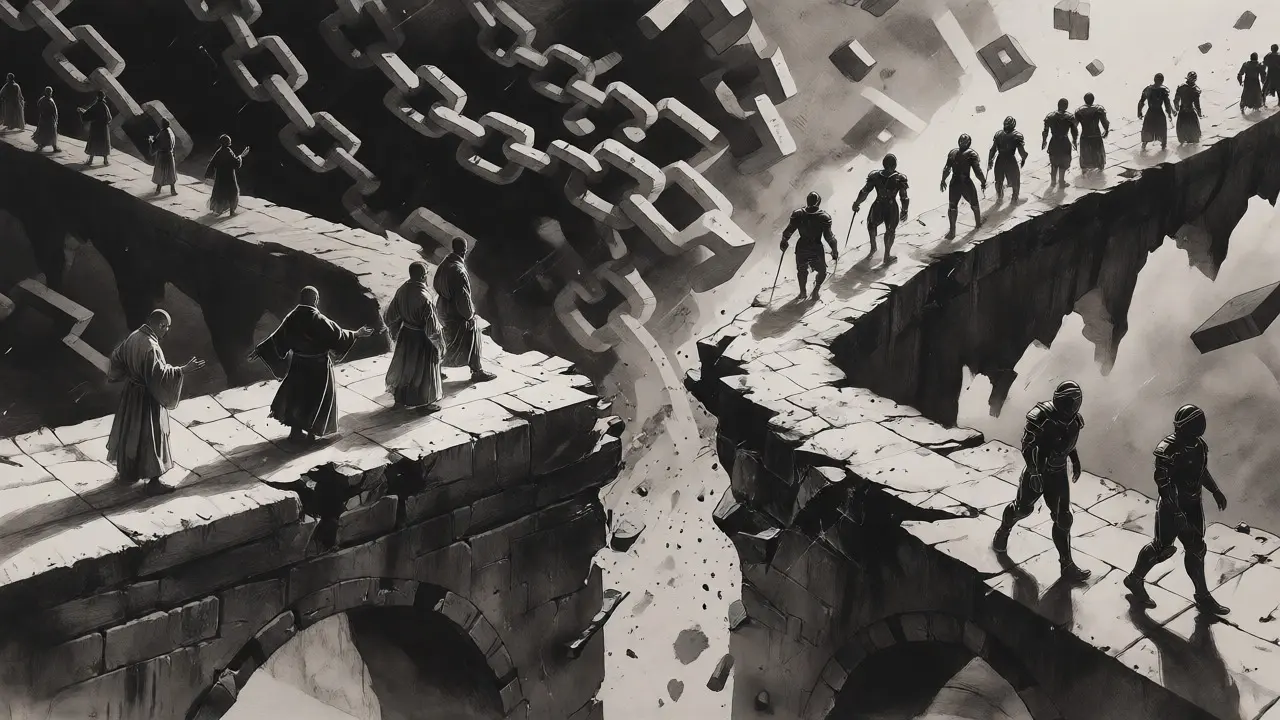
You’re holding Bitcoin. You check your wallet. Suddenly, the balance looks wrong, or maybe a new coin appeared out of nowhere. Did you get hacked? No. You just witnessed a blockchain fork. This isn’t a glitch; it’s how decentralized networks evolve. But here is the catch: not all forks are created equal. Some keep everyone on the same page. Others tear the community apart and create two entirely different currencies. If you don’t understand the difference between a hard fork and a soft fork, you might end up with a worthless asset or miss out on free money.
The Core Difference: Compatibility Is Everything
Think of a blockchain protocol like a set of rules for a game. Everyone playing must agree on these rules for the game to work. A soft fork is a rule change that makes the game stricter but keeps old players in the game. A hard fork changes the rules so fundamentally that anyone who doesn’t update their copy of the rulebook gets kicked out of the main game and has to start a separate league.
With a soft fork, backward compatibility is the magic word. Nodes running older software still see the new blocks as valid because the new rules are just tighter versions of the old ones. It’s like lowering the speed limit from 100 km/h to 80 km/h. Cars going 70 km/h were already following the old rules, so they aren’t breaking the new ones either. The network stays unified. One chain. One history. No drama.
A hard fork breaks this harmony. It introduces rules that old nodes reject. Imagine changing the speed limit to require cars to drive backwards. Old cars (nodes) can’t do that, so they ignore the new blocks. New cars (updated nodes) follow the new rule. Now you have two chains moving forward at the same time, but they don’t recognize each other’s progress. This splits the community and often the market value of the coin.
Soft Forks: The Quiet Upgrade
Soft forks are the preferred method for most routine upgrades. Why? Because they don’t force every user to panic. Developers implement them by adding constraints to the existing validation rules. Since these new rules are subsets of the old ones, non-upgraded nodes continue to validate transactions correctly, even if they don’t fully understand the new features.
The most famous example is Segregated Witness (SegWit), activated on Bitcoin in 2017. Before SegWit, transaction signatures took up too much space in a block, limiting capacity. SegWit moved these signatures to a separate structure. This tightened the rules on what counts as a valid block size. Old nodes still saw the blocks as valid because the core data remained intact. The result? Increased transaction throughput and fixed transaction malleability without splitting the Bitcoin network.
Here is why developers love soft forks:
- No forced upgrades: Users can stay on old software and still send/receive coins.
- Network unity: There is only one chain, so no confusion about which asset is "real."
- Lower risk: Fewer technical hurdles mean fewer chances for catastrophic bugs during activation.
However, soft forks have limits. You can’t use them to increase block size arbitrarily or change the total supply cap. They are great for tweaks, security patches, and minor feature additions. If you need to rewrite the engine while the car is driving, a soft fork won’t cut it.
Hard Forks: The Big Split
Hard forks are necessary when the protocol needs a fundamental overhaul. This happens when developers hit a wall with backward-compatible changes. Maybe the block size is too small to handle demand, or the consensus mechanism needs to shift from Proof-of-Work to Proof-of-Stake. In these cases, the old rules simply can’t accommodate the new vision.
When a hard fork activates, every participant must update their client software. If you don’t, your node rejects the new blocks. Meanwhile, updated nodes accept them. This creates a permanent divergence. Two chains exist: the original chain (following old rules) and the new chain (following new rules). Both share the same history up to the fork point, but after that, they grow separately.
Consider the Bitcoin Cash split in August 2017. A group of miners and developers believed Bitcoin needed larger blocks to scale as digital cash. The core developers disagreed, preferring Layer 2 solutions. The disagreement led to a hard fork. Those who upgraded got Bitcoin Cash (BCH). Those who didn’t stayed on Bitcoin (BTC). For a while, both coins traded independently, and holders of BTC received an equal amount of BCH for free.
Another classic case is Ethereum’s response to the DAO Hack in 2016. Hackers drained millions from a smart contract. The community voted to reverse the theft via a hard fork. Most users accepted the new chain (Ethereum). A minority refused to alter history, keeping the old chain, which became Ethereum Classic.

Technical Mechanics: How Activation Works
How does the network decide when to flip the switch? It’s rarely instantaneous. Both fork types rely on consensus mechanisms, but the signaling differs.
For soft forks, developers often use miner signaling. Miners include specific flags in the blocks they mine to show support for the upgrade. Once a certain percentage of blocks signal readiness within a defined window, the new rules activate. This ensures that the majority of hashing power supports the change before it locks in.
Hard forks usually involve a predetermined block height. At block number X, the new rules take effect. Every node must be updated by then. If a significant portion of the network fails to update, you get a stale chain. These nodes will mine blocks that the majority ignores, effectively isolating them. This is why exchanges pause withdrawals during major hard forks-to prevent sending funds to the wrong chain.
| Feature | Soft Fork | Hard Fork |
|---|---|---|
| Backward Compatibility | Yes. Old nodes accept new blocks. | No. Old nodes reject new blocks. |
| Network State | Single chain remains. | Potential for two separate chains. |
| User Action Required | None (optional upgrade). | Mandatory software update. |
| Complexity | Low. Limited scope of changes. | High. Can alter core protocols. |
| Market Impact | Minimal volatility. | High volatility; potential new assets. |
Risks and Security Concerns
Neither fork type is risk-free, but the dangers differ significantly. Soft forks carry the risk of accidental invalidation. If the new rules are too strict, some previously valid transactions might become invalid. This can cause temporary confusion or stuck transactions until nodes sync properly. However, since old nodes still participate, the network rarely halts completely.
Hard forks introduce more severe risks, primarily replay attacks. When a chain splits, transactions broadcast on one chain might be valid on the other because they share the same format and history. An attacker could capture a transaction on Chain A and replay it on Chain B, draining your funds twice. Modern wallets often add unique identifiers to transactions to mitigate this, but it remains a critical concern during the transition period.
Additionally, hard forks can fragment hash power. If miners split between the two chains, both networks may suffer from reduced security. A smaller chain with less hashing power is easier to attack with a 51% attack, where a single entity controls the majority of mining resources and can double-spend coins.
What This Means for Your Wallet
If you hold cryptocurrencies, you don’t need to be a developer, but you do need to pay attention during upgrade announcements. Here is a simple checklist to protect your assets:
- Check Exchange Status: Major exchanges like Coinbase or Kraken will suspend deposits and withdrawals around hard forks. Don’t try to move funds during this window unless you know exactly what you’re doing.
- Control Your Keys: During a hard fork, if you hold your own private keys, you typically receive tokens on both chains automatically. If your coins are on an exchange, the exchange decides whether to support the new fork. Some might credit you, others might ignore it.
- Wait for Confirmation: After a hard fork, wait several blocks before spending large amounts. This ensures the network has stabilized and replay protection is working correctly.
- Update Software: Always run the latest version of your wallet client. Outdated clients might struggle to sync with the new chain state after a hard fork.
Soft forks generally require no action from you. Your wallet continues to work seamlessly. You might notice faster transactions or lower fees, but the underlying mechanics remain invisible to the average user.
The Future of Protocol Evolution
As blockchain technology matures, the trend is shifting toward minimizing disruptive hard forks. Networks like Ethereum are moving toward modular architectures and Layer 2 scaling solutions. These approaches allow for rapid innovation without constantly rewriting the base layer protocol. The goal is to make upgrades feel like software updates on your phone-smooth, automatic, and unnoticeable.
However, hard forks will never disappear. They are the ultimate tool for emergency fixes and radical pivots. When the Tether hack occurred, Ethereum used a hard fork to freeze stolen funds. Sometimes, breaking compatibility is the only way to save the network.
Understanding the distinction helps you navigate the chaotic world of crypto news. Next time you see headlines about a "fork," ask yourself: Is this a quiet tightening of rules, or is it a civil war over the future of the currency? The answer determines whether you sit back and relax or grab your private keys and prepare for battle.
Do I lose my coins during a hard fork?
No, you don't lose coins. Typically, you end up with coins on both the original chain and the new chain. However, accessing the new coins requires proper handling, especially if your funds are held on an exchange rather than in a personal wallet.
Which is safer, a hard fork or a soft fork?
Soft forks are generally safer because they maintain backward compatibility and keep the network unified. Hard forks carry higher risks of fragmentation, replay attacks, and market volatility due to the creation of separate chains.
Why did Bitcoin Cash split from Bitcoin?
The split was caused by a disagreement on scalability. One faction wanted larger block sizes to process more transactions quickly (leading to Bitcoin Cash), while the other preferred smaller blocks and off-chain solutions like Lightning Network (remaining as Bitcoin).
Can a soft fork become a hard fork?
Not directly. They are distinct categories based on compatibility. However, if a soft fork implementation is flawed and causes a chain split where old nodes cannot recover, it effectively acts like a failed upgrade requiring manual intervention, similar to a hard fork scenario.
What is a replay attack?
A replay attack occurs during a hard fork when a transaction valid on one chain is also valid on the other. An attacker can rebroadcast your transaction on the second chain, causing you to spend your funds twice across the two resulting networks.