

Ever tried to send some crypto and got hit with a fee that made you double-check if you were sending the right amount? It happens. You think you're just moving money from wallet A to wallet B, but then there's this extra charge called a gas fee or a transaction fee. They sound like the same thing, right? Wrong. In the world of blockchain, these two terms describe different mechanics that affect your wallet balance in distinct ways.
Understanding the difference isn't just academic; it saves you real money. Whether you are holding Bitcoin or experimenting with smart contracts on Ethereum, knowing how these fees work helps you time your transactions better and avoid unexpected costs. Let’s break down exactly what each term means, how they are calculated, and why one might cost you more than the other depending on which network you are using.
The Core Difference: Scope and Application
At its simplest level, a Transaction Fee is the broader category. It is the payment required to get any movement recorded on a blockchain ledger. Think of it as the toll for using the road. This applies to every blockchain, from Bitcoin to Litecoin and Dogecoin.
Gas Fees, on the other hand, are a specific type of transaction fee found only on networks that support smart contracts, such as Ethereum, Solana, and Avalanche. The term "gas" comes from computing power. When you interact with a smart contract, the network needs to perform calculations. Gas measures those computational steps. So, while all gas fees are transaction fees, not all transaction fees are gas fees. If you are on Bitcoin, you pay a transaction fee. If you are swapping tokens on Ethereum, you pay a gas fee.
How Bitcoin Calculates Transaction Fees
Let’s look at Bitcoin first because it is the most straightforward. Bitcoin uses a Proof-of-Work system where miners compete to add new blocks to the chain. To incentivize them, users attach a fee to their transactions. Miners prioritize transactions with higher fees per byte of data.
The calculation here is based on size, not complexity. A standard Bitcoin transaction has a fixed structure. If you have many inputs (previous coins you are spending) or many outputs (recipients), your transaction gets larger in bytes. Larger transactions require more space in the block, so they cost more. The unit of measurement is satoshis per byte. One satoshi is 0.00000001 BTC. During low congestion, you might pay 10-20 satoshis per byte. During high demand, it can spike to over 100 satoshis per byte. This means the cost is directly tied to how busy the network is and how much data your specific transaction carries.
The Complexity of Ethereum Gas Fees
Ethereum changed the game by introducing smart contracts. These are self-executing programs that run code on the blockchain. Because code execution varies in complexity, a flat fee doesn’t work. That’s where gas comes in. Every action on Ethereum consumes a certain amount of gas units.
- A simple transfer of ETH costs 21,000 gas units.
- Interacting with a basic smart contract might cost 50,000 to 100,000 gas units.
- Complex DeFi swaps or NFT mints can exceed 300,000 gas units.
But gas units aren’t money yet. You multiply the gas units by the price of gas, measured in gwei. One gwei is 0.000000001 ETH. After the London Upgrade in August 2021, Ethereum introduced a three-part fee structure:
- Base Fee: This is determined by network congestion. It burns (removes from circulation) and adjusts automatically based on how full the previous block was.
- Tip: This goes directly to the validator who includes your transaction in a block. Higher tips mean faster processing.
- Gas Limit: The maximum amount of gas you are willing to spend. If the transaction fails, you still pay for the gas used up to that point.
This makes Ethereum fees dynamic. A simple transfer might cost $0.50 on a quiet day but $5.00 during an NFT frenzy. The volatility is significant because the base fee reacts instantly to supply and demand.
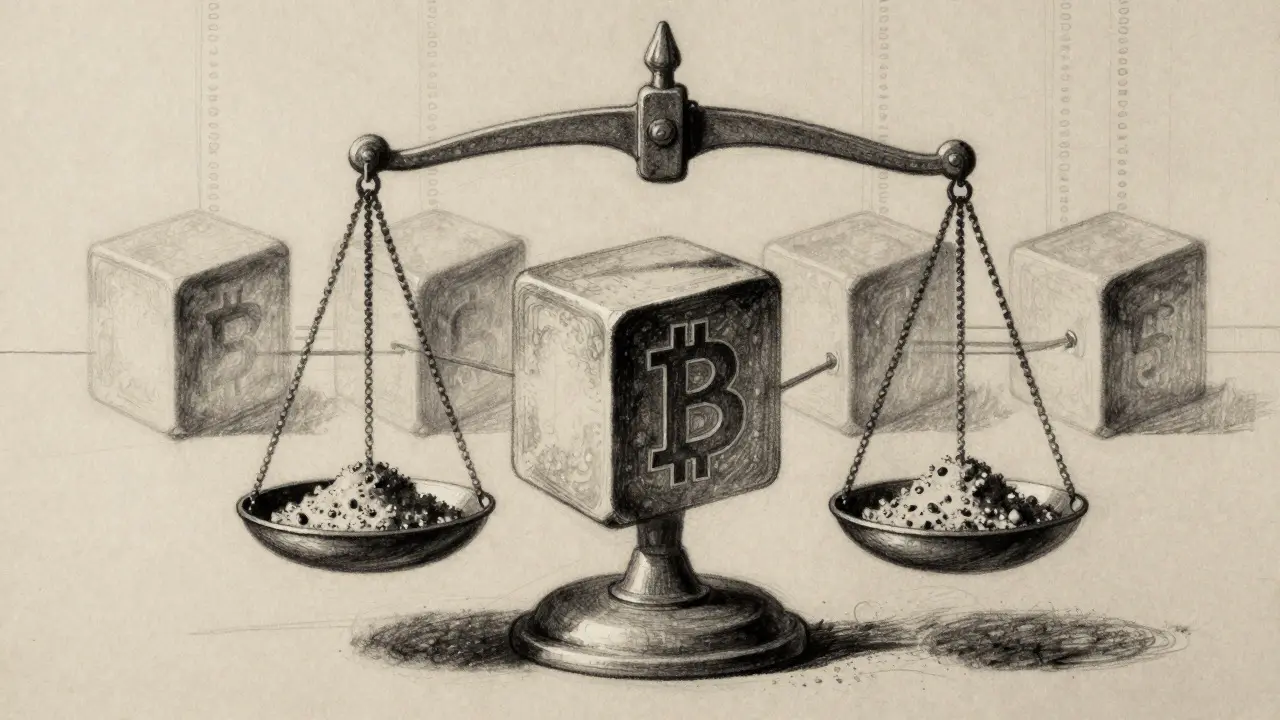
Comparison: Bitcoin vs. Ethereum Fee Mechanics
To visualize the differences, let’s compare the key attributes of these two major networks. This table highlights why one feels predictable and the other feels chaotic.
| Feature | Bitcoin (Transaction Fee) | Ethereum (Gas Fee) |
|---|---|---|
| Primary Driver | Transaction Size (Bytes) | Computational Complexity (Gas Units) |
| Currency Unit | Satoshis per Byte | Gwei |
| Fee Recipient | Miner | Validator (Tip) + Burned (Base Fee) |
| Predictability | Moderate (based on size/congestion) | Low (highly volatile based on demand) |
| Smart Contract Support | No | Yes |
| Typical Cost Range | $1 - $50+ | $0.10 - $50+ |
Notice that while Bitcoin fees scale with size, Ethereum fees scale with usage. If you just want to move value, Bitcoin is simpler. If you want to use decentralized finance apps, you must accept the complexity of gas fees.
Why Do Fees Spike? The Economics Behind the Numbers
Fees aren’t arbitrary; they follow basic economic laws. Both Bitcoin and Ethereum operate on supply and demand principles. The "supply" is the available capacity of the network (mining power for Bitcoin, validator capacity for Ethereum). The "demand" is the number of people trying to transact at the same time.
When demand exceeds supply, prices rise. In Bitcoin, this results in higher satoshis-per-byte rates. In Ethereum, this triggers a "gas war." Users bid up the tip to ensure their transaction gets processed quickly. During peak times, like a popular NFT drop, gas prices can exceed 500 gwei. At those levels, even a simple transfer can cost tens of dollars. This is why many users monitor tools like EthGasStation or GasTracker before making moves. They wait for off-peak hours, often late at night UTC, when demand drops and fees settle down.
For Bitcoin users, the strategy is similar but less dramatic. Timing transactions during weekends or early mornings can save money. However, the variation is usually smaller than Ethereum’s extreme spikes. Most Bitcoin users don’t need to track fees minute-by-minute unless they are making large transfers.

Managing Your Costs: Practical Tips
You don’t have to be a developer to manage these fees effectively. Here are some practical strategies for both types of networks.
For Bitcoin Users:
- Consolidate UTXOs: Unspent Transaction Outputs (UTXOs) are the building blocks of your Bitcoin balance. Having many small UTXOs increases your transaction size. Consolidating them into fewer, larger outputs reduces the byte count and lowers the fee.
- Use Fee Estimators: Don’t guess. Use built-in wallet estimators or external sites to see the current market rate. Aim for the median rate if speed isn’t critical.
- Avoid Peak Hours: Check mempool.space to see pending transactions. If the queue is long, wait until it clears.
For Ethereum Users:
- Use Layer 2 Solutions: Networks like Polygon, Arbitrum, and Optimism sit on top of Ethereum. They handle the heavy lifting and post summaries to the main chain. This reduces gas costs by 90% or more. If you don’t need instant finality on the mainnet, use a Layer 2.
- Optimize Gas Limits: Set your gas limit slightly above the estimated requirement. Setting it too high risks wasting funds if the transaction succeeds cheaper than expected, though modern wallets auto-adjust this. Setting it too low causes failed transactions, where you lose the fee anyway.
- Time Your Transactions: Like Bitcoin, Ethereum fees fluctuate. Use tracking tools to identify low-base-fee windows.
- Consider Alternative Chains: If fees are consistently too high for your use case, consider Solana or Avalanche. Solana offers sub-cent fees, and Avalanche typically charges between $0.05 and $0.25 per transaction.
The Future of Blockchain Fees
The landscape is shifting. Ethereum’s transition to Proof-of-Stake in September 2022 reduced energy consumption by 99.9%, but it didn’t immediately lower gas fees. That’s because fees are driven by demand, not energy costs. However, upcoming upgrades like sharding and proto-danksharding aim to increase network throughput significantly. Developers estimate these changes could reduce average gas fees by 90-95% by 2026.
Meanwhile, competition is fierce. Solana and Avalanche continue to improve their fee markets, offering dynamic pricing that keeps costs low. The global blockchain transaction fee market was valued at approximately $1.2 billion in 2023, with Ethereum accounting for roughly 40% of that revenue. As Layer 2 adoption grows, we expect the distinction between "mainnet" and "L2" fees to blur, giving users more control over their costs.
Ultimately, whether you call it a transaction fee or a gas fee, it serves the same purpose: compensating the network for securing your data. The difference lies in the mechanism. Bitcoin uses a simple size-based model. Ethereum uses a complex computation-based model. Knowing which one you’re dealing with allows you to plan smarter, spend less, and avoid the frustration of surprise costs.
Are gas fees the same as transaction fees?
Not exactly. Gas fees are a specific type of transaction fee used on smart contract blockchains like Ethereum. Transaction fees is the broader term that applies to all blockchains, including Bitcoin. All gas fees are transaction fees, but not all transaction fees are gas fees.
Why are Ethereum gas fees so expensive sometimes?
Ethereum gas fees spike due to high network demand. When many users try to transact simultaneously, the base fee increases automatically. Additionally, users may bid higher tips to validators to ensure faster processing, creating a competitive auction environment that drives prices up.
How do I calculate my Bitcoin transaction fee?
Bitcoin fees are calculated by multiplying the transaction size in bytes by the fee rate in satoshis per byte. For example, if your transaction is 250 bytes and the fee rate is 20 satoshis per byte, the total fee is 5,000 satoshis (0.00005 BTC).
Can I avoid paying gas fees on Ethereum?
You cannot avoid paying some form of fee on Ethereum mainnet, but you can drastically reduce costs by using Layer 2 solutions like Arbitrum, Optimism, or Polygon. These networks bundle transactions and post them to Ethereum, reducing individual user costs by over 90%.
What is the difference between Base Fee and Tip in Ethereum?
The Base Fee is the minimum amount required to include a transaction in a block, determined by network congestion, and is burned (removed from circulation). The Tip is an optional additional amount paid directly to the validator to incentivize them to process your transaction faster.
Which blockchain has the lowest transaction fees?
As of 2026, Solana and various Layer 2 solutions offer the lowest fees, often under $0.01 per transaction. Avalanche typically ranges between $0.05 and $0.25. Bitcoin and Ethereum mainnet generally have higher variable fees depending on congestion.