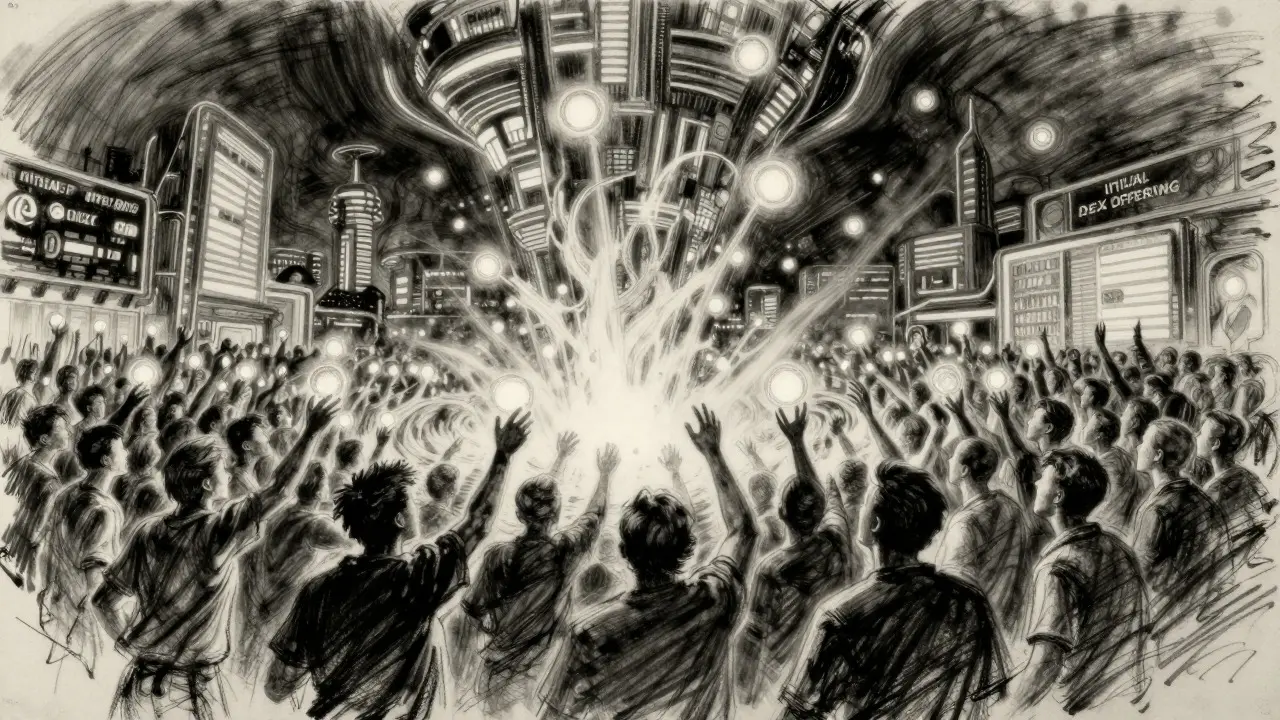
Most people searching for the GZONE airdrop are looking for a one-time giveaway that never really happened in the traditional sense. Instead, what you are actually seeing is a continuous reward mechanism built into the token's deflationary design. The GameZone project launched its Initial DEX Offering (IDO) in September 2021, raising over $1.2 million to build a launchpad for blockchain games. Since then, the "airdrop" has been redefined as ongoing staking rewards derived from trading fees, rather than a single distribution event.
What Actually Happened During the GZONE IDO?
To understand where your tokens come from, you need to look at how the initial capital was raised. The GameZone IDO wasn't just a simple token sale; it was a structured fundraising event designed to validate the platform before going live. The process happened in three distinct phases, each serving a different purpose in building the ecosystem's foundation.
- Private Sale: This phase raised $110,000 from early backers and strategic partners.
- Public IDO: This generated an additional $112,500, allowing retail investors to participate directly.
- Strategic Funding Round: The final push secured $1 million in capital injection, bringing the total raise to $1.22 million.
The timing of this launch was critical. Following the IDO completion, the GZONE token hit its all-time high of $1.18 on November 18, 2021. This spike demonstrated strong initial market reception, driven by the hype around the BlueZilla ecosystem and the promise of democratizing access to GameFi projects. However, like many tokens from that era, the price has since corrected significantly, currently trading around $0.00274 as of late 2026.
How the "Airdrop" Mechanism Actually Works
If you are holding GZONE expecting a separate wallet drop from a partner project, you might be disappointed. The core value proposition here is the internal reward system. GameZone operates on a deflationary model with a 7% fee applied to every sell order. Here is how that fee breaks down and creates your passive income stream:
| Fee Component | Percentage | Purpose |
|---|---|---|
| Burn Mechanism | 2% | Reduces total supply permanently |
| Staking Rewards | 5% | Distributed to active stakers (the "airdrop") |
Essentially, every time someone sells GZONE, 5% of that transaction goes back into the pool for stakers. This creates a continuous drip-feed of tokens to holders who keep their assets locked in the platform's tier-based system. It’s not a free giveaway, but it is a sustainable yield generation method that mimics the effect of regular airdrops without requiring external marketing campaigns.

Tier-Based Access and Staking Requirements
Your share of these rewards isn't equal for everyone. GameZone uses a tiered allocation system where your stake size determines your "pool weight." Think of it like a lottery ticket system: the more tickets (GZONE tokens) you hold and stake, the higher your probability of getting allocated in popular Initial Game Offerings (IGOs).
There are four distinct tiers. Higher stakes unlock better access to hot launches like Katana Inu or Galactic Quadrant, which previously ran through the platform. However, there is a catch. To prevent short-term flipping and encourage long-term commitment, GameZone enforces an early unstaking fee that can reach up to 25%. If you plan to hop in and out quickly, this penalty will eat into your potential gains. The system is designed to reward patience and loyalty to the ecosystem.
Current Market Reality vs. Past Hype
Let’s be real about the numbers. While the technology remains intact, the market sentiment has shifted dramatically since 2021. The token’s current market capitalization sits at approximately $1.15 million, with a circulating supply of roughly 421.5 million GZONE out of a 1 billion cap. Technical indicators paint a cautious picture:
- RSI (14-Day): 15.56, indicating deeply oversold conditions.
- Volatility: 13.21% over the last 30 days, showing significant uncertainty.
- Price Action: Only 8 green days out of the last 30, reflecting sustained downward pressure.
The all-time low of $0.003617 was recorded in March 2025. Currently, the Fear & Greed Index hovers around 26, signaling fear among traders. If you are considering entering now, you are buying during a bearish correction phase. The upside potential exists, but so does the risk of further stagnation if the broader crypto market doesn’t recover.
Why the BlueZilla Partnership Matters
You can’t talk about GZONE without mentioning its parent ecosystem, BlueZilla. This partnership is the backbone of the project’s credibility. BlueZilla acts as an incubator and accelerator for top-tier crypto startups, providing legal support, marketing muscle, and technical development resources to selected games. For GZONE holders, this means access to a curated pipeline of vetted projects rather than random, unverified tokens. The incubation program ensures that only viable blockchain gaming ventures get the spotlight, reducing the risk of participating in failed IGOs. This structural support is what separates GameZone from generic launchpads that simply list any project willing to pay.
Is GZONE Still Worth Holding in 2026?
The decision comes down to your investment horizon. If you are looking for quick flips, the 25% unstaking fee and current bearish trends make it a poor choice. But if you believe in the long-term growth of GameFi and want exposure to a platform with established infrastructure, the deflationary mechanics offer a safety net. The 2% burn rate continuously reduces supply, which theoretically supports price appreciation when demand increases. With projections suggesting potential highs of $2.50 to $3.70 in favorable market conditions, the current price of $0.00274 represents a deep discount to historical valuations. Just remember: the "airdrop" is only as good as the volume of trades happening on the platform. Low activity means lower staking rewards, so monitor the platform's user engagement closely.
Did GameZone have a traditional one-time airdrop?
No, there was no single large-scale giveaway event. The term "airdrop" in this context refers to the continuous staking rewards distributed from the 5% portion of the 7% sell fee. Holders earn these rewards passively while keeping their tokens staked in the tier-based system.
What is the penalty for unstaking GZONE too early?
GameZone imposes an early unstaking fee that can reach up to 25% of your staked amount. This fee is designed to discourage short-term speculation and ensure that participants remain committed to the ecosystem for a longer period.
How much did the GameZone IDO raise in total?
The total capital raised during the launch phases was $1.22 million. This included $110,000 from the private sale, $112,500 from the public IDO, and $1 million from a strategic funding round.
Which blockchains does GameZone operate on?
The platform supports multiple networks to maximize accessibility, including Polygon, Binance Smart Chain, Solana, and Ethereum. This multi-chain approach allows users to participate in launches across different ecosystems without bridging assets constantly.
What is the current status of the GZONE token price?
As of late 2026, GZONE is trading at approximately $0.00274. This is significantly lower than its all-time high of $1.18 in November 2021. Technical indicators show the token is in an oversold condition with high volatility, reflecting the broader bearish sentiment in the cryptocurrency market.