

Remember when bank CEOs called Bitcoin a "fraud"? That era is officially dead. In 2026, the narrative has shifted from skepticism to strategic necessity. Approximately 90% of major financial institutions are no longer just watching blockchain technology; they are actively integrating it into their core operations. This isn't about chasing hype anymore. It’s about survival and efficiency in a digital-first economy.
The shift is massive. We are looking at a market that grew from $8.1 billion in 2023 to a projected $80.2 billion by 2032. With executive confidence hitting 74% and institutional investments totaling over $552 million in blockchain activities, the message is clear: blockchain is becoming the new plumbing of global finance. But what does this actually look like on the ground? Let's break down how banks, asset managers, and payment processors are rewriting the rules.
From Skepticism to Strategy: The Institutional Turn
The most striking example of this turnaround is JPMorgan Chase, led by CEO Jamie Dimon. A few years ago, Dimon famously dismissed Bitcoin as worthless. Today, JPMorgan not only allows clients to buy Bitcoin but is also exploring loans backed by crypto holdings. This pivot signals a broader industry consensus: digital assets are legitimate, and ignoring them means losing market share.
This change isn't isolated to one bank. Global giants like Goldman Sachs, Societe Generale, and MUFG have advanced their tokenization efforts significantly. They recognize that customer demand for digital asset services is no longer a niche interest-it's mainstream. The number of banks issuing tokenized assets is expected to double in 2025 alone, creating new avenues for capital formation that traditional systems simply couldn't support efficiently.
Consulting firms like EY, Deloitte, and McKinsey have played a crucial role here. They haven't just advised clients; they've explored independent applications for auditing, compliance, and supply chain transparency. Their involvement adds a layer of credibility, showing that blockchain is ready for enterprise-grade scrutiny.
DeFi Lending: Where the Money Is Moving
If you want to see where the real action is, look at decentralized finance (DeFi). The growth has been explosive. Total borrowing in DeFi protocols has surged by 959% since 2022, reaching USD 19.1 billion across 20 protocols on 12 different blockchains. Even centralized finance (CeFi) lending hit USD 11.2 billion by late 2024.
Aave, an Ethereum-based lending protocol, stands out as a prime example of institutional maturity. By May 2025, Aave held a dominant 45% market share with a Total Value Locked (TVL) of USD 25.41 billion. The first quarter of 2025 saw a significant rebound, with borrowing increasing by 30% after earlier slumps. This indicates that institutions aren't just dipping their toes in; they are committing serious capital to these platforms because the yields and efficiency often beat traditional banking products.
| Metric | Traditional Banking (CeFi) | Decentralized Finance (DeFi) |
|---|---|---|
| Total Lending Volume (Late 2024) | $11.2 Billion | $19.1 Billion (across 20 protocols) |
| Growth Rate (Since 2022) | Steady/Moderate | +959% |
| Settlement Time | Days (T+2) | Minutes/Seconds |
| Access Barrier | High (Credit checks, KYC heavy) | Low (Permissionless, collateral-based) |
Cross-Border Payments: Killing the SWIFT Delay
One of the biggest pain points in global finance has always been cross-border payments. Sending money internationally used to take days, involve multiple intermediaries, and cost a fortune in fees. Blockchain solves this elegantly.
Platforms like RippleNet and JPM Coin are revolutionizing this space. Transactions that once took three to five business days now complete in seconds. The cost reduction is substantial, stripping away the layers of correspondent banking that inflated prices for end-users.
Looking ahead, digital payments using blockchain technology are projected to reach $140.26 billion by 2030. More impressively, stablecoin daily transaction volumes could hit $250 billion within three years. To put that in perspective, that would exceed the current daily volumes processed by major card networks like Visa or Mastercard in certain segments. For businesses engaged in international trade, this speed and cost efficiency are game-changers.

Asset Tokenization: Liquidity for the Illiquid
Perhaps the most transformative aspect of blockchain adoption is asset tokenization. This process converts rights to an asset into a digital token on a blockchain. Think of real estate, art, or private equity-assets that are traditionally hard to sell quickly.
BlackRock has been a pioneer here, launching tokenized funds that allow for instant settlement and fractional ownership. This opens up international private markets to a wider range of investors. Capital markets driven by tokenization capabilities are predicted to balloon to over $16 trillion by 2030. Trade finance alone could add $3 trillion in value by then through improved efficiency and reduced fraud.
The asset management sector is also booming, projected to grow from $1 billion in 2023 to $4.5 billion. Why? Because tokenization provides enhanced liquidity for assets that were previously stuck in long holding periods. Investors can enter and exit positions faster, and institutions can manage risk more dynamically.
The Regulatory and Technical Hurdles
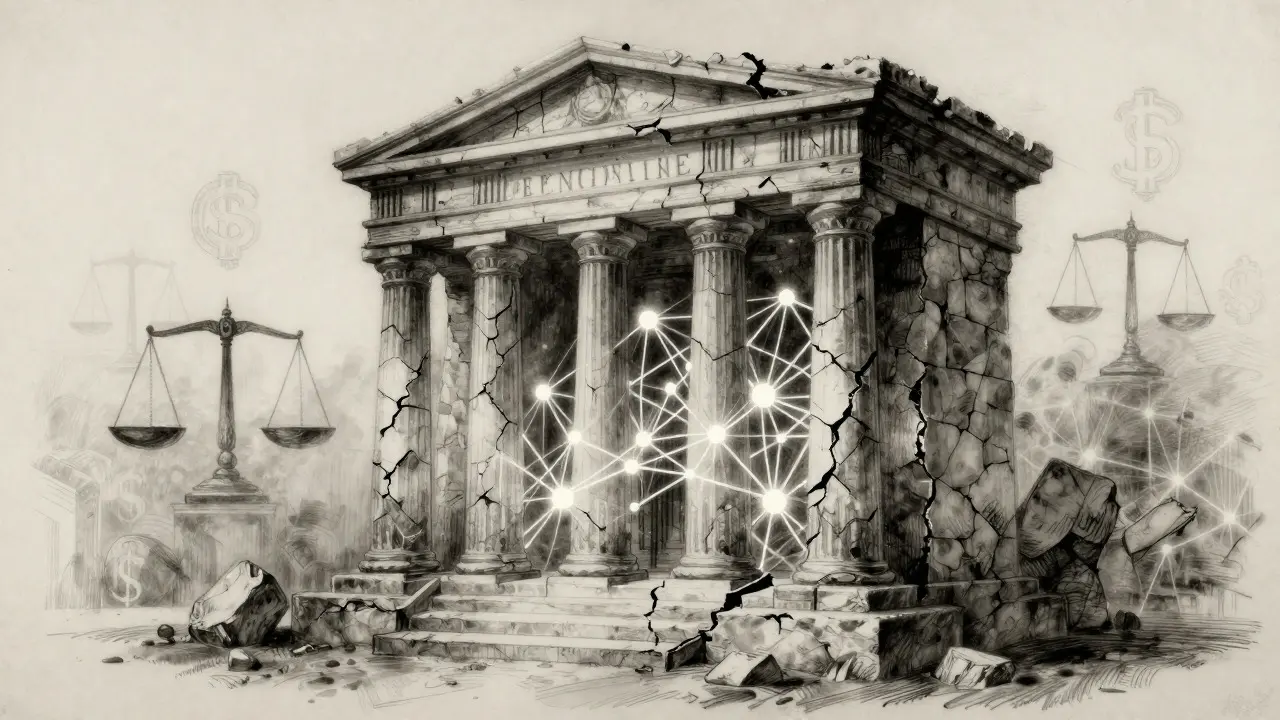
It’s not all smooth sailing. Financial institutions face significant challenges in implementation. Regulatory uncertainty remains a top concern, particularly regarding anti-money laundering (AML) and know-your-customer (KYC) requirements in decentralized environments. How do you apply strict identity checks to a permissionless ledger? It’s a complex puzzle that regulators and technologists are still solving.
Scalability is another issue. While blockchains are fast compared to old banking systems, they still struggle with handling the sheer volume of transactions that Visa processes during peak times. Integration with legacy systems is notoriously difficult. Core banking software is decades old, and plugging modern distributed ledger technology into it requires substantial infrastructure upgrades.
Implementation complexity varies wildly. A simple payment application might take months to pilot. A comprehensive asset tokenization platform? That’s a multi-year project requiring new technical competencies in smart contract development, cryptographic security, and cross-jurisdictional compliance.
CBDCs and the Future Landscape
Central Bank Digital Currencies (CBDCs) are emerging as critical catalysts for this transformation. Countries like France are leading the charge, with their central banks driving adoption initiatives. CBDCs provide the regulatory frameworks that facilitate broader blockchain adoption, giving institutions a safe harbor to operate within.
The incoming US administration is expected to adopt a more favorable stance toward digital assets, potentially positioning the United States as a global blockchain leader. This regulatory clarity could accelerate institutional adoption rates significantly. Meanwhile, the approval of Bitcoin ETFs has demonstrated growing institutional demand and legitimacy, forcing banks to integrate digital asset offerings to stay competitive.
There is also a strategic dilemma regarding stablecoins. If banks don’t issue their own stablecoins, they risk losing the deposits that constitute reserves to blockchain-native competitors. This pressure is driving many institutions to develop their own digital currency solutions, ensuring they remain relevant in an increasingly digital economy.
What This Means for You
For consumers and businesses, this shift means better services. Faster settlements, lower fees, and access to new investment opportunities are becoming standard. However, it also requires vigilance. As these systems evolve, understanding the basics of blockchain security and digital asset management will be essential.
The transformation represents more than a technological upgrade. It’s a fundamental reimagining of how financial institutions operate, compete, and serve customers. By 2030, mainstream integration across all major financial service categories is likely. The question is no longer if blockchain will change finance, but how quickly you can adapt to the new reality.
Why are banks finally adopting blockchain technology?
Banks are adopting blockchain primarily for efficiency and cost reduction. Traditional systems like SWIFT are slow and expensive for cross-border payments. Blockchain offers near-instant settlement and lower fees. Additionally, asset tokenization provides new revenue streams by making illiquid assets tradable, and competition from fintech companies forces traditional banks to innovate or lose market share.
Is DeFi safe for institutional investors?
DeFi carries risks, including smart contract vulnerabilities and regulatory uncertainty. However, institutional participation has grown significantly, with protocols like Aave locking billions in value. Institutions mitigate risk by using audited protocols, insurance products, and hybrid models that combine DeFi efficiency with CeFi oversight. The 959% growth in DeFi borrowing since 2022 suggests growing confidence in its stability.
How does asset tokenization work?
Asset tokenization involves converting rights to a physical or financial asset (like real estate or stocks) into a digital token on a blockchain. This allows for fractional ownership, easier transferability, and 24/7 trading. For example, BlackRock’s tokenized funds enable investors to buy shares of a fund instantly, without the traditional T+2 settlement delay.
What is the role of CBDCs in blockchain adoption?
Central Bank Digital Currencies (CBDCs) act as a bridge between traditional fiat money and blockchain technology. They provide a regulated, government-backed digital currency that encourages institutions to build compatible infrastructure. This reduces regulatory friction and helps banks integrate blockchain services while maintaining compliance with national monetary policies.
Will blockchain replace traditional banking entirely?
Unlikely in the short term. Instead, we are seeing a convergence. Traditional banks are integrating blockchain for specific use cases like cross-border payments and asset tokenization. The future is likely a hybrid model where blockchain handles backend settlement and data integrity, while traditional interfaces and customer service remain largely unchanged for the average user.
It is fascinating to observe the pendulum swing from outright dismissal to strategic necessity. The narrative shift at JPMorgan is particularly telling, as Dimon's reversal signals a broader industry capitulation to market realities rather than ideological conviction. We are witnessing the death of the 'fraud' label and the birth of institutional pragmatism.
The tokenization aspect is where the real magic happens for me. Converting illiquid assets like real estate into tradable digital tokens isn't just efficient; it democratizes access to wealth classes previously reserved for the ultra-rich. BlackRock leading this charge validates the entire sector in ways hype never could.
do not be fooled by the corporate spin here. this is merely a new layer of surveillance infrastructure being built over the ruins of privacy. the central banks are using CBDCs to track every single transaction you make. they want total control. the blockchain is not freedom it is a digital leash disguised as innovation. wake up sheeple
Indeed, the so-called efficiency gains are a mirage designed to obscure the deeper consolidation of power. These financial institutions are not adopting blockchain for your benefit; they are adopting it to eliminate the middlemen who might challenge their hegemony. It is a classic Trojan horse strategy. The legacy systems are not being replaced; they are being augmented with better tracking capabilities.
so much talk about efficiency but what about the actual user experience? i feel like we are getting more complicated interfaces for the same old banking headaches. 🤷♂️
You have to look past the initial friction, my friend. The cultural shift towards digital-first finance is inevitable and ultimately liberating. Imagine a world where cross-border payments are instantaneous and fees are negligible. That is the promise we are moving toward, even if the current implementation feels clunky. Trust the process.
I'm just watching from the sidelines with a cup of coffee. It's wild to see how fast the tide has turned on crypto. One day it's monkey business, the next day it's core infrastructure. I guess time will tell if these smart contracts actually hold up under pressure or if they're just another bubble waiting to burst.
the regulatory hurdles are basically non-existent because the regulators are writing the rules as they go along. its all about compliance theater really. they need to check boxes to feel safe while integrating this tech. its messy and bureaucratic but thats how big money works always has been
One must consider the philosophical implications of decentralization meeting centralization. When traditional banks adopt decentralized ledger technology, do they preserve the ethos of decentralization, or do they merely co-opt the technology to reinforce existing hierarchies? The integration of DeFi protocols like Aave suggests a hybrid model is emerging, which raises profound questions about the nature of trust in financial systems.
I think people are overestimating the speed of adoption. Legacy systems are incredibly stubborn. I've worked in fintech for years and trying to plug modern tech into mainframes from the 70s is a nightmare. This won't happen overnight, despite what the press releases say. 😒
its sad really that we let these corrupt banks dictate our financial future again. they burned us once with the 2008 crash and now they want back in with shiny new toys. moral hazard is alive and well. we should have banned them from crypto entirely instead of letting them pollute the ecosystem with their dirty fiat money
Look, I know everyone loves to hate the banks but honestly? If this means faster settlements and lower fees for regular folks, I am all for it. My wallet doesn't care about ideology it cares about keeping more of my hard earned cash. Let them integrate whatever they want as long as it benefits the consumer.
It is truly heartbreaking to see how quickly skepticism can turn into blind faith. Yet, there is hope in the transparency that blockchain offers. If institutions are forced to operate on immutable ledgers, perhaps we can finally achieve the accountability that has been missing for decades. Let us remain vigilant but open to positive change.
from an indian perspective the remittance angle is huge. sending money home used to take forever and cost a fortune. if ripple or similar tech cuts that down to seconds it changes lives literally. maybe the west is too focused on speculation but for developing nations this is pure utility
This is awesome news guys! Lets gooo! 🚀