

You want to trade leveraged positions without handing your keys over to a centralized company. You want the speed of Binance but the security of self-custody. That is exactly where Drift Protocol fits in. It is not just another copycat decentralized exchange. Built on the Solana blockchain, Drift has carved out a specific niche: high-speed perpetual futures trading that actually feels fast.
As we move through mid-2026, the landscape of decentralized finance (DeFi) derivatives has shifted dramatically. The days of slow Ethereum-based swaps are fading for active traders. Drift Protocol, now operating on its robust v2 architecture, has processed over $50 billion in cumulative volume. But does it live up to the hype? Is it safe enough for your capital? And more importantly, will it handle your trades when the market goes crazy?
This review cuts through the marketing fluff. We look at the mechanics, the risks, the costs, and the real-world performance data from late 2025 and early 2026 to help you decide if Drift belongs in your trading toolkit.
What Exactly Is Drift Protocol?
Drift Protocol is a non-custodial decentralized exchange specializing in perpetual futures contracts. Unlike spot exchanges where you buy and hold an asset, perpetuals allow you to bet on the price direction of assets like Bitcoin (BTC), Ethereum (ETH), or Solana (SOL) with leverage, without an expiration date.
The platform was founded in December 2022 by Hyunwoo Kim and his team. They identified a critical gap: existing decentralized derivatives platforms were too slow and expensive due to their reliance on Ethereum. By building natively on Solana, Drift taps into a network capable of handling thousands of transactions per second with minimal fees.
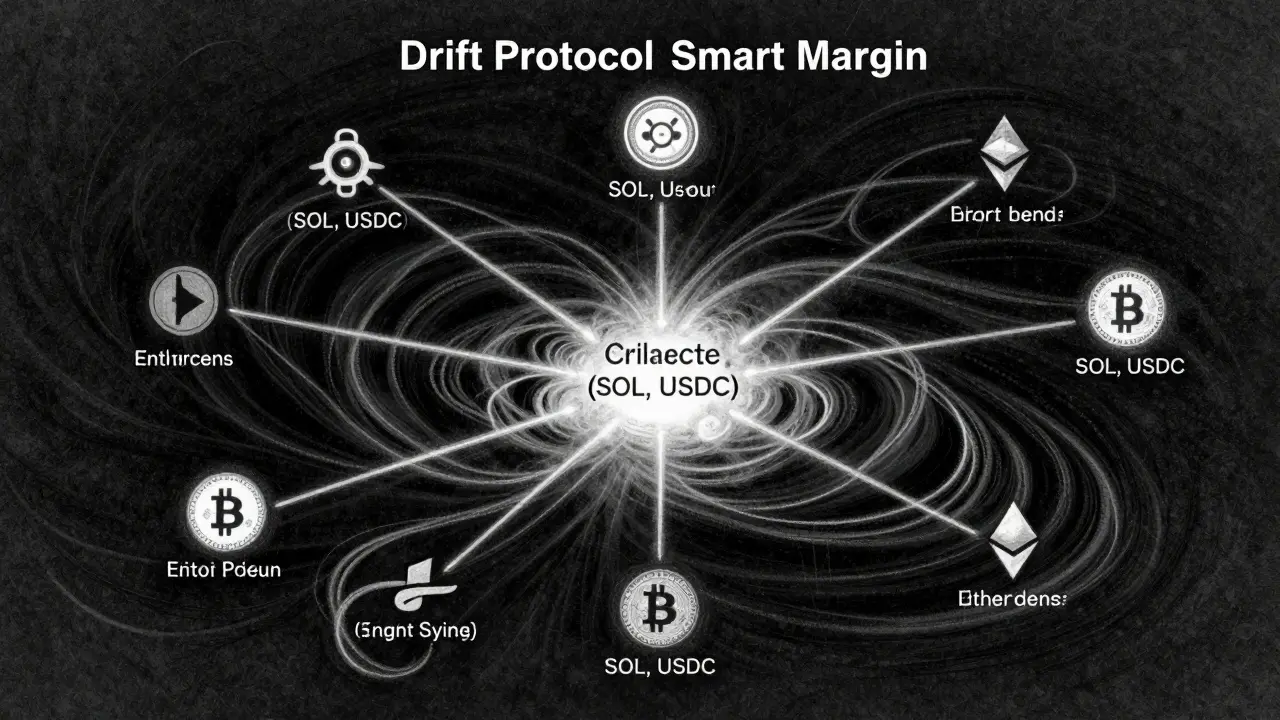
The core innovation here is the Smart Margin system. In most traditional DeFi platforms, you have to isolate your collateral for each position. If you want to trade BTC and ETH, you need separate accounts for each. Drift unifies this. You deposit one pool of collateral-whether it is SOL, USDC, or even other volatile assets-and use it across all your open positions. This unified margin account improves capital efficiency significantly, allowing you to offset losses in one market with gains in another automatically.
Key Features and Technical Specs
To understand why traders flock to Drift, you need to look under the hood. Here is what powers the engine:
- Execution Speed: Drift boasts sub-600 millisecond trade execution latency. In crypto trading, milliseconds matter. This speed ensures your limit orders fill before the price moves against you.
- Leverage Options: Major assets like BTC, ETH, and SOL offer up to 50x leverage. While higher leverage exists for some altcoins, 50x is the standard sweet spot for risk management on the platform.
- Just-In-Time (JIT) Liquidity: This mechanism allows liquidity providers to enter and exit positions instantly around your trade. It means large orders suffer less slippage because liquidity is injected precisely when needed.
- Gasless Trading: You do not pay gas fees for placing or canceling orders. You only pay the spread and funding rates associated with the trade itself. This makes scalping viable, which is often impossible on Ethereum-based DEXs.
- Oracle Infrastructure: Price feeds come from the Pyth Network, updating every 15 seconds. This frequent update cycle helps prevent oracle manipulation during volatile spikes.
As of Q3 2025, the platform supported 43 distinct markets. This includes major cryptocurrencies, indices, and even prediction markets for real-world events, such as political elections. The breadth of options rivals many centralized exchanges.
Security and Risk Management
In DeFi, security is not a feature; it is the foundation. If the code breaks, your money vanishes. Drift takes this seriously, implementing multiple layers of protection.
The backbone of their security is the Safety Module (DSM). Think of this as an on-chain insurance fund. Users stake DRIFT tokens to backstop the protocol. If a trader gets liquidated incorrectly or a bug causes bad debt, the DSM covers the loss. As of September 2025, the DSM held approximately $23.7 million in assets. It has already paid out for 12 instances of bad debt totaling $867,000. This proves the system works in practice, not just on paper.
The codebase is open-source under the Apache-2.0 license, meaning anyone can audit it. More importantly, professional firms have done so. Between January 2023 and August 2025, Drift underwent 14 comprehensive audits:
- Trail of Bits: Conducted 3 audits, finding zero critical vulnerabilities in their latest August 2025 report.
- Neodyme: Completed 5 audits focusing on smart contract logic.
- OtterSec: Performed 6 audits, specifically targeting front-end and backend integration risks.
All critical vulnerabilities discovered during these processes were patched within 30 days. Additionally, the Immunefi bug bounty program has paid out $1.7 million across 87 valid reports, with rewards reaching up to $250,000 for critical issues. This incentivizes white-hat hackers to find bugs before malicious actors do.
However, no system is perfect. Trail of Bits noted "oracle manipulation risks during low-liquidity hours" as a medium-severity concern. While rare, traders should be aware that extreme volatility combined with low liquidity can sometimes lead to inaccurate pricing feeds.
Drift vs. The Competition
How does Drift stack up against other giants in the decentralized derivatives space? Let's compare it directly with dYdX and GMX, two of its primary competitors.
| Feature | Drift Protocol (v2) | dYdX | GMX |
|---|---|---|---|
| Blockchain | Solana | Berachain / Starknet | Avalanche / Arbitrum |
| Margin System | Unified Smart Margin | Cross-Margin | Isolated Margin |
| Max Leverage | Up to 50x | Up to 20x | Up to 50x |
| Transaction Cost | Gasless (Order placement) | Low Gas | Medium Gas |
| 24h Volume (Sept 2025) | $218 Million | $412 Million | $189 Million |
| Best For | High-frequency & Scalpers | Large Institutional Orders | Simple Spot-like Futures |
Drift holds the #7 position among decentralized derivatives platforms globally. It trails dYdX in total volume, largely because dYdX attracts larger institutional players who prefer its specific order book model. However, Drift exceeds GMX in volume and offers superior capital efficiency due to its unified margin system. Internal testing shows Drift provides 37% higher capital efficiency compared to isolated margin systems used by competitors like GMX.
If you are a retail trader making quick entries and exits, Drift’s gasless nature and Solana speed make it the clear winner. If you are moving millions of dollars in a single block, you might still face liquidity constraints compared to centralized giants like Binance, which offers 8.7 BTC depth at 0.1% slippage versus Drift’s 1.2 BTC.
User Experience and Practical Usage
Getting started with Drift is straightforward if you are already familiar with Solana wallets. You will need a wallet like Phantom, Backpack, or Solflare. Connect your wallet, deposit collateral (USDC, SOL, etc.), and you are ready to trade.
The learning curve is moderate. New users report needing 8-12 hours to fully master advanced features like cross-margin optimization and providing JIT liquidity. The platform provides extensive documentation, rated 4.2/5 on GitHub, including 37 tutorial videos and interactive walkthroughs.
One standout feature introduced in the September 2025 v2.3 upgrade is Social Trading. This allows you to copy the trades of the top 100 performers on the platform. Within weeks of launch, 12,000 followers allocated $47 million into copied positions. This lowers the barrier to entry for novice traders who lack the time to analyze charts but trust proven strategies.
Support is handled via Discord, which maintains a 92% user satisfaction rating. Common technical issues include wallet connection failures (reported in 23% of reviews) and occasional price feed discrepancies during peak Solana congestion. These are typically resolved quickly through community support channels.
Risks and Limitations You Must Know
No investment is risk-free, and DeFi derivatives carry amplified dangers. Here is what you need to watch out for:
- Solana Network Instability: Drift is entirely dependent on Solana’s uptime. In Q2 2025, three brief protocol pauses caused $4.2 million in unrealized PnL discrepancies. While funds were not lost, trading was halted. Always monitor Solana network status before entering large positions.
- Liquidity Depth: During extreme volatility, liquidity can dry up. In March 2025, during a BTC flash crash, Drift’s liquidation engine processed 78% of positions safely, compared to 91% on Hyperliquid. Large orders may experience significant slippage.
- Regulatory Uncertainty: The SEC’s July 2025 enforcement actions against derivatives protocols prompted Drift to implement geo-blocking for 32 high-risk jurisdictions. If you reside in a restricted country, access may be limited or revoked.
- Impermanent Loss: If you use the Earn system to stake assets for yield, you may face impermanent loss if the market moves sideways or against your staked position. 78% of reviewers rate the Earn system as "good for passive income," but warn about this specific risk.
Tokenomics and DRIFT Token Outlook
The DRIFT token serves multiple utilities within the ecosystem. It is used for governance, staking in the Safety Module, and earning fees. The October 2025 tokenomics overhaul shifted from pure fee-sharing to a multi-utility model, enhancing long-term value accrual.
Price predictions vary wildly. TradingBeast forecasts a rise to $1.02 by late 2025 (+35%), while WalletInvestor projects a decline to $0.38 (-48%) citing competition from Hyperliquid V3. Currently consolidating around $0.75, technical analysts point to Fibonacci targets at $0.95 and $1.26 as key resistance levels. Remember, token price does not dictate platform utility, but it does reflect community sentiment and growth expectations.
Final Verdict: Who Should Use Drift?
Drift Protocol is not for everyone. If you are a beginner looking to buy and hold Bitcoin for ten years, stick to a simple spot exchange. If you require massive institutional-grade liquidity for orders exceeding $10 million, centralized venues remain safer bets.
However, if you are an active trader, a quant firm running algorithms, or a sophisticated retail investor seeking high leverage with self-custody, Drift is currently the best option on Solana. Its combination of speed, low cost, and robust risk management makes it a serious contender in the $18.3 billion decentralized derivatives market.
Start small. Test the waters with minimal leverage. Understand the Smart Margin system thoroughly. And always keep an eye on Solana’s network health. Done right, Drift offers a powerful, secure, and efficient way to trade crypto derivatives without compromising your sovereignty.
Is Drift Protocol safe to use?
Drift Protocol employs strong security measures, including 14 audits by firms like Trail of Bits and Neodyme, and a $23.7 million Safety Module insurance fund. However, as a DeFi platform on Solana, it carries risks related to smart contract bugs and network congestion. Always use strong wallet security and never invest more than you can afford to lose.
What is the maximum leverage available on Drift?
Major assets like BTC, ETH, and SOL offer up to 50x leverage. Some altcoin pairs may offer different leverage tiers. Higher leverage increases both potential profits and the risk of rapid liquidation.
Does Drift charge gas fees for trading?
No, Drift offers gasless trading for order placement and cancellation. You only pay the trading spread and funding rates associated with holding your position. This makes it significantly cheaper than Ethereum-based DEXs for active traders.
How does Drift compare to dYdX?
Drift is built on Solana, offering faster execution and lower costs, making it ideal for high-frequency trading. dYdX operates on Berachain/Starknet and generally has higher liquidity depth, making it better for large institutional orders. Drift’s unified margin system also offers greater capital efficiency for retail traders.
Can I copy trade on Drift Protocol?
Yes, the Social Trading feature introduced in v2.3 allows users to copy the positions of the top 100 traders on the platform. This is useful for beginners who want to follow proven strategies without performing their own analysis.