

You see a shiny Yield Farming dashboard flashing "300% APY" and your heart skips a beat. You think you've found free money. But when you check your wallet three months later, your profit is barely enough to cover the gas fees. What happened? The numbers on the screen didn't lie, but they didn't tell the whole truth either.
Calculating yield farming returns isn't just about multiplying your deposit by a percentage. It's a puzzle involving compounding frequencies, hidden fees, token price volatility, and the silent killer known as impermanent loss. If you treat DeFi like a high-yield savings account, you'll get burned. If you understand the math behind the metrics, you can actually keep what you earn.
The Core Math: APR vs. APY
Most beginners confuse these two terms, and protocols love it because higher numbers look better. Let's clear this up once and for all using simple math.
APR (Annual Percentage Rate) is simple interest. It assumes you take your profits out and do nothing with them. If you deposit $1,000 at 10% APR, you get $100 after one year. Period. No growth on the growth.
APY (Annual Percentage Yield) includes compounding. It assumes you reinvest your rewards immediately. That same $1,000 at 10% APY, compounded daily, turns into roughly $1,105.17. That extra $5.17 might seem small, but at 50% APY, the difference between APR and APY becomes massive.
| Compounding Frequency | Effective Annual Return (APY) | Final Balance ($1k Start) |
|---|---|---|
| Simple Interest (APR) | 20.00% | $1,200.00 |
| Monthly | 21.94% | $1,219.40 |
| Daily | 22.13% | $1,221.34 |
| Continuous (Theoretical Max) | 22.14% | $1,221.40 |
See that jump from monthly to daily? In DeFi, where rewards are often streamed per block or claimed hourly, you need to know if the protocol compounds automatically or if you have to pay gas fees to claim and restake. If you're paying $5 in gas to compound a $2 reward, your effective APY drops through the floor.
The Hidden Cost: Impermanent Loss
This is the part most calculators ignore, and it’s why many farmers end up with less value than if they had just held their tokens in a cold wallet. Impermanent Loss (IL) occurs when you provide liquidity to an Automated Market Maker (AMM) pool containing two volatile assets, like ETH and USDC.
Here’s the scenario: You deposit 50% ETH and 50% USDC. If ETH doubles in price, the AMM algorithm sells some of your ETH for USDC to maintain the balance. When you withdraw, you have less ETH than you started with. If the price moves too much, the IL can exceed your farming rewards.
For example, if you farm a pair with 20% APY, but the price of one asset moves 50% against the other, you might suffer a 6-8% impermanent loss. Your net return? Maybe 12%. If the price swings wildly, you could lose money even while earning "high yields." Always calculate your expected IL based on historical volatility before jumping in.
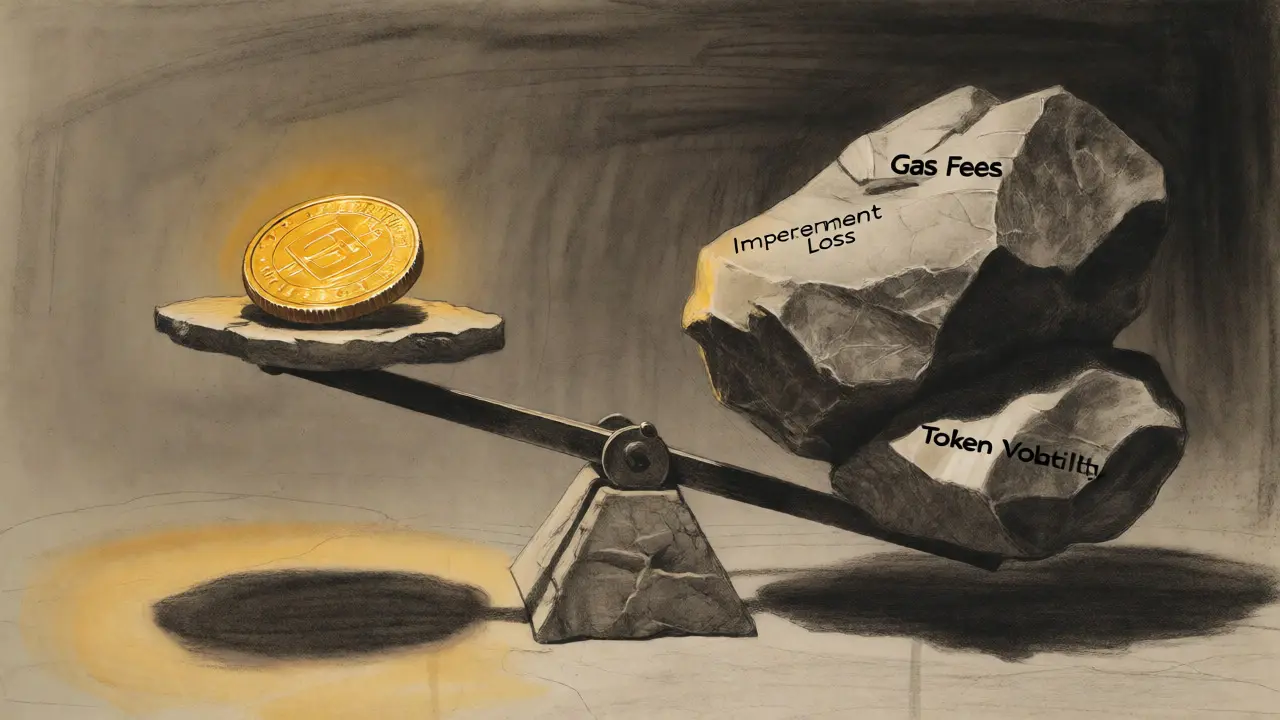
Real Returns vs. Advertised Rates
Advertised APYs are gross figures. They don’t account for the costs required to capture those returns. To find your true profit, you must subtract three specific things:
- Gas Fees: On Ethereum mainnet, claiming rewards might cost $10-$50 depending on congestion. On Layer 2s like Arbitrum or Optimism, it’s cents. This changes everything for small deposits.
- Platform Fees: Some protocols take a cut of your yield (e.g., 10-20%) to fund development treasuries.
- Token Price Volatility: You’re paid in governance tokens (like CRV, UNI, or AAVE). If the token price drops 50%, your 50% APY effectively becomes 0% in USD terms.
Let’s run a realistic calculation. You deposit $10,000 into a stablecoin pool offering 10% APY. The protocol takes a 10% fee on earnings. You pay $20 in gas to enter and exit. You hold for one year.
- Gross Earnings: $10,000 * 10% = $1,000.
- Protocol Fee: $1,000 * 10% = $100 deducted.
- Net Earnings: $900.
- Gas Costs: $20 total.
- Actual Profit: $880.
- True ROI: 8.8%.
Now imagine the governance token you were paid in drops 20% in value during that year. Your $900 in tokens is now worth $720. Your actual ROI is 7%. The advertised 10% was a mirage.
Leveraged Yield Farming: Multiplying Risk
Platforms like Alpaca Finance allow you to borrow funds to increase your position size. This is called leveraged yield farming. It sounds great until you realize leverage amplifies losses just as much as gains.
If you use 3x leverage, your potential return triples, but so does your exposure to price swings and liquidation risks. You also pay borrowing interest rates. If the borrow rate is 5% and your farm yields 10%, your spread is only 5%. But if the market dips slightly, you might get liquidated, losing your entire principal. Calculating returns here requires modeling the "break-even" point where borrowing costs eat all your yield.

Tools and Strategies for Accurate Estimation
Don't rely on the protocol's front-end calculator alone. They are often optimistic. Use third-party aggregators like Zapper, Zerion, or DefiLlama to cross-reference data. These tools track real-time TVL (Total Value Locked), which helps gauge if a pool is getting crowded (and thus, lower yields).
A solid strategy involves checking the "Reward APY" separately from the "Supply APY." Supply APY comes from trading fees or lending interest-it’s relatively stable. Reward APY comes from emissions of new tokens-it’s inflationary and can drop quickly as more people join the pool. If 80% of your APY comes from rewards, be careful. That number will likely decay.
Frequently Asked Questions
Is APY always higher than APR?
Yes, mathematically, APY is always equal to or higher than APR because APY accounts for compounding effects. However, in DeFi marketing, sometimes protocols quote inflated APYs based on short-term spikes that aren't sustainable, making the comparison tricky without looking at historical averages.
How does gas fee impact my yield farming return?
Gas fees significantly reduce net returns, especially for smaller investments. If you invest $100 and pay $20 in gas to enter and exit a position, you start with a -20% loss. You need substantial capital or low-cost networks (like Polygon or Arbitrum) to make gas fees negligible relative to your yield.
What is a good APY for yield farming?
There is no single "good" number, but generally, 5-15% APY on stablecoins is considered safe and sustainable. Anything above 20-30% usually implies higher risk, such as volatile token rewards or impermanent loss exposure. Be skeptical of triple-digit APYs; they often signal high inflation or unsustainable emissions.
Can I lose money in yield farming?
Absolutely. Besides market crashes affecting token prices, you face smart contract bugs, de-pegs (where stablecoins lose their 1:1 value), and impermanent loss. High APYs are compensation for these risks, not guaranteed profit.
Do I need to claim rewards manually?
It depends on the protocol. Some auto-compound rewards back into the principal, boosting your APY automatically. Others require you to claim tokens manually, which incurs gas fees and requires you to decide whether to sell, hold, or restake them. Manual claiming allows for better tax management but adds operational overhead.