

China banned cryptocurrency-but millions still use it
China outlawed crypto trading, mining, and exchanges in 2021. Officially, owning Bitcoin or Ethereum is illegal. Banks are ordered to block crypto-related transactions. Apps that offer wallets are taken down. Yet, by 2025, 59 million Chinese citizens are still actively buying, selling, and holding cryptocurrency. That’s more than the entire population of Spain. And it’s the second-largest crypto user base in the world-behind only India.
How is this possible? The answer isn’t magic. It’s ingenuity, desperation, and a system that can’t fully control what people do in private.
They banned it, but they didn’t stop it
The Chinese government didn’t just warn about crypto-they shut it down. In 2013, the People’s Bank of China first warned about Bitcoin risks. By 2017, they banned ICOs. In September 2021, they made it official: all crypto-related activities were illegal. Exchanges like Binance and OKX were forced to exit mainland China. Mining farms were shut down. Bank accounts linked to crypto were frozen.
But here’s the twist: the ban only applies to businesses and platforms. Private ownership? It’s in a legal gray zone. No law says you can’t hold Bitcoin in your phone. But if you’re caught trading it, you’re on your own. There’s no legal recourse. No protection. No insurance. If you get scammed, you lose everything.
And yet, people keep doing it.
How do they do it? Offshore apps, VPNs, and WeChat groups
Chinese users don’t use local exchanges anymore. They use offshore platforms-Binance, Bybit, OKX-all based outside China. To access them, they use VPNs. About 78% of Chinese crypto traders rely on virtual private networks to bypass the Great Firewall, according to Chainalysis.
But the real story is peer-to-peer (P2P) trading. Over 63% of crypto transactions in China happen directly between people, not on exchanges. The most common method? WeChat and QQ groups. Buyers and sellers meet in encrypted chats, agree on a price, and use escrow services. One person sends the money. The other sends the crypto. A third party holds the funds until both sides confirm the trade. It’s risky-but it works.
Some users even use apps like ‘CryptoBridge’ and ‘Silk Road Wallet,’ built by Chinese developers to slip past government blocks. These apps hide behind encrypted channels and fake domain names. They’ve been downloaded over 8.7 million times on third-party Android stores since January 2025.
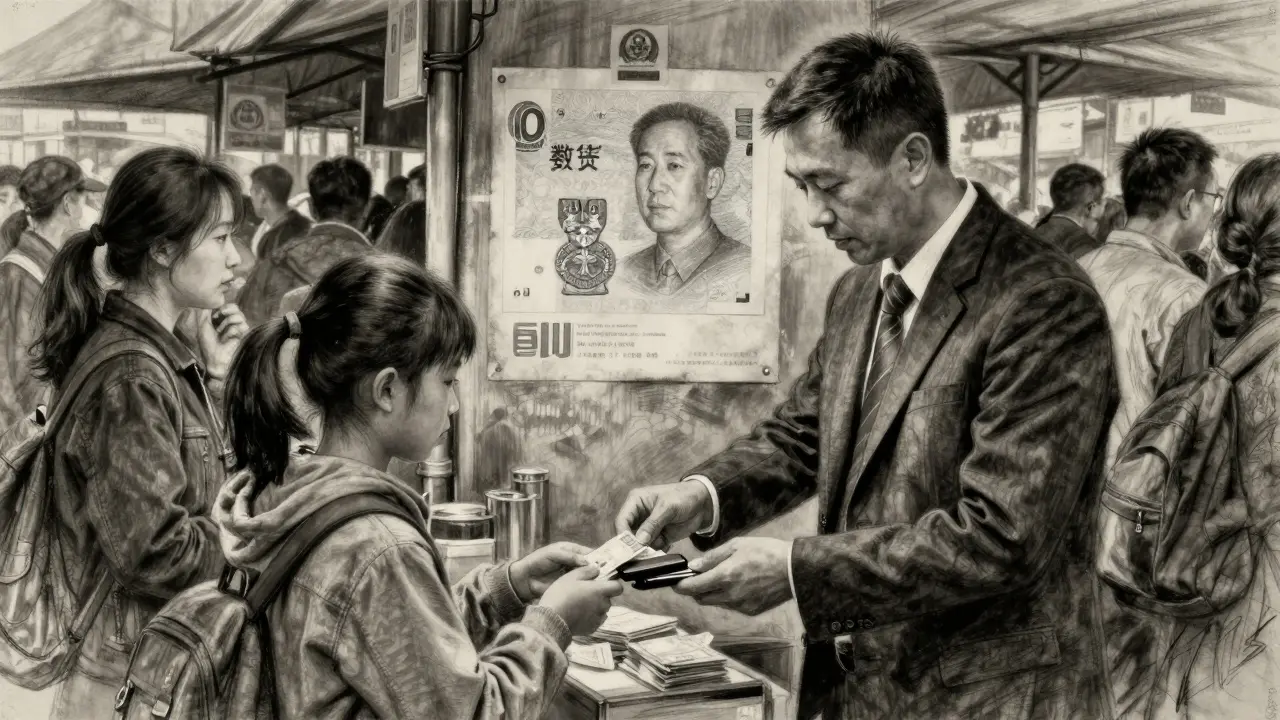
Stablecoins are the secret weapon
Bitcoin and Ethereum are volatile. Not ideal if you’re trying to send money to your kid in Australia or protect savings from inflation.
That’s why stablecoins like USDT (Tether) dominate. As of mid-2025, 38.7% of all crypto transactions in China are in stablecoins-up from just 21.7% in 2024. Why? Because USDT moves like cash, but across borders.
One user on a WeChat crypto forum wrote: “Sending $5,000 to my daughter in Australia used to cost me 87% in bank fees and take three days. Now I send USDT. It’s done in 15 minutes. No paperwork. No questions.”
For many, crypto isn’t about speculation. It’s about survival-beating capital controls, avoiding currency devaluation, and keeping money accessible when the government won’t let you take it out.
The digital yuan is the government’s answer
While cracking down on Bitcoin, China is pushing its own digital currency: the e-CNY, or digital yuan.
By the end of 2024, over 260 million personal wallets and 15.5 million business wallets had been created. In the first half of 2025, the digital yuan processed 1.8 trillion CNY ($248 billion) in transactions. It’s being used to pay civil servants, buy subway tickets, and settle B2B trade in pilot zones.
The government calls it “innovation.” Critics call it surveillance. Unlike Bitcoin, the e-CNY gives the state full visibility into every transaction. Who you paid. How much. When. Where. Even what you bought.
For many Chinese users, this is the core conflict: they want financial freedom-but the state wants control.
Who’s using crypto in China? Young, male, tech-savvy
It’s not everyone. Crypto users in China are skewed.
According to Peking University’s 2025 study, 89.2% are men. That’s higher than the global average of 86.9%. And the biggest group? People aged 25 to 34. They make up 37.5% of users-way above the global average of 31%.
People over 45? Only 12.8% of users. That’s less than half the global rate. Older generations don’t trust it. Or they don’t understand it. Or they’re too scared of the risks.
Younger users? They grew up with smartphones, hacking culture, and a distrust of state-controlled systems. Crypto isn’t just an investment. It’s a rebellion.

The cost of breaking the rules
It’s not risk-free.
According to a Reddit survey from April 2025, 68% of Chinese crypto users have had their bank accounts frozen because of crypto activity. The average loss per incident? 23,500 CNY-around $3,250.
Scams are rampant. In Q1 2025 alone, Chinese authorities recorded 1.2 billion CNY ($165 million) in crypto fraud losses. Fake trading bots. Fake P2P escrow services. Fake “guaranteed returns” on Telegram channels.
But here’s the surprising part: 82% of users who lost money still keep trading. And 45% actually increased their investment in 2025 compared to 2024.
Why? Because the alternatives are worse.
Is the ban changing? Signs point to yes
China’s stance isn’t static. Behind closed doors, officials are debating.
In July 2025, the Shanghai State-owned Assets Supervision and Administration Commission released meeting minutes suggesting a shift. One deputy director said: “The rapid evolution of digital assets necessitates more nuanced regulatory approaches.” That’s not a full reversal-but it’s not a hardline stance either.
Meanwhile, Hong Kong, a separate financial system under “one country, two systems,” has become a crypto gateway. Seven exchanges are now licensed there. In April 2025, they handled $14.3 billion in monthly trading volume. Many mainland Chinese users route their trades through Hong Kong accounts.
Even the State Administration of Foreign Exchange, which cracked down on 27 P2P platforms in May 2025, is now monitoring overseas crypto flows-not to stop them entirely, but to track capital flight.
Analysts at Bernstein predict a 65% chance China will soften its stance by 2027. Maybe they’ll tax crypto like India does-with a flat 30% rate. Maybe they’ll allow regulated exchanges under strict oversight.
But for now? The ban stands. And the people keep trading.
What’s next for crypto in China?
China’s crypto story isn’t about defiance. It’s about adaptation.
The government wants control. The people want freedom. Neither side is backing down. The result? A hidden economy of encrypted chats, offshore apps, and stablecoin transfers-running parallel to the state’s digital yuan.
One thing is clear: you can ban a currency. But you can’t ban the need for it.
As long as capital controls exist, as long as inflation looms, and as long as young people distrust the system-crypto will find a way.
Is it illegal to own Bitcoin in China?
Owning Bitcoin or other cryptocurrencies isn’t explicitly illegal for individuals-but trading, exchanging, or using them through platforms is. The government doesn’t prosecute people for holding crypto in a personal wallet. But if you use an exchange, send crypto to someone, or even receive crypto as payment, you risk having your bank account frozen, facing fines, or being investigated. There’s no legal protection if you’re scammed.
How do Chinese people buy crypto if exchanges are banned?
Most use offshore exchanges like Binance, Bybit, or OKX via VPNs. But the majority-63%-trade peer-to-peer through WeChat or QQ groups. Buyers and sellers arrange trades manually, often using escrow services. Some use specialized apps like CryptoBridge that bypass government filters. Payments are made via bank transfer, Alipay, or WeChat Pay, then matched with crypto delivery.
Why are stablecoins so popular in China?
Stablecoins like USDT are used because they’re stable, fast, and borderless. People use them to send money overseas without triggering capital controls. Sending $5,000 to family abroad via traditional banks can cost hundreds in fees and take days. With USDT, it’s done in minutes for under $10. They’re also used to protect savings from inflation and currency devaluation.
What’s the difference between crypto and China’s digital yuan?
Crypto is decentralized, anonymous, and uncontrolled. The digital yuan (e-CNY) is a state-backed digital currency controlled entirely by the People’s Bank of China. Every transaction is tracked. The government knows who paid whom, how much, and when. Crypto offers freedom. The digital yuan offers control. They’re opposites.
Are people getting arrested for using crypto in China?
Most individuals aren’t arrested for personal use. But businesses, exchange operators, and large-scale traders face serious penalties. In 2025, Chinese authorities froze over 1,287 bank accounts linked to crypto and imposed $32.6 million in fines. While jail time is rare for ordinary users, repeated violations or involvement in money laundering can lead to criminal charges under China’s Anti-Money Laundering Law.
Will China ever legalize crypto?
Full legalization is unlikely. But a regulated system-like India’s 30% tax on crypto gains-is possible by 2027. Analysts believe China may allow crypto trading under strict oversight, with licensed exchanges and KYC rules. The goal won’t be to embrace decentralization, but to bring it under state control. The digital yuan will remain the official digital currency. Crypto might become a restricted investment asset, not a payment tool.


