

You might have heard rumors that South Korea is slapping a massive 45% or even higher tax on your crypto profits. It sounds terrifying if you are an active trader or a staking enthusiast. But the reality is far more nuanced-and potentially much kinder to small investors than those scary headlines suggest.
As of mid-2026, the landscape for cryptocurrency taxation in South Korea has shifted dramatically due to political negotiations. The government has officially delayed the implementation of the new crypto tax regime until January 2027. This delay provides a crucial window for investors to understand exactly how the rules will work once they kick in. The headline numbers often cited-ranging from 20% to nearly 50%-depend entirely on whether you are treating crypto as an investment (capital gains) or as a paycheck (income).
The 2027 Deadline: Why the Delay Matters
For years, South Korea’s crypto tax law was a moving target. Initially slated for 2022, it was pushed to 2025, and finally, after intense lobbying by the ruling People Power Party and opposition groups in late 2024, the start date was set for January 1, 2027. This isn't just bureaucratic shuffling; it reflects a genuine struggle to balance government revenue needs with the fear of driving capital offshore.
Why does this matter to you? Because until that January 2027 deadline, there is no specific capital gains tax on cryptocurrencies for residents. However, do not mistake this silence for permission to ignore record-keeping. The National Tax Service (NTS) has been issuing clarifications throughout 2025 and 2026, signaling that once the clock starts, they expect full compliance. The delay gives you time to organize your transaction history, which can be a nightmare if you’ve been trading since 2020.
Capital Gains vs. Income: The Two Different Tax Buckets
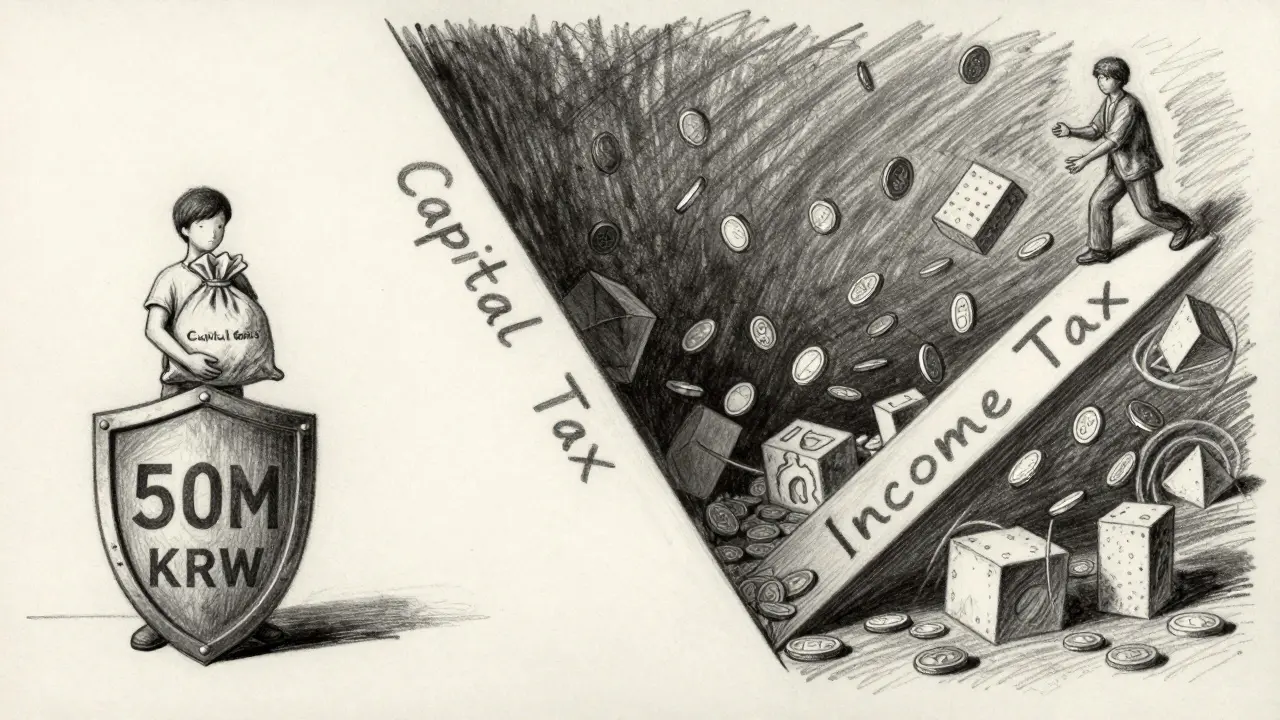
To understand why you see rates ranging from 20% to 49.5%, you need to separate two distinct concepts: Capital Gains Tax (CGT) and Income Tax. Most retail investors fall into the first category, but many mistakenly assume all crypto earnings are taxed the same way.
| Tax Type | Applies To | Rate Structure | Exemption Threshold |
|---|---|---|---|
| Capital Gains Tax (CGT) | Selling/trading crypto for profit (investment) | 20% + 10% local surcharge = 22% effective rate | 50 million KRW (~$35,900 USD) annual gains |
| Income Tax | Mining, staking, airdrops, paid services ("Other Income") | Progressive rates: 6.6% to 49.5% | No specific high-threshold exemption; added to total taxable income |
The 22% Capital Gains Rate (With a Huge Safety Net)
If you buy Bitcoin today and sell it next year for a profit, that is a capital gain. Under the 2027 framework, the base tax rate is 20%. However, South Korea adds a 10% local inhabitant tax on top of national taxes, bringing the effective rate to 22%.
Here is the critical part that saves most retail investors: the 50 million Korean Won exemption. You only pay this 22% tax on the portion of your annual gains that exceeds 50 million KRW. If you made 40 million KRW in profit this year, you pay zero capital gains tax. If you made 60 million KRW, you only pay 22% on the extra 10 million KRW. This structure protects casual investors while targeting high-volume traders and institutional players.
The Up to 49.5% Income Tax Trap
This is where the "45%+" rumors come from. If you earn crypto through mining, staking rewards, airdrops, or by accepting crypto as payment for freelance work, the NTS classifies this as "other income." This income is added to your salary, business profits, and other earnings to determine your total taxable income for the year.
South Korea uses a progressive income tax system. If your total income (including crypto) places you in the highest bracket, the marginal tax rate can reach 45% nationally, plus the 10% local surcharge, totaling 49.5%. So, if you are a high-earner receiving significant staking rewards, those rewards could indeed be taxed at nearly half their value. This distinction is vital: passive holding is taxed lightly (if above the threshold), but active yield generation is taxed heavily.
Who Is Exempt? Understanding the Thresholds
Let’s break down who actually pays money under this system. The 50 million KRW threshold is generous compared to many Western nations that tax every dollar of gain immediately. For context, 50 million KRW is roughly $35,900 USD.
Consider these scenarios:
- The Casual Investor: Buys $5,000 worth of Ethereum, holds it for two years, sells for $10,000. Profit: $5,000. Since this is well below the 50 million KRW threshold, the capital gains tax is 0%.
- The Active Trader: Makes 80 million KRW in net trading profits over the year. They pay 22% tax only on the 30 million KRW that exceeds the limit. That’s 6.6 million KRW in tax.
- The Staker: Earns 10 million KRW in staking rewards. This is added to their regular salary. If their total income pushes them into a higher bracket, they might pay 15-20% on that extra income, depending on their overall financial picture.
Note that there is no "holding period" exemption like in Germany (where holding for one year makes gains tax-free). In South Korea, whether you hold for a week or ten years, if you sell for a profit above the threshold, it’s taxed the same way.
Foreigners and Non-Residents: A Different Rulebook
If you are not a tax resident of South Korea, the rules change significantly. Foreign individuals and corporations disposing of crypto assets face either an 11% withholding tax on the transfer price or a 22% tax on net capital gains, depending on specific treaties and circumstances. There is no 50 million KRW exemption for non-residents in the same way. This means foreign investors need to be particularly careful about structuring their exits from Korean exchanges.
Compliance Challenges: Tracking DeFi and Cross-Border Trades
The biggest headache for taxpayers won’t be the rate itself, but the reporting. The blockchain is transparent, and the NTS has access to data from major exchanges. But what about your DeFi transactions?
Transactions involving decentralized finance (DeFi), such as swapping tokens on Uniswap or providing liquidity, are treated as taxable events. Every time you swap Token A for Token B, you must calculate the fair market value in Korean Won at that exact moment to determine your cost basis. Without automated software, tracking hundreds of these micro-transactions is nearly impossible manually.
Tax professionals estimate that setting up proper records for an active trader takes 10-20 hours initially, plus monthly maintenance. You need to export CSV files from every exchange and wallet, reconcile them, and convert historical prices to KRW. The NTS has clarified that residents must report comprehensive income from virtual assets received from foreign corporations, closing loopholes that some users previously exploited.

Practical Steps to Prepare Before 2027
Even though the tax doesn’t start until 2027, you should act now. Here is a checklist to ensure you aren’t blindsided:
- Consolidate Your Data: Start exporting transaction histories from all exchanges (Bithumb, Upbit, Binance, etc.) and wallets (MetaMask, Ledger) quarterly. Do not wait until December 2026.
- Use Crypto Tax Software: Tools like CoinTracker or Koinly can integrate with Korean exchanges and calculate cost basis automatically. Given the complexity of DeFi, manual spreadsheets are prone to error.
- Separate Investment from Income: Keep clear records of which wallets are used for trading (capital gains) and which receive staking/mining rewards (income). Mixing them complicates your tax filing significantly.
- Monitor NTS Updates: The National Tax Service releases guidance periodically. Subscribe to updates from reputable Korean tax firms to catch changes in interpretation, especially regarding NFTs and cross-border transfers.
- Consult a Specialist: If your gains exceed 50 million KRW or you have complex DeFi activity, hire a tax accountant familiar with virtual assets. General accountants may not understand the nuances of crypto-to-crypto trades.
Global Context: How Does South Korea Compare?
South Korea’s approach is relatively moderate for capital gains but aggressive for income. Compared to the United States, where long-term capital gains can be 15-20% and short-term gains are taxed as ordinary income (up to 37%), South Korea’s flat 22% rate on excess gains is simpler. However, the lack of a holding-period benefit puts it at a disadvantage for long-term holders compared to countries like Germany or Portugal (though Portugal’s rules have also tightened recently).
In Asia, Japan taxes crypto gains as miscellaneous income with progressive rates up to 55%, making South Korea’s capped 22% rate for pure trading profits quite attractive. Singapore remains tax-free for crypto gains, but lacks the robust regulatory clarity and investor protections that South Korea is building.
When does South Korea's crypto tax officially start?
The cryptocurrency capital gains tax is scheduled to begin on January 1, 2027. This date was confirmed after political negotiations in late 2024, delaying previous plans for 2022 and 2025.
Do I pay tax on small crypto profits?
No. If your annual capital gains from selling or trading crypto are below 50 million Korean Won (approx. $35,900 USD), you pay zero capital gains tax. The 22% rate only applies to profits exceeding this threshold.
How are staking rewards taxed in South Korea?
Staking rewards are classified as "other income," not capital gains. They are added to your total annual income and taxed at progressive rates ranging from 6.6% to 49.5%, depending on your total income level. There is no specific exemption threshold for staking income.
Is there a VAT on cryptocurrency transactions?
No. Value-Added Tax (VAT) is not imposed on cryptocurrency transactions in South Korea because crypto is not legally defined as goods or services under current tax law.
What happens if I am a foreigner trading on Korean exchanges?
Non-residents face different rules. They may be subject to an 11% withholding tax on the transfer price or a 22% tax on net capital gains. Unlike residents, foreigners generally do not benefit from the 50 million KRW exemption for capital gains.
Does holding crypto longer reduce my tax bill?
Currently, no. South Korea does not offer a long-term holding exemption for crypto like some other countries (e.g., Germany’s one-year rule). All capital gains above the threshold are taxed at the same 22% effective rate, regardless of how long you held the asset.