
Imagine logging into your favorite crypto exchange to check your portfolio, only to find the site completely empty. No charts, no prices, and worse-no way to withdraw your funds. This isn’t a hypothetical nightmare for many traders who once trusted RightBTC. If you are reading this hoping to sign up or trade on RightBTC today, I have some urgent news for you: RightBTC is a defunct cryptocurrency exchange that ceased operations and is currently classified as dead by multiple industry trackers.
You cannot deposit money here. You cannot trade here. And if you somehow still have an account from years ago, those funds are likely gone forever. This review isn't about how great the platform used to be; it’s a critical look at why RightBTC failed, what happened to its users, and exactly what you should avoid when choosing an exchange in 2026.
The Current Status: Dead and Buried
Let’s get straight to the point. As of mid-2026, RightBTC is not operational. Major cryptocurrency tracking platforms like CryptoWisser and ICORankings have officially moved RightBTC to their "Exchange Graveyard." What does that actually mean for you?
- No Active Markets: There are zero trading pairs available. You can’t buy Bitcoin, Ethereum, or any altcoin on this platform.
- No Reserve Transparency: The exchange stopped publishing proof-of-reserves audits. In the post-FTX era, an exchange without public reserve data is a massive red flag.
- Website Inaccessibility: While the domain might technically exist, the trading interface is broken or non-functional for new users.
- Untracked Volume: Data aggregators like CoinMarketCap and CoinGecko no longer list RightBTC because it fails to meet minimum volume and liquidity requirements.
If you try to visit the site right now, you won’t find the bustling marketplace it claimed to be. Instead, you’ll encounter a digital ghost town. For anyone considering using RightBTC, the answer is a hard no. Do not attempt to register.
A Brief History: How RightBTC Rose and Fell
To understand why RightBTC collapsed, we need to look back at where it started. Founded in 2014, RightBTC emerged during the wild west days of cryptocurrency. Back then, barriers to entry were low, and security standards were practically nonexistent.
In its prime, RightBTC marketed itself as a user-friendly platform for both beginners and pros. They boasted about being a "regular in the top 25 crypto exchanges by volume" according to historical data from CryptoCompare. They offered 24/7 customer support and a clean design that was praised by early reviewers. It seemed like a solid option compared to the clunky interfaces of other early exchanges.
However, the crypto landscape changed drastically between 2014 and 2026. Exchanges had to scale up, implement rigorous security protocols, and navigate complex global regulations. RightBTC failed to keep pace. Unlike giants like Binance or Coinbase, which invested millions in compliance and technology, RightBTC remained a mid-tier player with limited resources. When the market turned bearish and regulatory pressure increased, the platform simply couldn’t survive.
Fees and Features: What Was Offered?
When analyzing defunct exchanges, it’s helpful to look at their last known fee structures and features to understand their business model. RightBTC operated on a surprisingly simple pricing model.
| Fee Type | RightBTC (Historical) | Industry Standard (e.g., Binance/Kraken) |
|---|---|---|
| Maker Fee | 0.2% | 0.1% - 0.16% |
| Taker Fee | 0.2% | 0.1% - 0.15% |
| Withdrawal Fees | Variable (Network Dependent) | Variable (Often lower due to scale) |
That flat 0.2% fee was easy to understand, but it wasn’t competitive. High-volume traders prefer maker-taker models where they pay less for providing liquidity. By sticking to a flat rate, RightBTC alienated professional traders while offering no significant advantage to casual users who could easily find cheaper alternatives on larger platforms.
Feature-wise, RightBTC was basic. It offered spot trading for popular cryptocurrencies like Bitcoin and Litecoin. There were no advanced derivatives, no staking services, and no decentralized finance (DeFi) integrations. In 2026, these features are table stakes. An exchange without them is considered outdated, even if it were still running.
Why Did RightBTC Fail? The Core Issues
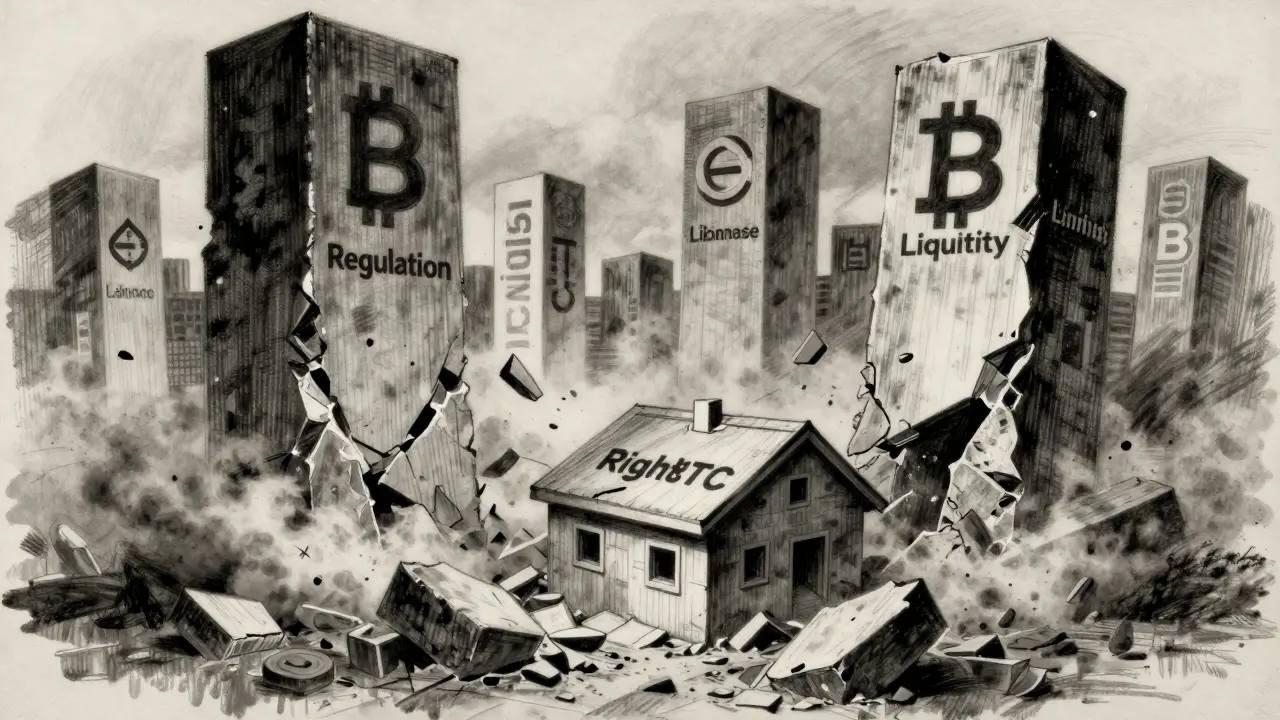
Exchanges don’t just disappear overnight. There are usually warning signs. Based on expert analysis from firms like Chainalysis and ICORankings, three main factors led to RightBTC’s demise:
- Lack of Liquidity: Trading volume dried up. Without enough buyers and sellers, spreads widen, and slippage increases. Users hate this, so they leave, causing further volume decline-a death spiral.
- No Regulatory Compliance: As governments cracked down on crypto, exchanges needed licenses. Coinbase spent over $150 million annually on compliance by 2023. RightBTC had no evidence of such investments, making it vulnerable to legal shutdowns.
- Security and Trust Deficits: After the FTX collapse in 2022, users demanded proof-of-reserves. RightBTC stopped providing transparency. Without trust, capital flees.
This pattern is common. According to a 2023 report, approximately 68% of exchanges operating in 2018 had ceased operations by 2023. RightBTC was part of that statistic. It wasn’t necessarily hacked; it just became unsustainable.
Is Your Money Safe? Recovering Funds from Defunct Exchanges
This is the question keeping people up at night. If you had funds on RightBTC before it shut down, what are your chances of getting them back?
The harsh reality is that recovery is extremely difficult. A study by the Cambridge Centre for Alternative Finance found that 83% of failed exchanges provide no mechanism for user fund recovery. Here is why:
- No Legal Entity: Many older exchanges were registered in offshore jurisdictions with loose laws. If the company dissolves, there is often no one to sue.
- Insolvency: Even if the company exists, it may owe more than it has. Creditors (including users) get pennies on the dollar, if anything.
- Lost Keys: In some cases, the private keys to the cold wallets holding user funds are lost or corrupted, making the assets mathematically inaccessible.
If you are affected, do not fall for scams. People will DM you on social media claiming they can "recover" your RightBTC funds for a fee. These are always scams. Legitimate recovery requires official bankruptcy proceedings, which rarely happen for small crypto exchanges.
Safe Alternatives for 2026
Since RightBTC is off the table, where should you go? You need an exchange that prioritizes security, transparency, and regulatory compliance. Here are three reliable alternatives that dominate the market in 2026:
1. Coinbase
Coinbase is the gold standard for regulated trading in the US and globally. It is publicly traded, meaning it undergoes strict financial audits. It offers high security, insurance on USD holdings, and excellent customer support. Ideal for beginners and institutional investors alike.
2. Kraken
Kraken has a long history of never being hacked. They are transparent about their reserves and offer competitive fees for active traders. Their focus on privacy and security makes them a favorite among experienced crypto holders.
3. Binance
Binance remains the largest exchange by volume. It offers a vast array of coins, low fees, and advanced trading tools. However, due to its size and global reach, it faces ongoing regulatory scrutiny in various countries. Always check local legality before using it.
How to Spot a Bad Exchange Before It’s Too Late
Don’t let another RightBTC situation happen to you. Use this checklist to vet any exchange before you deposit a single cent:
- Proof of Reserves: Does the exchange publish regular, audited proof-of-reserves reports? If not, run.
- Regulatory Licenses: Is the exchange licensed in reputable jurisdictions (like the US, UK, EU, Singapore)?
- Volume Consistency: Check independent trackers like CoinGecko. Is the volume real, or does it spike artificially?
- Customer Support Responsiveness: Try contacting support before signing up. If they ignore you, they won’t help you when things go wrong.
- Age and Reputation: Older isn’t always better, but brand new exchanges with no track record are risky. Look for consistent positive feedback over years, not months.
The crypto market is volatile, but your exchange shouldn’t be. Stick to established players with skin in the game.
Is RightBTC a scam?
While RightBTC may not have been founded as a deliberate scam, it operates as a defunct platform with no ability to return user funds. In practical terms, using it now would result in total loss of assets, which mimics the outcome of a scam. Experts classify it as "dead" due to lack of activity and transparency.
Can I still access my old RightBTC account?
You may be able to log in if the website is still partially hosted, but you will not be able to trade or withdraw funds. The exchange has no active markets. Any funds displayed in your account balance are likely frozen and unrecoverable.
What happened to RightBTC in 2023?
In 2023, major tracking sites like CryptoWisser and ICORankings marked RightBTC as "defunct" or "empty." This was due to a complete cessation of trading volume, lack of reserve audits, and general inactivity following the broader crypto market downturn and increased regulatory pressures.
Are there any refunds for RightBTC users?
There is no official refund program. Historical data suggests that most users of failed mid-tier exchanges receive nothing. Be wary of third parties claiming they can recover your funds, as these are almost certainly frauds.
Which crypto exchanges are safest in 2026?
As of 2026, Coinbase, Kraken, and Binance are considered among the safest due to their large market share, regulatory compliance efforts, and regular proof-of-reserves publications. Always verify current regulatory status in your specific country.