
Imagine you need to prove that a specific receipt is part of a massive ledger containing millions of entries. You could send the entire ledger to your friend so they can check it themselves, but that would take forever and use up all their storage space. Or, you could just show them the receipt, but how do they know you didn’t forge it? This is the exact problem Merkle Trees are cryptographic data structures used to verify the integrity of large datasets efficiently. They solve this by creating a single digital fingerprint for the whole dataset, allowing anyone to verify a small piece of data without seeing the rest.
In the world of blockchain, where trust is distributed among thousands of strangers, this efficiency isn't just convenient-it's essential. Without Merkle Trees, verifying transactions on networks like Bitcoin or Ethereum would be computationally impossible for most users. Let’s break down how these trees work, why they matter, and how they keep your digital assets safe.
The Anatomy of a Merkle Tree
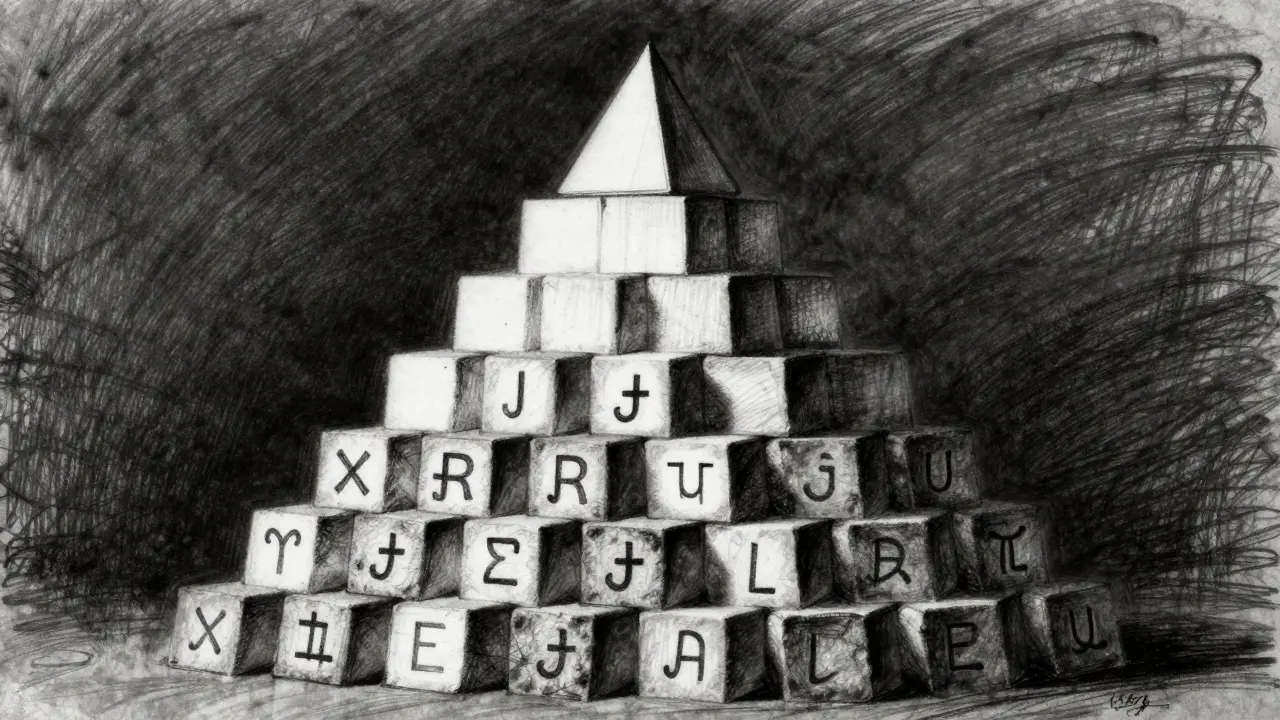
To understand how verification works, we first need to look at the structure itself. A Merkle Tree is essentially a binary tree built from the bottom up using cryptographic hashes. Think of it like building a pyramid out of blocks, but instead of stacking physical bricks, you are stacking mathematical summaries.
Here is the step-by-step process:
- Leaf Nodes: At the very bottom of the tree, you have individual pieces of data-in blockchain terms, these are transactions. Each transaction is hashed (using an algorithm like SHA-256) to create a unique string of characters called a leaf node.
- Pairing and Hashing: These leaf nodes are then paired up. The two hashes in a pair are concatenated (joined together) and hashed again. This creates a new parent node above them.
- Repeating Upwards: This pairing and hashing process continues level by level. If there is an odd number of nodes at any level, the last node is duplicated and paired with itself.
- The Merkle Root: Eventually, you reach the top of the tree with a single hash remaining. This is the Merkle Root. It serves as a comprehensive digital fingerprint for every single transaction in that block.
This root hash is then stored in the block header of the blockchain. Because every hash depends on the ones below it, changing even one bit of data in a single transaction will completely change its leaf hash, which changes its parent hash, and so on, all the way up to the Merkle Root. This makes tampering immediately obvious.
Why Efficiency Matters: The Logarithmic Advantage
You might wonder why we don’t just check the whole list. In a centralized database, that’s fine. But in a decentralized network like Bitcoin, there are hundreds of thousands of transactions per day. Storing and processing the entire history requires significant hardware and bandwidth.
Merkle Trees offer a mathematical shortcut. The time it takes to verify a transaction grows logarithmically with the size of the dataset, not linearly. Here is what that means in practice:
| Number of Transactions | Brute Force Checks Needed | Merkle Proof Steps Needed |
|---|---|---|
| 10 | 10 | ~4 |
| 1,000 | 1,000 | ~10 |
| 10,000 | 10,000 | ~14 |
| 1,000,000 | 1,000,000 | ~20 |
As you can see, even with a million transactions, you only need about 20 hash operations to prove one of them exists. This is a massive reduction in computational overhead. It allows lightweight devices, like smartphones, to interact with the blockchain without needing to download gigabytes of data.

Simplified Payment Verification (SPV)
The most common real-world application of Merkle Trees is in Simplified Payment Verification (SPV) wallets. These are the lightweight wallets you likely use on your phone to send Bitcoin or Ethereum. They don’t store the full blockchain; they only store the block headers.
When you receive a payment, your wallet needs to confirm that the transaction is actually included in a valid block. Here is how the proof works:
- Your wallet requests a "Merkle Proof" from a full node on the network.
- The full node provides the hash of your transaction, plus the sibling hashes needed to traverse up the tree to the root.
- Your wallet recalculates the path from your transaction hash up to the Merkle Root.
- If the calculated root matches the Merkle Root in the block header, the transaction is verified.
This process requires minimal data transfer-just a few kilobytes instead of megabytes. It enables scalability because millions of users can verify transactions without clogging the network with full-node synchronization requests.
Beyond Bitcoin: Ethereum and Smart Contracts
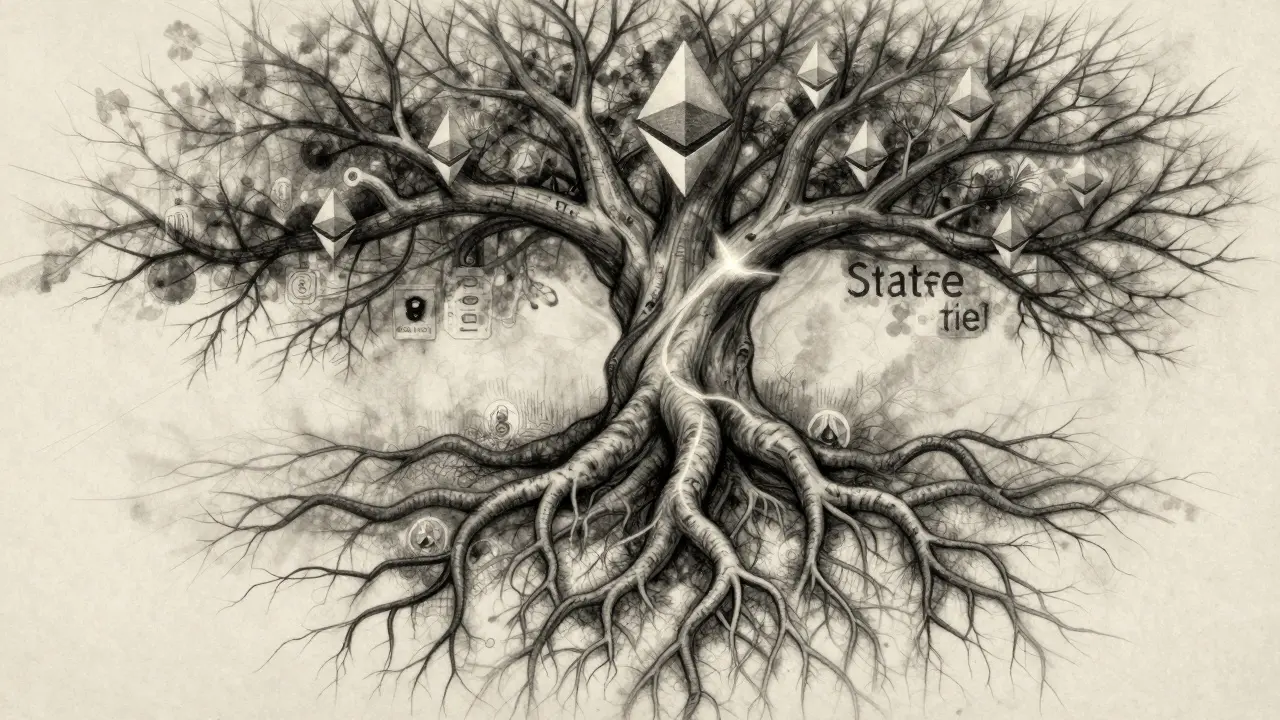
While Bitcoin uses Merkle Trees primarily for transaction lists, Ethereum applies them more broadly. Ethereum uses a variant called the Patricia Merkle Trie (often just called the State Trie). This structure doesn’t just track transactions; it tracks the state of the entire network-including account balances, contract code, and storage variables.
Every time a smart contract executes, the state changes, and the Merkle Root updates. This allows developers to build applications that rely on verifiable data. For example, if a decentralized finance (DeFi) protocol claims you have a certain balance, you can cryptographically prove that claim using a Merkle proof against the current state root.
This versatility is why Merkle Trees are considered foundational infrastructure. They enable:
- Data Integrity: Ensuring no records have been altered since they were written.
- Privacy: Zero-knowledge proofs often use Merkle Trees to prove membership in a set without revealing the specific element.
- Interoperability: Cross-chain protocols like Cosmos IBC use Merkle proofs to verify events on one chain before executing actions on another.
Common Challenges and Implementation Details
Implementing Merkle Trees correctly is tricky. Developers often run into edge cases that can compromise security or efficiency. One common issue is handling odd numbers of leaf nodes. As mentioned earlier, if you have three transactions, the third one must be duplicated to form a pair. If implemented incorrectly, this can lead to malleability attacks where different trees produce the same root.
Another challenge is performance. While the verification is fast, generating the proof requires access to the full tree. Full nodes must maintain the complete dataset to serve proofs to SPV clients. This creates a dependency between lightweight users and resource-intensive validators, which is a centralization risk if too few full nodes remain online.
Furthermore, as quantum computing advances, the hash functions used in Merkle Trees (like SHA-256) may eventually become vulnerable. Researchers are already exploring post-quantum cryptographic algorithms to future-proof these structures, ensuring that the integrity guarantees hold up against next-generation threats.
Real-World Impact Outside Crypto
Merkle Trees aren’t limited to cryptocurrency. Their ability to provide efficient, tamper-evident verification makes them valuable in many industries. Banking institutions use them to create audit trails for financial records, allowing regulators to verify millions of entries by checking a single hash. Supply chain managers use them to track goods from factory to consumer, ensuring that product data hasn’t been altered mid-transit.
Even file-sharing systems like Git use similar concepts to manage version control efficiently. By understanding how Merkle Trees work, you gain insight into the fundamental technology that powers trust in our digital economy.
What happens if a transaction in a Merkle Tree is changed?
If even a single bit of data in a transaction is altered, its leaf hash changes completely. This change propagates up the tree, altering every parent hash until the final Merkle Root is completely different. Since the Merkle Root is stored in the block header, any mismatch indicates tampering, and the block is rejected by the network.
Do Merkle Trees require storing the entire blockchain?
No. That is their primary advantage. Lightweight wallets (SPV clients) only need to store the block headers and request Merkle Proofs for specific transactions. This reduces storage requirements from gigabytes to kilobytes while maintaining cryptographic security.
Are Merkle Trees secure against quantum computers?
Current implementations use hash functions like SHA-256, which are considered resistant to quantum attacks for the foreseeable future. However, researchers are developing post-quantum hash algorithms to ensure long-term security as quantum computing capabilities advance.
How does Ethereum use Merkle Trees differently than Bitcoin?
Bitcoin uses Merkle Trees primarily to hash transactions within a block. Ethereum uses a more complex structure called the Patricia Merkle Trie to hash the entire state of the network, including account balances and smart contract storage, allowing for verifiable state transitions.
What is a Merkle Proof?
A Merkle Proof is a set of sibling hashes that allows you to verify that a specific data item is included in a Merkle Tree. By hashing the target data along with the provided siblings, you can reconstruct the path to the Merkle Root and confirm inclusion without downloading the entire dataset.
so we trust math now? wow. just wow. the idea that a bunch of hashes can replace actual human oversight is terrifyingly naive but here we are. 🙄
This is literally the most boring explanation of cryptography I have ever read. Why do people care about this stuff anyway?
The centralized nature of the nodes required to generate these proofs is a glaring weakness. You think you are decentralized, but you rely on a few full nodes to serve the data. It is a trap designed to keep us dependent on the very institutions we claim to distrust.
i kinda get it now. its like a receipt for your digital money. pretty cool how it saves space on my phone tho. thanks for explaining!
Look at all you people falling for this tech hype. 😂 The 'efficiency' is just a marketing term for reducing security checks. You are handing over your keys to algorithms you don't understand. Typical. 🤡
Obviously anyone with a basic CS degree knows this already. Writing this for laymen is insulting to the intellectual capacity of this subreddit. The Patricia Merkle Trie is not just a 'variant', it is a fundamental shift in state management that requires deep understanding of sparse tries. Most of you wouldn't know a hash collision if it bit you.
It is fascinating how structure creates truth. The tree grows from the ground up, much like our own understanding of reality. Each node depends on the one below it. If the foundation is flawed, the root is corrupted. We must ensure our foundations are solid. 🌳
I appreciate the breakdown of SPV wallets. It really helps demystify how lightweight clients work without compromising security. For those who are worried about the centralization risk mentioned by Lee, it is important to remember that incentives align for many nodes to stay online because they earn fees. It is a delicate balance, but the protocol design encourages distribution rather than consolidation.
Let me tell you something. This technology was born out of American ingenuity and innovation. While other countries were busy with inefficiencies, we built the backbone of the future internet. Don't let anyone tell you otherwise. It is pure excellence.
Sarcasm aside, this is actually quite elegant. It reminds me of how different cultures verify oral histories through repetition and consensus. Maybe there is more wisdom in code than we give credit for. Or maybe I am just tired. Who knows? 😉
You missed the point entirely. The real issue is malleability. If you do not handle odd nodes correctly, you open yourself up to attacks that can invalidate entire blocks. It is sloppy coding practices that lead to these vulnerabilities. Fix your implementation before you preach about trust. 🛑
Another day, another buzzword salad. Merkle Trees are just fancy receipts for scammers. You think this protects you? Please. The elites use these structures to hide their own transactions while telling you to trust the math. Wake up sheeple. The system is rigged against you no matter what hash function you use.
Great post! Let's keep pushing forward! Understanding these basics is crucial for everyone involved in the crypto space. Keep learning, keep growing, and never stop questioning the underlying mechanics. That is how we build a stronger community! 💪
The logarithmic advantage is indeed significant. However, it is worth noting that the proof size still scales with the depth of the tree. For extremely large datasets, even 20 steps might be non-trivial for constrained devices. But generally, the efficiency gains are undeniable.
So basically, if I change one tiny thing, the whole thing breaks? That seems fragile. Like, why can't it just ignore small changes? Is that not possible? I feel like this is overly complicated for what should be a simple check. Can someone explain why we can't just use a checksum instead? Because that sounds easier.
A checksum only verifies integrity, not inclusion. A Merkle Tree proves that specific data is part of a larger set without revealing the rest. This distinction is vital for privacy and scalability in distributed systems. It allows verification without full disclosure.
OMG this is amazing! I never realized how much math goes into keeping my bitcoin safe! It feels like magic but it is just science! I love learning new things! Thank you so much for sharing this knowledge! It makes me feel so smart! ✨
hi friends. good article. i think merkle trees are useful. maybe we should use them more in daily life. just a thought. no pressure. hope everyone has a nice day. :)