
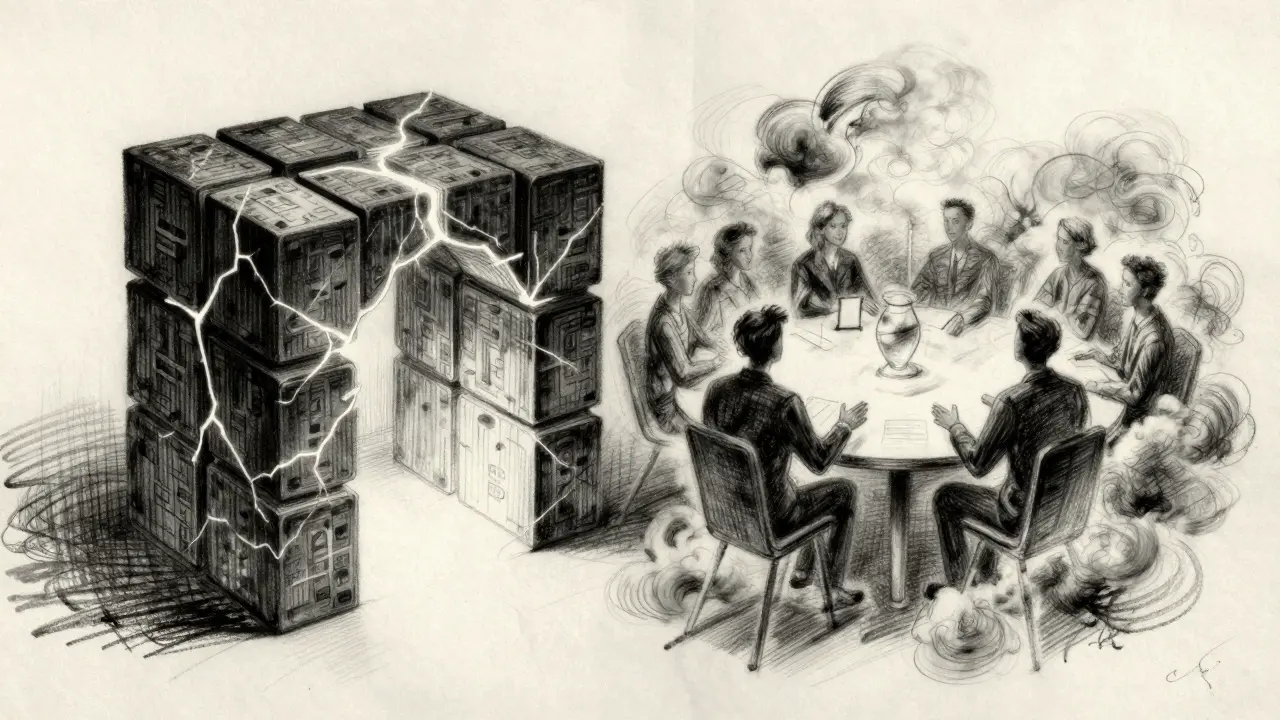
Imagine you’re part of a decentralized organization managing millions in assets. You want to propose a change to how interest rates are calculated. Do you click a button in your wallet to cast a vote that instantly updates the protocol? Or do you head to a forum, debate the idea for weeks, and hope the developers actually read the comments before they push an update?
This is the core tension in Blockchain Governance, which is the framework determining how blockchain networks evolve, upgrade, and respond to community needs. As we move through 2026, the debate isn't just academic anymore. It’s about where power lies, who gets heard, and whether your voice actually changes code or just generates noise.
The two main camps are On-Chain Governance, where decisions happen directly on the blockchain via smart contracts, and Off-Chain Governance, where discussions and votes occur on external platforms like forums or Discord. Neither is perfect. One is rigid but secure; the other is flexible but fragile. Let’s break down why most serious projects are moving toward a middle ground.
How On-Chain Governance Actually Works
When people talk about "true decentralization," they usually mean on-chain governance. In this model, every step of the decision-making process is recorded on the ledger. If a proposal passes, the smart contract executes it automatically. No humans need to intervene. No developers need to manually deploy code. The chain itself enforces the will of the majority.
Take MakerDAO, one of the earliest adopters of this system. When token holders vote to adjust the stability fee for DAI, that decision is written into the protocol’s logic immediately. This creates what experts call immutability and automated execution. Once the vote ends, the outcome is final and irreversible. There is no "oops" button. There is no CEO overriding the result because they disagree with the crowd.
The benefits here are clear:
- Transparency: Every vote, every delegation, and every proposal is public. You can audit the entire history of decisions without trusting anyone.
- Inclusivity: Anyone holding the governance token can participate. You don’t need permission from a foundation board.
- Security: Because the rules are in code, they are tamper-proof. A malicious actor cannot quietly change the voting results after the fact.
But there’s a catch. On-chain governance is expensive and slow. Voting costs gas fees. On Ethereum, even a simple vote can cost dollars, which prices out small holders. Plus, if a bad proposal slips through-say, a hack disguised as a feature-the network suffers until a new vote reverses it. That delay can be catastrophic.
The Reality of Off-Chain Governance
Now look at the other side. Off-Chain Governance relies on social consensus rather than code enforcement. Think of Bitcoin. There is no single "Bitcoin App" where you log in and vote on upgrades. Instead, miners, node operators, developers, and users discuss changes on GitHub, mailing lists, and conferences. Eventually, if enough nodes agree, they update their software to support the new version. If not, the chain splits (forks).
This approach has huge advantages for scalability and cost. Discussing a proposal on Discord or Telegram costs nothing. You can have thousands of people debating nuances without clogging the blockchain. It allows for nuance, education, and persuasion-things that binary yes/no votes often miss.
However, off-chain governance suffers from a major flaw: lack of binding enforcement. Just because 90% of voters said "yes" on a forum doesn’t mean the developers will implement it. They might ignore the community. They might misinterpret the vote. Or worse, a small group of insiders might collude off-chain to manipulate the narrative while pretending to listen to the crowd.
We’ve seen this play out in several high-profile controversies where communities felt unheard because the "vote" had no teeth. Without on-chain verification, trust becomes centralized around the reputation of a few key figures.

Comparing the Two Models: A Practical Breakdown
To decide which model fits your project or investment thesis, you need to look at specific attributes. Here is how they stack up against each other in real-world scenarios.
| Attribute | On-Chain Governance | Off-Chain Governance |
|---|---|---|
| Cost | High (Gas fees per vote/action) | Low (Free to discuss/vote externally) |
| Speed | Slow (Block confirmation times) | Fast (Instant messaging/forum posts) |
| Enforcement | Automatic (Smart contracts execute) | Manual (Developers must implement) |
| Privacy | None (All data is public) | Higher (Private channels possible) |
| Barrier to Entry | High (Need crypto wallet & tokens) | Low (Just need internet access) |
| Trust Model | Trustless (Code is law) | Social Trust (Rely on reputations) |
Notice the trade-off between enforcement and cost. On-chain gives you certainty but charges you for it. Off-chain gives you freedom but leaves you vulnerable to broken promises.
Why Hybrid Governance Is Winning in 2026
If pure on-chain is too rigid and pure off-chain is too weak, what’s the solution? The answer, increasingly adopted by leading DeFi protocols like Aave and Compound, is a hybrid governance model.
Here’s how it typically works:
- Discussion Phase (Off-Chain): Ideas are proposed on forums like Snapshot. Snapshot uses cryptographic signatures to allow voting without paying gas fees. This lets the community debate, refine, and gauge interest without costing money or slowing down the chain.
- Voting Phase (Off-Chain/Light On-Chain): A preliminary vote happens on Snapshot. If it passes, it signals strong community support.
- Execution Phase (On-Chain): Only the final, critical parameters are submitted to the blockchain for execution. This minimizes gas costs while ensuring the actual change is enforced by code.
This approach solves the biggest pain points. It keeps the discussion open and cheap (off-chain) but ensures the final decision is binding and transparent (on-chain). It prevents "voter apathy" caused by high fees while avoiding the "tyranny of the minority" where devs ignore the crowd.
For example, when Aave wants to add a new asset to its lending pool, they don’t just flip a switch. They run a multi-week process involving risk assessments, community feedback, and finally, an on-chain vote to update the protocol’s configuration. This balances speed with security.

Common Pitfalls to Avoid
Even with hybrid models, governance fails when teams ignore human behavior. Here are three traps that kill DAOs:
1. Whale Dominance
In many on-chain systems, those with the most tokens have the most votes. This leads to plutocracy, not democracy. Large holders can sway votes disproportionately. To fix this, some projects use quadratic voting or delegation mechanisms, where smaller holders can delegate their power to trusted representatives.
2. Low Participation Rates
Most governance votes see less than 5% turnout. This means a tiny fraction of the community decides the fate of billions in assets. Off-chain tools help by making voting easier, but engagement remains a challenge. Projects must incentivize participation, perhaps through token rewards or reputation systems.
3. Complexity Fatigue
If the voting process takes ten steps and requires understanding complex financial metrics, most people will tune out. Simple interfaces and clear explanations are crucial. Remember, governance is for humans first, machines second.
What’s Next for Blockchain Governance?
As we look ahead, technology is evolving to bridge these gaps further. Layer 2 Solutions like Arbitrum and Optimism are reducing gas costs so much that fully on-chain voting is becoming more feasible. Meanwhile, Zero-Knowledge Proofs (ZKPs) may soon allow private voting on public blockchains, solving the privacy issue inherent in on-chain transparency.
The future isn’t about choosing between on-chain and off-chain. It’s about using the right tool for the right job. Use off-chain for exploration, debate, and low-stakes decisions. Use on-chain for execution, finality, and high-stakes enforcement. The best DAOs will be those that master this balance.
Is on-chain governance always better than off-chain?
Not necessarily. While on-chain governance offers superior security and automatic enforcement, it is often slower and more expensive due to gas fees. Off-chain governance is faster and cheaper but lacks binding enforcement. Most successful projects now use a hybrid approach to get the best of both worlds.
What is Snapshot used for in governance?
Snapshot is a popular off-chain voting platform that allows users to vote without paying gas fees. It uses cryptographic signatures to verify ownership of tokens. It is commonly used for preliminary votes or signaling community intent before executing changes on-chain.
How do whales influence on-chain governance?
In standard one-token-one-vote systems, large holders (whales) have disproportionate power. They can sway outcomes simply by virtue of their holdings. To mitigate this, some DAOs implement quadratic voting, delegation, or sybil-resistant identity systems to ensure fairer representation.
Can off-chain governance be trusted?
Off-chain governance relies on social trust and reputation. It is less secure because there is no code enforcing the results. Developers or core teams can theoretically ignore off-chain votes. However, in practice, ignoring the community often leads to loss of credibility and user exodus, acting as a soft enforcement mechanism.
What role do Layer 2 solutions play in governance?
Layer 2 solutions like Arbitrum and Optimism significantly reduce transaction costs and increase speed. This makes fully on-chain governance more practical by lowering the barrier to entry for voters and allowing for more frequent, granular decisions without prohibitive fees.
You're missing the point entirely. Gas fees are a feature, not a bug. They filter out noise and ensure only serious actors participate. If you can't afford to vote, you don't deserve a say in protocol changes.
Oh wow, that's such a harsh take! 😲 I think we need to remember that governance is about inclusion, right? If we lock people out because of fees, we're just creating a digital aristocracy. Let's find a way to make everyone feel heard!
The whole concept of 'democracy' in crypto is a farce. Its just plutocracy with extra steps. The whales always win because they hold the keys to the kingdom. You cant fix this with hybrid models, its baked into the code itself. Tragic really.
Fascinating perspective 🧐 But isn't it true that without capital stake, there's no skin in the game? Perhaps the elitism is necessary for security? Just a thought! ✨
I have been thinking about this for a very long time and i believe that the problem is not just the money but also the understanding of the people who are voting. When we talk about governance we are talking about power and when power is concentrated in the hands of a few it becomes dangerous for everyone else involved in the process which is why we need more education and less reliance on simple yes or no votes that do not capture the complexity of the situation at hand.
While the article attempts to simplify the nuances of DAO governance, it fails to address the fundamental issue of voter apathy which is exacerbated by the complexity of the proposals themselves. Most participants lack the technical expertise to understand the implications of their votes, leading to decisions made by a small, informed minority rather than the broader community, thus undermining the very principle of decentralization that these systems claim to uphold.
That is a very insightful observation! It is indeed crucial to consider the educational aspect of governance. Perhaps we could implement better resources for voters?
The masses are incapable of governing. History proves this. Only those with significant holdings have the incentive to protect the value of the network. Your sentimentality is misplaced.
i mean if u r gonna be a whale u should probally know what ur doing but still feels wrong to exclude ppl just cuz they dont have enough cash. its kinda like saying only rich ppl get to vote in real life elections. yikes.
They want you to believe hybrid is the answer but its just another layer of control. The devs still pull the strings behind the scenes. Off-chain votes are manipulated by bots and paid shills. Trust no one. :)
Whoa, easy there! Let's not jump to conclusions about malicious intent everywhere. While skepticism is healthy, assuming all off-chain processes are rigged ignores the genuine community efforts happening daily.
I think its important to look at how other projects handle this. Some use quadratic voting which helps reduce whale dominance. We shud explore more options instead of just accepting the status quo.
Quadratic voting is theoretically sound but practically fraught with sybil attack vulnerabilities. Unless identity verification is robust, it merely shifts the advantage from wealth to computational power.
The hybrid model is a band-aid on a bullet wound. It doesn't solve the core issue of centralized development teams holding veto power. Until code is truly law, we are just playing pretend.
Thats a strong statement! But maybe the 'pretend' part is actually where the magic happens? Social consensus matters too. We cant ignore the human element in tech.
It is evident that most commenters here lack a fundamental understanding of cryptographic incentives. Governance is not about feelings; it is about economic alignment. Those who cannot grasp this should refrain from commenting.
Look, nobody cares about your ego. The reality is L2s are making on-chain voting cheap enough that the hybrid argument is becoming obsolete. Stop clinging to old narratives.
This entire industry is a scam built on American innovation being exploited by foreign entities. We need to bring governance back to local jurisdictions. Global DAOs are a threat to national sovereignty.
Umm... that seems like a pretty extreme view! 😬 I think crypto is meant to be borderless. Lets focus on how we can make it work for everyone, not divide people! 🌍✨
the nature of truth in blockchain is paradoxical. if the chain says it is true then it is true even if it is false. this ontological shift is what terrifies the establishment. they fear the loss of narrative control.
So you're saying the code is god now? Interesting. But who writes the code? Still humans. So we just replaced politicians with developers. Not sure that's an upgrade. 🤔
In conclusion, it appears that the integration of various governance mechanisms requires a meticulous approach to ensure that all stakeholders are adequately represented while maintaining the integrity of the decision-making process which is essential for the long-term sustainability of decentralized autonomous organizations.