
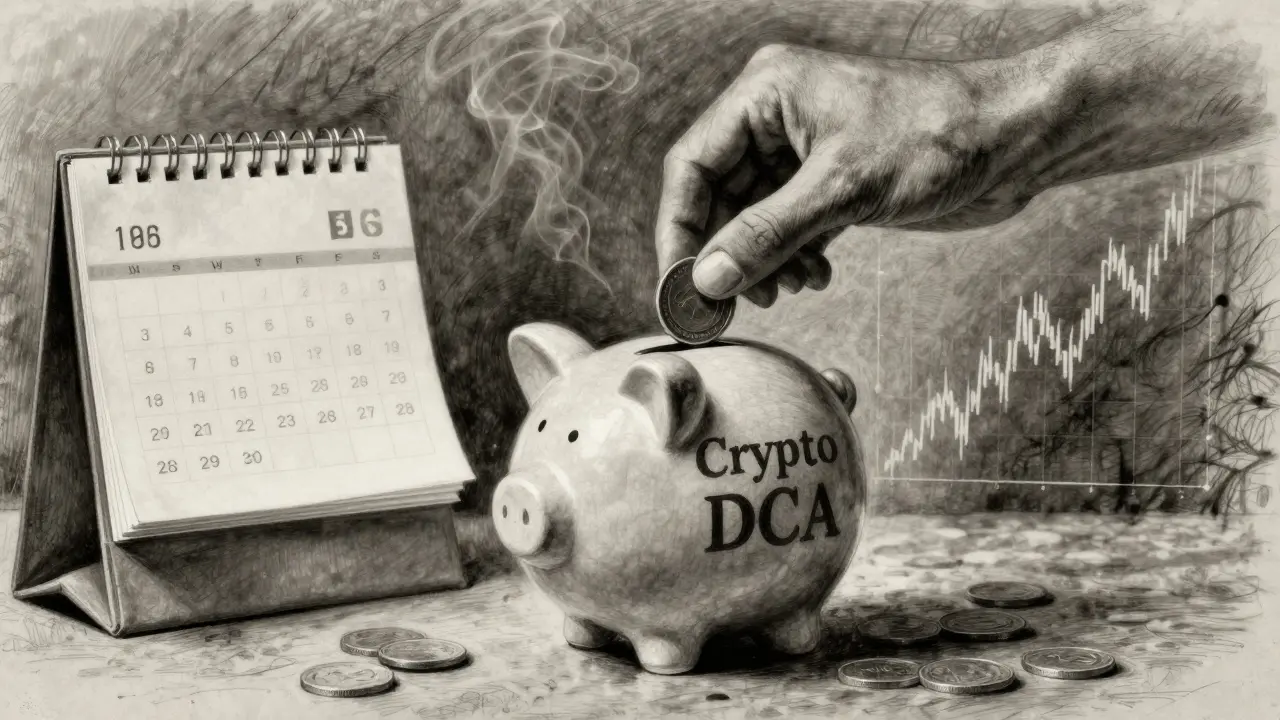
Buying cryptocurrency at the right time feels impossible. One day Bitcoin drops 15%. The next, it surges 20%. If you wait for the perfect moment, you might never buy. That’s where dollar-cost averaging comes in - a simple, proven way to invest without guessing the market.
Dollar-cost averaging (DCA) means buying a fixed amount of crypto on a regular schedule - say $50 every Friday - no matter if prices are up, down, or sideways. You don’t try to time the market. You just show up, week after week, and buy. Over time, you end up paying an average price instead of getting stuck buying at a peak.
This isn’t theory. In Kraken’s 2025 survey, nearly 60% of crypto investors said DCA is their main strategy. Why? Because it works for real people with real lives. You don’t need to watch charts all day. You don’t need to be a finance expert. You just need consistency.
How DCA Reduces Emotional Stress
Crypto markets swing wildly. A coin can lose half its value in a week. That’s terrifying if you’re trying to pick the bottom. Many new investors panic-sell when prices drop, or FOMO-buy when they spike. Both are costly mistakes.
DCA removes that pressure. If Bitcoin crashes, you buy more for the same dollar amount. If it surges, you buy less. You’re not reacting to fear or greed - you’re following a plan. That mental relief is huge. People who use DCA report less anxiety, fewer late-night scrolling sessions, and more confidence in their long-term holdings.
Platforms like Coinbase and Kraken let you set up recurring buys with a few clicks. You link your bank account, pick your crypto, set the amount and frequency, and forget it. Your money keeps working while you sleep, work, or go on vacation.
Why DCA Beats Lump-Sum Investing for Most People
Sometimes you hear: “Why not just dump $10,000 into Bitcoin all at once?” It sounds smart - if you bought in 2020, you’d be rich. But here’s the catch: you’d have to guess the exact bottom. And no one can do that consistently.
Back in 2022, Bitcoin dropped from $69,000 to $15,000 in under a year. Someone who invested $10,000 at the top lost over $50,000 in paper value. That’s crushing. Now imagine someone who invested $500 every month for 12 months. They bought at $69k, $45k, $22k, $18k - averaging around $30k. Even in a bear market, they ended up with a lower cost basis and didn’t lose their nerve.
Studies show that over 10-year periods, lump-sum investing outperforms DCA only about 30% of the time. That means for seven out of ten stretches, DCA gives you better or equal results - with far less stress. For most people, that’s the better trade-off.
DCA Works Best in Volatile Markets
Crypto isn’t like stocks or bonds. Prices move fast, often without clear reason. A tweet, a regulatory announcement, or a whale selling can send a coin spiraling. That volatility makes timing impossible - and DCA perfect.
During the 2018 crypto winter, Ethereum fell from $1,400 to $80. A DCA investor buying $100 every week ended up with over 200 ETH by the end of the year. Someone who waited for the “right time” might have missed the bottom entirely.
The same happened in 2022. Bitcoin dipped below $16,000. DCA investors kept buying. When it hit $70,000 in 2024, those who stuck to their plan had built solid positions without ever needing to predict the rebound.
Regular market swings mean DCA naturally buys low and sells high - not by choice, but by math. You get more coins when prices are low. Fewer when they’re high. Over time, your average cost drops.

It’s Beginner-Friendly and Easy to Start
You don’t need a degree in finance to use DCA. If you can use a phone app, you can set it up. Most major exchanges - Coinbase, Kraken, Kriptomat - have built-in recurring buy tools. You pick your crypto, choose your amount ($25, $50, $100), set the day (every Monday, every 15th), and hit confirm.
It takes less than 10 minutes. No complex charts. No indicators. No jargon. You just need a bank account and the discipline to keep going.
Many first-time investors start with $20 a week. That’s it. Over a year, that’s $1,040. Even if the price only goes up 50%, they’ve made a real gain - without ever feeling overwhelmed. And that small start builds confidence. Before long, they’re increasing their amount, adding other coins, or learning more about the space.
What DCA Doesn’t Do - And What to Watch Out For
DCA isn’t magic. It doesn’t guarantee profits. If you keep buying Bitcoin while it steadily falls for two years, you’ll still lose money - unless the price eventually recovers. That’s why DCA works best as a long-term habit, not a short-term gamble.
Transaction fees can add up. If you’re buying $25 every week on an exchange that charges $1 per trade, you’re paying 4% in fees annually. That eats into returns. Look for exchanges with lower fees or flat-rate plans. Some, like Kraken, offer fee discounts for higher-volume users or recurring purchases.
Also, DCA doesn’t protect you from bad crypto choices. Buying a low-quality token every week won’t make it a good investment. Stick to established coins like Bitcoin and Ethereum unless you know what you’re doing.
And yes - during a bull run, DCA can feel slow. If Bitcoin rockets from $30k to $70k in six months, someone who bought it all at $30k will outperform you. But you won’t have spent nights worrying if you bought too late. You’ll just have steady growth.
How to Make DCA Work for You
Here’s how to start right:
- Decide how much you can afford to invest monthly - not what you wish you could, but what you can truly spare. Start small if needed.
- Choose one or two major cryptocurrencies. Bitcoin and Ethereum are the safest starting points.
- Pick a day each week or month to buy. Consistency matters more than the exact date.
- Set up automatic purchases on a trusted exchange. Avoid manual buys - they break the discipline.
- Ignore the noise. Don’t check your portfolio daily. Let time do the work.
- Review your plan every 6 months. If your income changes, adjust your amount. But don’t stop.
Some people automate even further - linking DCA to direct deposits. A portion of each paycheck goes straight into crypto. That’s how you turn investing into a habit, not a chore.
The Bigger Picture: Why DCA Is Here to Stay
Institutional investors - hedge funds, pension funds, even banks - are now offering DCA-based crypto products. That’s not a fad. It’s a sign the market is maturing.
As crypto becomes more regulated and integrated into traditional finance, tools like DCA will become standard. They’re not about getting rich quick. They’re about building wealth slowly, safely, and sustainably.
For most people, that’s the real goal. Not flipping coins. Not chasing memes. Just owning a piece of the future, bit by bit, without losing sleep.
DCA won’t make you a millionaire overnight. But if you stick with it for five, ten, or twenty years - and you avoid the panic sells - it will almost certainly make you better off than if you’d done nothing at all.
Is DCA better than buying crypto all at once?
For most people, yes. Buying all at once only beats DCA if you time the market perfectly - which even professionals rarely do. DCA reduces the risk of buying at the top and smooths out price swings over time. In volatile markets like crypto, it’s a safer, more reliable way to build holdings.
Can I lose money with DCA in crypto?
Yes. If the crypto you’re buying loses value permanently and never recovers, you’ll lose money. DCA doesn’t protect against bad investments - it just helps you buy at an average price. Stick to established coins like Bitcoin and Ethereum, and avoid speculative tokens unless you fully understand the risk.
How often should I DCA crypto?
Weekly or monthly are the most common. Weekly lets you average prices more finely, but may cost more in fees. Monthly is simpler and cheaper if your exchange charges per transaction. Pick what fits your cash flow. The key is consistency - not frequency.
Do I need a lot of money to start DCA?
No. You can start with as little as $10 or $20 per month. Many exchanges let you buy fractions of a Bitcoin or Ethereum. Small, regular investments add up over time - even $25 a week is $1,300 a year. That’s a solid foundation.
What’s the best exchange for DCA?
Coinbase, Kraken, and Kriptomat all offer reliable recurring buy features. Look for low fees, easy bank linking, and strong security. Avoid exchanges that charge high per-trade fees - they’ll eat into your returns over time. Check which ones support your local currency and payment method.
Should I DCA during a crypto crash?
Yes - that’s when it works best. DCA is designed for volatility. When prices drop, your fixed amount buys more coins. That lowers your average cost. Sticking to your plan during a crash builds wealth faster than waiting for things to “look better.”


